
Massachusetts Paycheck Calculator: Real 2026 Take Home Pay
A Massachusetts paycheck calculator shows you exactly what lands in your bank account after Massachusetts takes its flat 5% and the federal government takes its share. Enter your salary, pick your pay frequency, and you get your take home pay per paycheck and per year in seconds. No signup, no email, no cost.
Massachusetts hides two surprises most national calculators miss. First, your 401k contributions do not lower your Massachusetts tax the way they lower your federal tax. Second, Massachusetts lets you deduct up to $2,000 of the Social Security and Medicare taxes you paid, which lowers your state tax by up to $100. This page models both facts, so the result matches a real Massachusetts return far better than a flat 5% on your whole salary.
Massachusetts Paycheck Calculator
Enter your pay and see exactly what lands in your bank account for 2026.
| Per paycheck | Per year | |
|---|---|---|
| Gross pay | ||
| Federal income tax | ||
| Massachusetts state income tax | ||
| Social Security (6.2%) | ||
| Medicare (1.45%) | ||
| Take home pay |
Massachusetts charges a flat 5% on taxable income after personal exemptions of $4,400 single, $8,800 married filing jointly, or $6,800 head of household, less a deduction of up to $2,000 per earner for Social Security and Medicare taxes paid. An extra 4% surtax applies only to taxable income above $1,107,750 in 2026. Unlike most states, Massachusetts taxes 401k contributions in the year you earn them, so your 401k does not lower your Massachusetts tax. Paid family and medical leave contributions vary by employer and are not modeled here. Estimates use 2026 IRS brackets and the 2026 Social Security wage base of $184,500.
How do I use the Massachusetts paycheck calculator?
Using the Massachusetts paycheck calculator takes less than a minute. So how much will you actually take home? Let us run the numbers together.
- Enter your gross pay. Type your salary per year, your pay per paycheck, or your hourly wage. The calculator converts hourly pay using 40 hours a week and 52 weeks a year.
- Pick your pay frequency. Weekly, every 2 weeks, twice a month, or monthly. Most Massachusetts employers pay every 2 weeks.
- Choose your filing status. Single, married filing jointly, or head of household. Your status changes your federal tax and the personal exemption Massachusetts gives you.
- Add your 401k and other pre tax deductions. Your 401k lowers your federal tax but not your Massachusetts tax, and the calculator handles that split for you.
- Press Calculate My Take Home Pay. You get your net pay per paycheck and per year, with every deduction shown on its own line.
How much is Massachusetts income tax in 2026?
Massachusetts charges one flat rate of 5% on your taxable income in 2026. There are no brackets to climb and no separate rate for high earners. Every dollar of taxable income pays the same 5%, except for income above the millionaire surtax line explained below. The rate has sat at 5% since 2020, after a series of small cuts tied to state revenue growth.
Massachusetts does not have a standard deduction. Instead it gives you a personal exemption. You get $4,400 if you file single, $8,800 if you file married filing jointly, and $6,800 if you file head of household. Each dependent adds a $1,000 exemption, and filers who are 65 or older or blind get an extra $700. You must have at least $8,000 of Massachusetts gross income before you even need to file a return.
| Filing detail | 2026 Massachusetts rule |
|---|---|
| State rate | 5% flat on all taxable income |
| Standard deduction | None, personal exemptions apply instead |
| Personal exemption | $4,400 single, $8,800 joint, $6,800 head of household |
| Dependent exemption | $1,000 per dependent |
| FICA deduction | Up to $2,000 per earner for Social Security and Medicare taxes paid |
| Surtax | Extra 4% on taxable income above $1,107,750 |
| Filing threshold | $8,000 of Massachusetts gross income |
The FICA deduction is the detail most calculators skip. Massachusetts lets you deduct what you paid in Social Security and Medicare taxes, up to $2,000 per earner. A worker earning $85,000 pays $6,502.50 in Social Security and Medicare taxes, so the full $2,000 deduction applies and saves $100 of state tax. A married couple with two earners can deduct up to $2,000 each. The widget applies one $2,000 deduction, so a two earner joint return may owe up to $100 less than the widget shows.
The second surprise cuts the other way. Massachusetts taxes your 401k contributions in the year you earn them. In most states your 401k contribution lowers both your federal and your state tax. In Massachusetts it lowers only your federal tax. Your 401k money is then partly exempt when you withdraw it in retirement, so you are not taxed twice, but while you are working, a $6,000 401k contribution saves you $1,320 of federal tax and $0 of Massachusetts tax. The widget models this split exactly.
On top of the 5% rate sits the Fair Share Amendment surtax, approved by voters in 2022 and in effect since 2023. It adds 4% to taxable income above $1,107,750 in 2026, for a combined 9% on income above that line. Income below the line pays only the flat 5%. Short term capital gains are taxed separately at 8.5%, while long term gains pay the normal 5%.
Massachusetts has no local income tax anywhere in the state, so Boston, Worcester, and Springfield all follow the same state rate. What Massachusetts does charge is a 6.25% sales tax with no local additions, and a separate paid family and medical leave program. The total PFML contribution rate is 0.88% of wages in 2026, split between employer and employee depending on employer size, and it is not modeled in the widget because the employee share varies.
What does an $85,000 salary look like in Massachusetts?
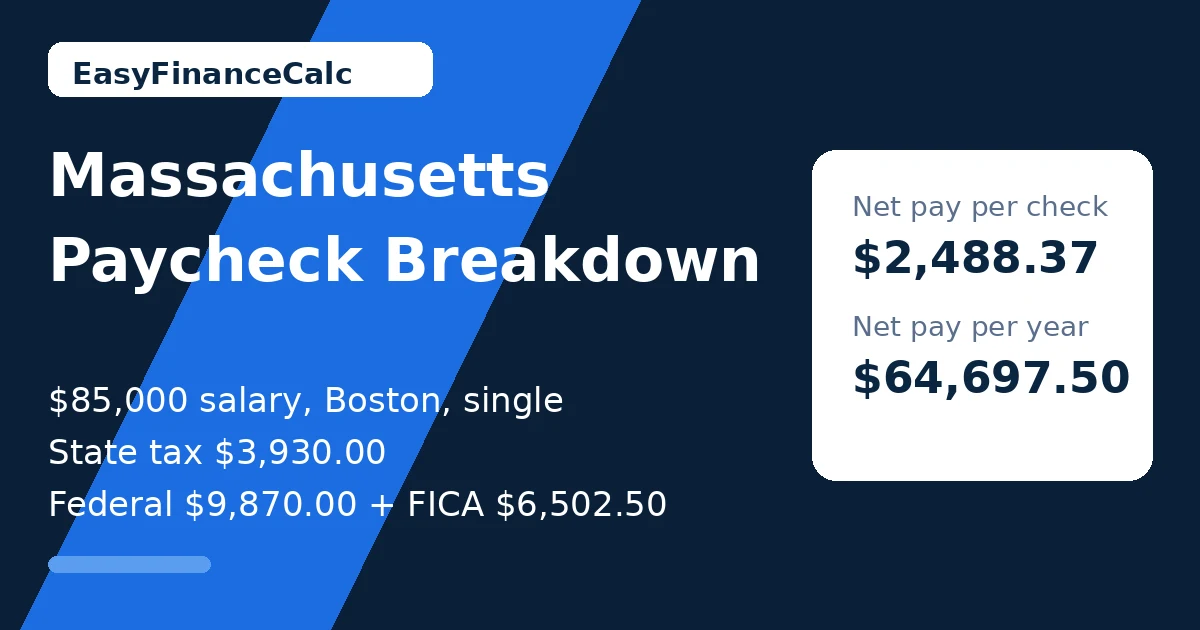
Meet Priya, a software support specialist in Boston who earns $85,000 a year, files single, claims no dependents, and gets paid every 2 weeks. Her paycheck shows exactly how the flat rate, the exemption, and the FICA deduction work in real life.
| Line | Per paycheck | Per year |
|---|---|---|
| Gross pay | $3,269.23 | $85,000.00 |
| Federal income tax | $379.62 | $9,870.00 |
| Massachusetts state income tax | $151.15 | $3,930.00 |
| Social Security (6.2%) | $202.69 | $5,270.00 |
| Medicare (1.45%) | $47.40 | $1,232.50 |
| Take home pay | $2,488.37 | $64,697.50 |
Here is the math behind her check. Her federal taxable income is $85,000 less the $16,100 federal standard deduction, which leaves $68,900. The 2026 federal brackets tax that at 10% on the first $12,400, 12% on the next $38,000, and 22% on the last $18,500, for a total of $9,870.
Her Massachusetts taxable income is $85,000 less her $4,400 personal exemption and less the $2,000 FICA deduction, which leaves $78,600. The flat 5% on that amount is $3,930. Social Security takes 6.2% of $85,000, which is $5,270, and Medicare takes 1.45%, which is $1,232.50. Add it all up and Priya keeps $64,697.50 of her $85,000, or $2,488.37 every two weeks.
Now add a 401k. If Priya contributes $6,000 to her 401k, her federal tax falls from $9,870 to $8,550, a saving of $1,320. Her Massachusetts tax stays exactly $3,930, because Massachusetts taxes the contribution now. Her take home pay becomes $60,017.50 a year, or $2,308.37 every two weeks, after the $6,000 contribution leaves her check. That split is the single most useful thing a Massachusetts paycheck calculator can show you, because a national calculator would wrongly cut her state tax by $300.
What about an hourly worker? Take a restaurant supervisor in Worcester who earns $22 an hour and works 40 hours a week. That is $45,760 a year. Federal tax comes to $3,311.20, Massachusetts state tax comes to $1,968, Social Security is $2,837.12, and Medicare is $663.52. Take home pay is $36,980.16 a year, or $1,422.31 every two weeks. The same flat rate applies at every income level, so the math stays simple no matter what you earn.
Does moving to New Hampshire save you Massachusetts tax?
New Hampshire charges no tax on wages, so the move looks tempting from Boston. But Massachusetts taxes income earned in Massachusetts no matter where you live. A New Hampshire resident who works in Boston still pays the full Massachusetts 5% on those wages. A Massachusetts resident who works remotely from home for a New Hampshire employer still pays Massachusetts 5% on all of it. The only way the move saves state tax is if both your home and your work leave Massachusetts behind. That is why the Massachusetts paycheck calculator matters even for commuters: your work location, not just your address, decides the bill.
| Situation | 2026 Massachusetts tax on $85,000 |
|---|---|
| Live in Boston, work in Boston | $3,930.00 |
| Live in Nashua, work in Boston | $3,930.00 |
| Live in Boston, work remotely for a New Hampshire employer | $3,930.00 |
| Live and work in New Hampshire | $0.00 |
5 mistakes Massachusetts workers make
- Assuming your 401k lowers your state tax. It does not in Massachusetts. Budget your state withholding from your full salary, not from your salary after 401k.
- Forgetting the $2,000 FICA deduction. It saves up to $100 of state tax a year. If your return shows no FICA deduction, you overpaid.
- Thinking a New Hampshire address escapes Massachusetts tax. Massachusetts taxes Massachusetts source income. Only moving both home and work out of state ends the bill.
- Missing the surtax line on a big year. A lump sum bonus, a stock sale, or a large 401k withdrawal can push taxable income above $1,107,750, where the extra 4% applies.
- Ignoring PFML on your check. Paid family and medical leave contributions vary by employer size, so check your pay stub: the deduction is real even though this widget does not model it.
Massachusetts paycheck calculator FAQs
Does Massachusetts have a state income tax?
Yes. Massachusetts charges a flat 5% on taxable income in 2026. There are no brackets, and the same rate applies to every dollar of taxable income below the surtax line, whatever your filing status.
What is the Massachusetts personal exemption for 2026?
The personal exemption is $4,400 for single filers, $8,800 for married filing jointly, and $6,800 for head of household. Each dependent adds $1,000, and filers who are 65 or older or blind get an extra $700.
Does Massachusetts have a standard deduction?
No. Massachusetts uses personal exemptions and specific deductions instead. The most valuable one for workers is the deduction of up to $2,000 per earner for Social Security and Medicare taxes paid.
What is the Massachusetts millionaire tax?
The Fair Share Amendment adds a 4% surtax to taxable income above $1,107,750 in 2026. Income above that line is taxed at a combined 9%, while income below it pays only the flat 5%.
Does Massachusetts tax 401k contributions?
Yes, in the year you earn them. Unlike most states, Massachusetts does not let your 401k contribution lower your state taxable income. Your contribution still lowers your federal tax, and withdrawals in retirement are partly exempt so you are not taxed twice.
Is Social Security taxed in Massachusetts?
No. Social Security benefits are exempt from Massachusetts income tax. Government pensions from the United States, Massachusetts, or a Massachusetts city or town are also exempt, while most private pensions are taxed at 5%.
What is the Massachusetts minimum wage in 2026?
The Massachusetts minimum wage is $15.00 an hour in 2026, unchanged since January 1, 2023. Tipped workers must be paid a service rate of at least $6.75 an hour, with tips bringing total pay to at least $15.00 an hour for each shift.
Does Massachusetts have a local income tax?
No. No Massachusetts city or town charges its own income tax. Boston, Worcester, and Springfield all follow the same flat 5% state rate, and the state sales tax of 6.25% also has no local additions.
What is Massachusetts paid family and medical leave?
Massachusetts runs a paid family and medical leave program with a total contribution rate of 0.88% of wages in 2026. The split between employer and employee depends on employer size, and benefits run up to 12 weeks of family leave and 20 weeks of medical leave.
Do I need to file a Massachusetts return?
You must file if your Massachusetts gross income is at least $8,000 for the year. Full year residents file Form 1, and part year residents and nonresidents with Massachusetts source income file Form 1-NR/PY.
Does Massachusetts tax capital gains differently?
Short term capital gains are taxed at 8.5%, higher than the flat 5% on wages and long term gains. The 4% surtax still applies above $1,107,750 of total taxable income.
Can I deduct rent on my Massachusetts return?
Yes, in part. Massachusetts allows a rental deduction of 50% of rent paid, up to $4,000 a year, for rent on your principal residence. It is one of the few state level deductions that renters should never skip.
Related calculators
Try the New York paycheck calculator to compare a graduated state, or the salary to hourly calculator to convert your pay. The main paycheck calculator covers federal tax for any state.
Disclaimer
This calculator gives estimates for planning only. Your real paycheck depends on your withholding elections, your deductions, your PFML contribution, and your employer payroll setup. For a binding answer, check the Massachusetts Department of Revenue guidance or talk to a tax professional.
Sources
- Massachusetts Department of Revenue, Circular M Income Tax Withholding Tables at 5.0% Effective January 1, 2026, mass.gov
- Massachusetts Department of Revenue, Massachusetts Personal Income Tax Exemptions, mass.gov
- Massachusetts Department of Revenue, Massachusetts 4% Surtax on Taxable Income, mass.gov
- Massachusetts Department of Revenue, Form 1 Instructions, Social Security and Medicare deduction up to $2,000, mass.gov
- Massachusetts General Laws Chapter 62 Section 3, personal exemptions and deductions, malegislature.gov
- Massachusetts Attorney General Fair Labor Division, minimum wage $15.00 and tipped service rate $6.75, mass.gov
- Internal Revenue Service, 2026 federal brackets and standard deduction
- Social Security Administration, 2026 wage base $184,500