
Wisconsin Paycheck Calculator: Real 2026 Take Home Pay
A Wisconsin paycheck calculator shows you exactly what lands in your bank account after Wisconsin takes its graduated income tax and the federal government takes its share. Enter your salary, pick your pay frequency, and you get your take home pay per paycheck and per year in seconds. No signup, no email, no cost.
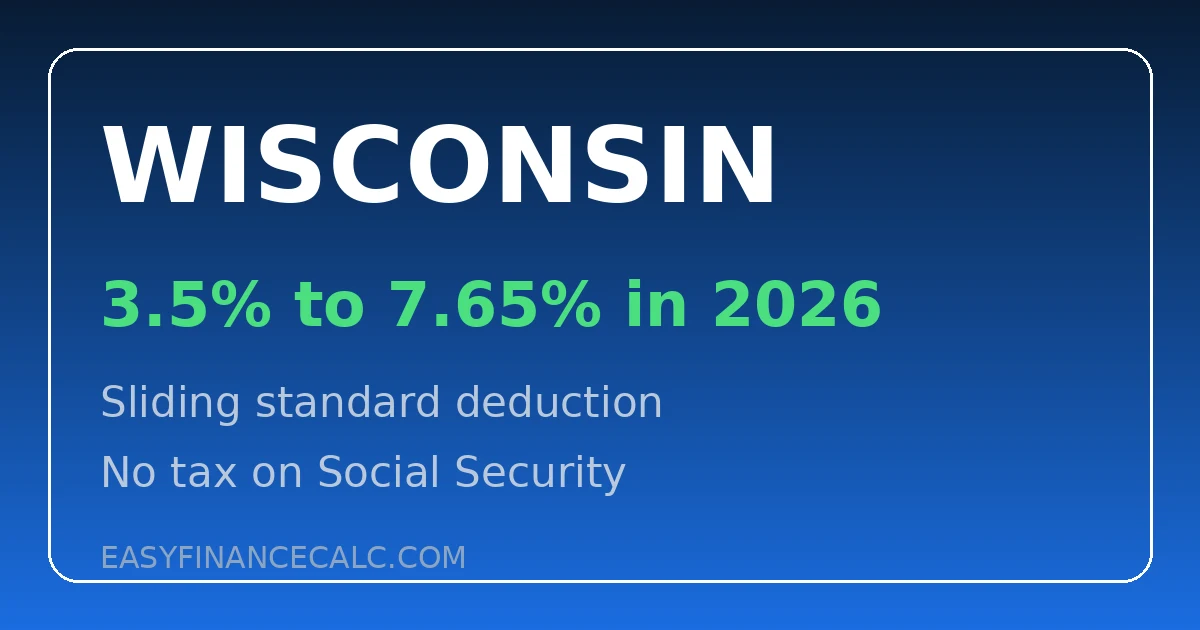
Wisconsin hides one fact most national calculators miss. Wisconsin has no fixed standard deduction: the deduction slides down as your income rises, from $13,960 at low incomes to $0 at high incomes for a single filer. A calculator that uses one fixed number gets Wisconsin wrong for almost everyone. This page models the sliding deduction, the four graduated rates, and the $700 personal exemption exactly, so the result matches a real Wisconsin paycheck far better than a flat rate guess.
Wisconsin Paycheck Calculator
Enter your pay and see exactly what lands in your bank account for 2026.
| Per paycheck | Per year | |
|---|---|---|
| Gross pay | ||
| Federal income tax | ||
| Wisconsin state income tax | ||
| Social Security (6.2%) | ||
| Medicare (1.45%) | ||
| Take home pay |
Wisconsin tax uses the 2026 Form 1-ES schedules: graduated rates 3.5% to 7.65%, sliding standard deduction, $700 exemption per person. No local income tax in Wisconsin. Estimates use 2026 IRS brackets and the 2026 Social Security wage base of $184,500. Your real withholding follows IRS Publication 15-T tables and your W-4, so your actual check can differ by a few dollars.
How do I use the Wisconsin paycheck calculator?
Using the Wisconsin paycheck calculator takes less than a minute. So how much will you actually take home? Let us run the numbers together.
- Enter your gross pay. Type your salary per year, your pay per paycheck, or your hourly wage. The calculator converts hourly pay using 40 hours a week and 52 weeks a year.
- Pick your pay frequency. Weekly, every 2 weeks, twice a month, or monthly. Most Wisconsin employers pay every 2 weeks.
- Choose your filing status. Single, married filing jointly, or head of household. Your status changes your federal tax, your Wisconsin brackets, and your Wisconsin standard deduction schedule.
- Add your 401k and other pre tax deductions. Wisconsin starts from your federal adjusted gross income, so your 401k lowers both your federal tax and your Wisconsin tax, and it also raises your Wisconsin standard deduction, because the deduction is set by your income.
- Press Calculate My Take Home Pay. You get your net pay per paycheck and per year, with every deduction shown on its own line.
How much is Wisconsin income tax in 2026?
Wisconsin charges four graduated rates in 2026: 3.5%, 4.4%, 5.3%, and 7.65%. You pay the lower rate on the first part of your income and higher rates only on the part above each threshold. The second bracket was widened in the 2025 to 2027 state budget, so more income now sits at 4.4% instead of 5.3%. Single filers and heads of household share the same bracket thresholds, while married filing jointly thresholds run about one third higher, not double.
| 2026 single brackets | Rate |
|---|---|
| Taxable income up to $15,110 | 3.5% |
| $15,111 to $51,950 | 4.4% |
| $51,951 to $332,720 | 5.3% |
| Above $332,720 | 7.65% |
| 2026 married filing jointly brackets | Rate |
|---|---|
| Taxable income up to $20,150 | 3.5% |
| $20,151 to $69,260 | 4.4% |
| $69,261 to $443,630 | 5.3% |
| Above $443,630 | 7.65% |
Then comes the sliding standard deduction, the part that makes Wisconsin different. For a single filer, the deduction is $13,960 on Wisconsin income up to $20,119, then it shrinks by 12% of each dollar above $20,119, and it reaches $0 above $136,453. For married filing jointly, the deduction is $25,840 on income up to $29,039, then it shrinks by 19.778% of each dollar above $29,039, and it reaches $0 above $159,690. Heads of household start at $18,030 on income up to $20,119, then phase down from there. Each person also gets a $700 personal exemption, plus $250 more if you are 65 or older.
Wisconsin has no local income tax anywhere in the state, so Milwaukee, Madison, Green Bay, and Appleton all follow the same state rates. Wisconsin also does not tax Social Security benefits at all, which is a real break for retirees that neighboring Minnesota does not give. What Wisconsin does charge is a 5% state sales tax base, with county taxes on top in most counties. The state minimum wage is $7.25 an hour, unchanged since 2009, with a $2.33 cash wage for tipped workers, and no city or county may set its own higher minimum wage.
What does a $75,000 salary look like in Wisconsin?
Meet Emily, a claims specialist in Madison who earns $75,000 a year, files single, claims no dependents, and gets paid every 2 weeks. Her paycheck shows exactly how the sliding deduction and the graduated rates work in real life.
| Line | Per paycheck | Per year |
|---|---|---|
| Gross pay | $2,884.62 | $75,000.00 |
| Federal income tax | $295.00 | $7,670.00 |
| Wisconsin state income tax | $113.21 | $2,943.52 |
| Social Security (6.2%) | $178.85 | $4,650.00 |
| Medicare (1.45%) | $41.83 | $1,087.50 |
| Take home pay | $2,255.73 | $58,648.98 |
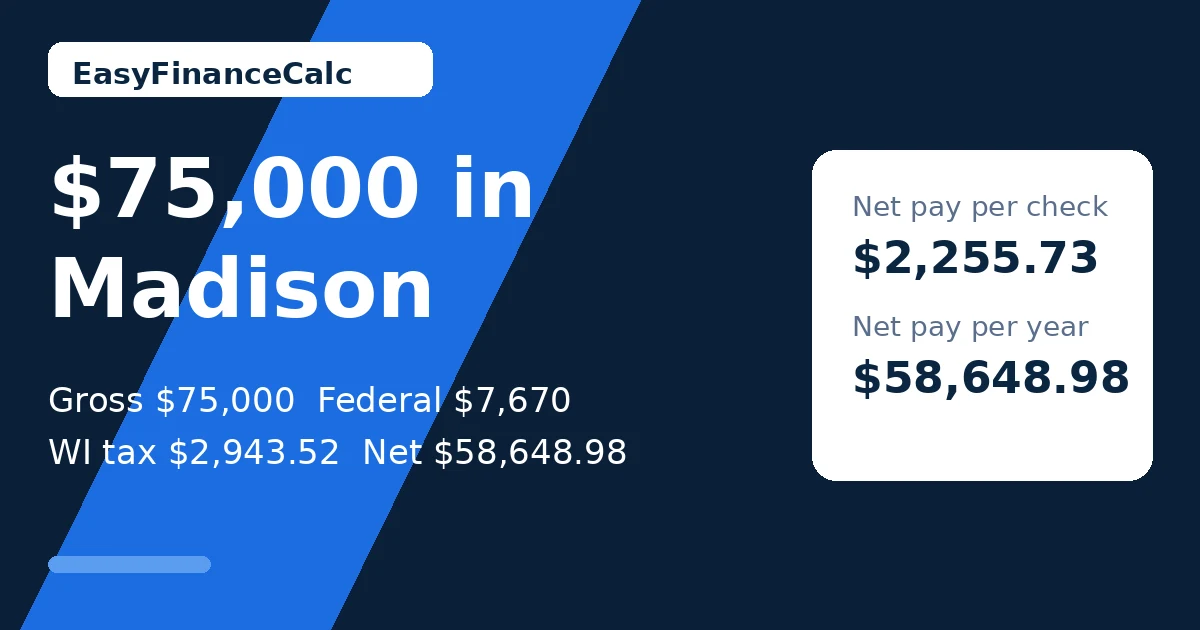
Here is the math behind her check. Her federal taxable income is $75,000 less the $16,100 federal standard deduction, which leaves $58,900. The 2026 federal brackets tax that at 10% on the first $12,400, 12% on the next $38,000, and 22% on the last $8,500, for a total of $7,670.
Her Wisconsin standard deduction is $13,960 less 12% of the $54,881 by which her $75,000 income passes $20,119, which leaves $7,374.28. Her Wisconsin taxable income is $75,000 less that $7,374.28 and less the $700 exemption, which leaves $66,925.72. The 3.5% rate on the first $15,110 is $528.85, the 4.4% rate on the next $36,840 is $1,620.96, and the 5.3% rate on the remaining $14,975.72 is $793.71, for a total of $2,943.52. Social Security takes 6.2% of $75,000, which is $4,650, and Medicare takes 1.45%, which is $1,087.50. Add it all up and Emily keeps $58,648.98 of her $75,000, or $2,255.73 every two weeks.
Now add a 401k. If Emily contributes $6,000 to her 401k, her federal tax falls from $7,670 to $6,350, a saving of $1,320, and her Wisconsin tax falls from $2,943.52 to $2,587.36, a saving of $356.16. The Wisconsin saving is bigger than the bracket math alone suggests, because the contribution also lowers her Wisconsin income, which raises her sliding standard deduction from $7,374.28 to $8,094.28. Her take home pay becomes $54,325.14 a year after the $6,000 contribution leaves her check.
What about an hourly worker? Take a machine operator in Green Bay who earns $20 an hour and works 40 hours a week. That is $41,600 a year. Federal tax comes to $2,812, Wisconsin state tax comes to $1,162.79, Social Security is $2,579.20, and Medicare is $603.20. Take home pay is $34,442.81 a year, or $1,324.72 every two weeks.
Why the sliding standard deduction is the Wisconsin trap
The sliding deduction punishes raises in a way no flat deduction state does. At $75,000, a single filer keeps only $7,374.28 of the $13,960 maximum deduction. At $150,000, a married couple keeps only about $1,916 of the $25,840 maximum. At $136,453 of income, a single filer gets $0. Every extra dollar of pay therefore does double duty against you: it is taxed itself, and it shrinks the deduction shielding the dollars below it. Inside the phaseout range, your true marginal rate runs higher than your bracket rate, because each new dollar also removes 12 cents of deduction for a single filer, or almost 20 cents for a married couple.
That is also why a 401k contribution is worth more in Wisconsin than in most states. The contribution cuts your taxable income twice: once directly, and once by restoring part of the deduction you had lost. Emily’s $6,000 contribution saved $356.16 of Wisconsin tax, not just the $318 you would expect from the 5.3% bracket alone. If you are negotiating a raise near the top of the phaseout range, run the numbers here first: the raise that looks like $5,000 on paper can land closer to $3,500 after Wisconsin takes its double bite.
Does working in Minnesota change your Wisconsin tax?
No, not on your wages, thanks to reciprocity. Wisconsin has reciprocity agreements with Illinois, Indiana, Kentucky, Michigan, and Minnesota, so a commuter generally pays tax only to the home state on wages. If you live in Wisconsin and work in Minnesota, you pay Wisconsin tax on those wages. If you live in Minnesota and work in Wisconsin, you pay Minnesota tax instead. Your home state wins, not your work state, for wages and salaries only.
| Situation | 2026 state tax on $75,000 |
|---|---|
| Live in Madison, work in Madison | $2,943.52 to Wisconsin |
| Live in Madison, work remotely for a Minnesota employer | $2,943.52 to Wisconsin |
| Live in Hudson, Wisconsin, work in St. Paul, Minnesota | $2,943.52 to Wisconsin |
| Live in St. Paul, Minnesota, work in Hudson, Wisconsin | $0 to Wisconsin, Minnesota tax applies |
| Live and work in Milwaukee | $2,943.52 to Wisconsin |
The agreement covers wages only. If you have rental income, business income, or other income from the other state, that income can still be taxed there. Commuters along the St. Croix River should check their withholding carefully: a Minnesota resident working in Wisconsin should file for exemption from Wisconsin withholding, or Wisconsin tax will be withheld all year and only refunded at filing time.
5 mistakes Wisconsin workers make
- Using a fixed standard deduction. Wisconsin has none. At $75,000, a single filer gets $7,374.28, not $13,960, and at $136,453 the deduction is gone entirely.
- Forgetting the phaseout when you get a raise. Inside the phaseout range, each extra dollar also shrinks your deduction, so your true marginal rate runs above your bracket rate.
- Assuming Minnesota taxes your Wisconsin job. Under reciprocity, a Wisconsin resident working in Minnesota owes Wisconsin, not Minnesota, on those wages. Fix the withholding instead of waiting for a refund.
- Assuming Milwaukee has a city income tax. It does not. No Wisconsin city or county charges one, and no locality may set its own minimum wage either.
- Ignoring the Social Security break in retirement planning. Wisconsin does not tax Social Security benefits, so a retiree paycheck looks very different from a Minnesota one.
Wisconsin paycheck calculator FAQs
Does Wisconsin have a state income tax?
Yes. Wisconsin charges four graduated rates in 2026, from 3.5% to 7.65%. The rate you pay depends on your taxable income and your filing status, and only income above each threshold pays the higher rate.
What is the Wisconsin standard deduction for 2026?
Wisconsin has no fixed standard deduction. For a single filer it is $13,960 on income up to $20,119, then it shrinks by 12% of each dollar above that, reaching $0 above $136,453. For married filing jointly it starts at $25,840 and phases out above $29,039.
What is the top Wisconsin tax rate in 2026?
The top rate is 7.65%, and it applies to taxable income above $332,720 for a single filer and above $443,630 for married filing jointly. Very few workers reach it.
Does Wisconsin have a local income tax?
No. No Wisconsin city or county charges a local income tax on wages, so a paycheck in Milwaukee, Madison, and Green Bay follows the same state rates.
What is the Wisconsin minimum wage in 2026?
The Wisconsin minimum wage is $7.25 an hour, unchanged since 2009. Tipped workers have a $2.33 cash wage, with tips making up the rest to $7.25 an hour. No city or county may set a higher local minimum wage.
Does Wisconsin tax 401k contributions?
No, in the year you contribute. Wisconsin starts from federal adjusted gross income, so a 401k contribution lowers your Wisconsin taxable income just as it lowers your federal taxable income, and it also raises your sliding standard deduction. Withdrawals in retirement are then taxed as ordinary income.
Does Wisconsin tax Social Security benefits?
No. Wisconsin does not tax Social Security benefits at all, which sets it apart from neighboring Minnesota, where some benefits are taxed.
Do Wisconsin residents working in Minnesota pay Minnesota tax?
No, not on their wages. Under the Wisconsin Minnesota reciprocity agreement, a Wisconsin resident who works in Minnesota pays Wisconsin tax on those wages. A Minnesota resident who works in Wisconsin pays Minnesota tax on all of it.
What is Form WT-4?
Form WT-4 is the Wisconsin Employee’s Withholding Exemption Certificate. You give it to your employer to set your Wisconsin withholding, including personal allowances for yourself, your spouse, and your dependents.
What is the Wisconsin sales tax rate?
The state sales tax base is 5%, with county taxes on top in most counties. The sales tax never appears on your paycheck, but it is part of the Wisconsin cost picture.
Does Wisconsin tax capital gains differently?
No. Wisconsin taxes capital gains as ordinary income at the same four graduated rates. There is no separate lower rate for long term gains, though a 30% capital gain exclusion applies in some cases at filing time.
Do I need to file a Wisconsin return?
You must file if your Wisconsin gross income meets the filing threshold for your status, or if Wisconsin tax was withheld and you want a refund. Full year residents file Form 1, and part year residents and nonresidents with Wisconsin income file Form 1NPR.
How do I use a Wisconsin paycheck calculator to check my take-home pay?
Enter your gross pay as a salary per year, pay per paycheck, or hourly wage, then pick your pay frequency and filing status and add any 401(k) or other pre-tax deductions. The calculator applies Wisconsin’s sliding standard deduction, which shrinks as income rises, along with federal tax, Social Security, and Medicare. For example, Emily in Madison earns $75,000 a year as a single filer paid every two weeks, and the calculator shows $2,255.73 take-home pay per biweekly paycheck. Change any entry to see how a raise, a different filing status, or a larger 401(k) contribution changes your take-home pay.
Related calculators
Try the Minnesota paycheck calculator to compare the state across the St. Croix River, or the salary to hourly calculator to convert your pay. The main paycheck calculator covers federal tax for any state.
Disclaimer
This calculator gives estimates for planning only. Your real paycheck depends on your withholding elections, your deductions, your reciprocity status, and your employer payroll setup. For a binding answer, check the Wisconsin Department of Revenue guidance or talk to a tax professional.
Sources
- Wisconsin Department of Revenue, 2026 Form 1-ES Instructions, 2026 tax rate schedules and standard deduction schedules, revenue.wi.gov
- Wisconsin Department of Revenue, 2026 standard deduction: $13,960 single maximum, $25,840 married filing jointly maximum, $700 personal exemption, revenue.wi.gov
- Wisconsin Department of Workforce Development, Minimum wage $7.25 per hour, tipped cash wage $2.33, dwd.wi.gov
- Internal Revenue Service, 2026 federal brackets and standard deduction
- Social Security Administration, 2026 wage base $184,500