
Free · Private · No Signup
Sales Tax Calculator: Know the Real Price Before You Pay
This free sales tax calculator shows the true cost of anything you buy in seconds. Enter a price and a tax rate to add tax, back tax out of a total, or compare what the same purchase costs in different states. It uses 2026 rates checked against Tax Foundation data. No signup, everything runs in your browser.
- 2026 state rates checked against Tax Foundation data
- Runs in your browser, nothing is stored or sent
- Five modes: add, reverse, cart, car and compare
Calculate your sales tax
Pick a mode, enter your numbers, see the real price.
Reverse mode divides the total by (1 + rate). It never subtracts the percent, which would give the wrong price.
Estimates only, rounded to the nearest cent. Rates change often and vary by exact address.
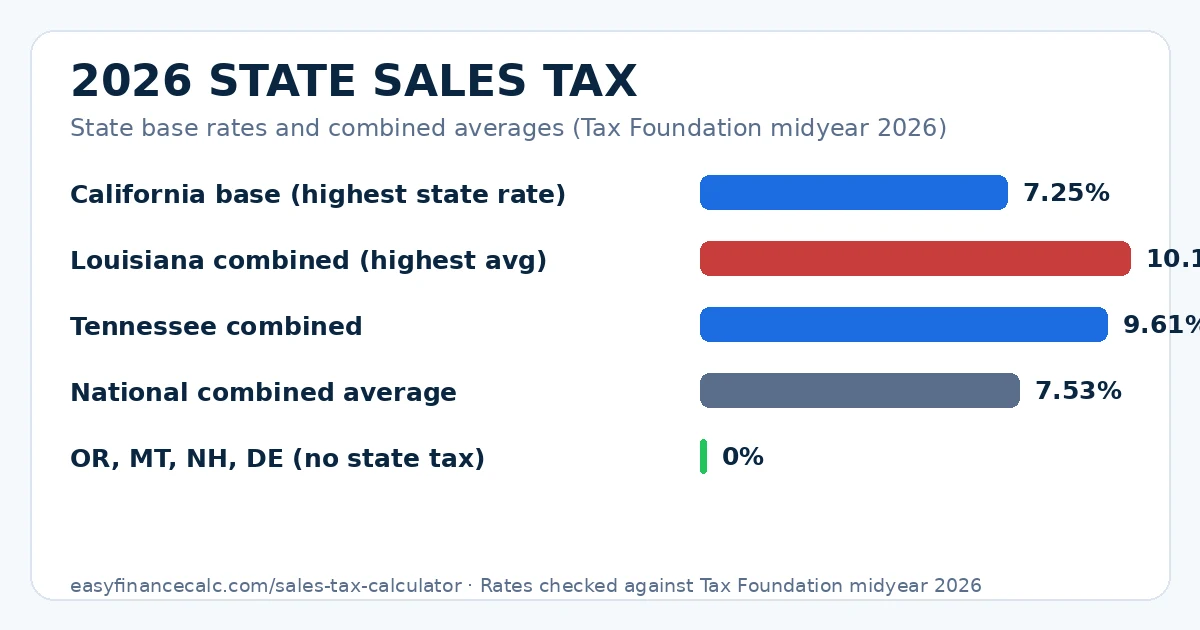
Quick answer: A sales tax is a percentage added to the price of most goods at checkout, set by your state plus any county, city, or district add ons. For 2026, state base rates run from 0% in five states to 7.25% in California, and combined rates average 7.53% nationally. The sticker price is almost never the final price, so why guess when you can calculate it in seconds?
How to Use This Sales Tax Calculator
Five modes, one tool. Wondering where to start? Pick the mode that matches your question.
- Add tax to a price. Enter the price and the rate. This free tool beats mental math because local add ons stack in ways nobody memorizes.
- Back tax out of a total. Enter what you paid and the rate. The reverse sales tax calculator mode divides instead of subtracting, which is the step most people get wrong.
- Total a cart. Add each item, and the tool taxes the subtotal once. Faster than taxing line by line, same result.
- Price a car. Enter the sticker price and your trade in. The car sales tax calculator mode shows tax with and without the trade in credit, since a few states tax the full price.
- Compare states. Enter one price and up to three rates. Thinking of buying across a state line? See the difference before you drive.
2026 State Sales Tax Rates
There is no national sales tax in the US. Instead, 45 states plus thousands of local jurisdictions set their own rates, which is why the same $100 item can cost $100 in Oregon and $110.13 in parts of Louisiana. These are Tax Foundation midyear 2026 figures.
| State | State base rate | Avg combined rate | Note |
|---|---|---|---|
| California | 7.25% | 8.80% | Highest state base rate; up to 10.25% in Los Angeles |
| Texas | 6.25% | 8.20% | 8.25% max cap |
| Florida | 6.00% | 7.02% | County surtax on cars capped at first $5,000 |
| New York | 4.00% | 8.54% | New York City 8.875% |
| Louisiana | 5.00% | 10.13% | Highest combined average in the US |
| Tennessee | 7.00% | 9.61% | Second highest combined |
| Colorado | 2.90% | 7.89% | Lowest nonzero state rate |
| District of Columbia | 6.00% | 6.00% | District rate |
| New Jersey | 6.625% | 6.60% | Salem County carve out |
States with no sales tax: Alaska, Delaware, Montana, New Hampshire, and Oregon charge no statewide sales tax. Alaska is the exception that proves the rule, since local Alaska jurisdictions can add their own tax. So which states with no sales tax are truly zero at the register? Delaware, Montana, New Hampshire, and Oregon.
Freshness warning. Some ranking pages still show stale numbers. We found one listing Louisiana at 4.45%, but Louisiana raised its state rate to 5% in 2025. Another lists California at 6% instead of 7.25%. A sales tax calculator 2026 page that cannot get the year right is not worth your trust. Ours are checked against the Tax Foundation midyear 2026 table.
October 2026 update: No US state changed its base sales tax rate on October 1, 2026, according to the Avalara October 2026 bulletin. The changes that month were local only, with city, county, and district changes across about 15 states, plus Pennsylvania destination-sourcing for Philadelphia and Allegheny.
Shoppers often search for a california sales tax calculator or texas sales tax calculator before a big purchase. Every state uses the same math on this page: pick the rate, run the numbers.
The Math: Adding Tax and Backing It Out
The math runs on two formulas. Learning how to calculate sales tax by hand takes thirty seconds and saves you from the most common mistake in personal finance math.
Add tax: total = price × (1 + rate/100). A $80 jacket at 7% is $80 × 1.07 = $85.60.
Back it out: before tax price = total / (1 + rate/100). Paid $108.25 at 8.25%? That is $108.25 / 1.0825 = $100.00 exactly.
Here is the trap. Most people back tax out by subtracting: $108.25 minus 8.25% = $99.32. That answer is wrong by 68 cents, because the 8.25% was figured on the $100 price, not on the $108.25 total. On a $1,200 purchase at 8.25%, the same mistake costs you $8.06. So how do you know which method a receipt used? Divide, never subtract, and you will always land right.
Recover a rate: rate = (total/price − 1) × 100. Paid $107 on a $100 tag? That is (107/100 − 1) × 100 = 7%.
Worked Example: Buying a Car With a Trade In
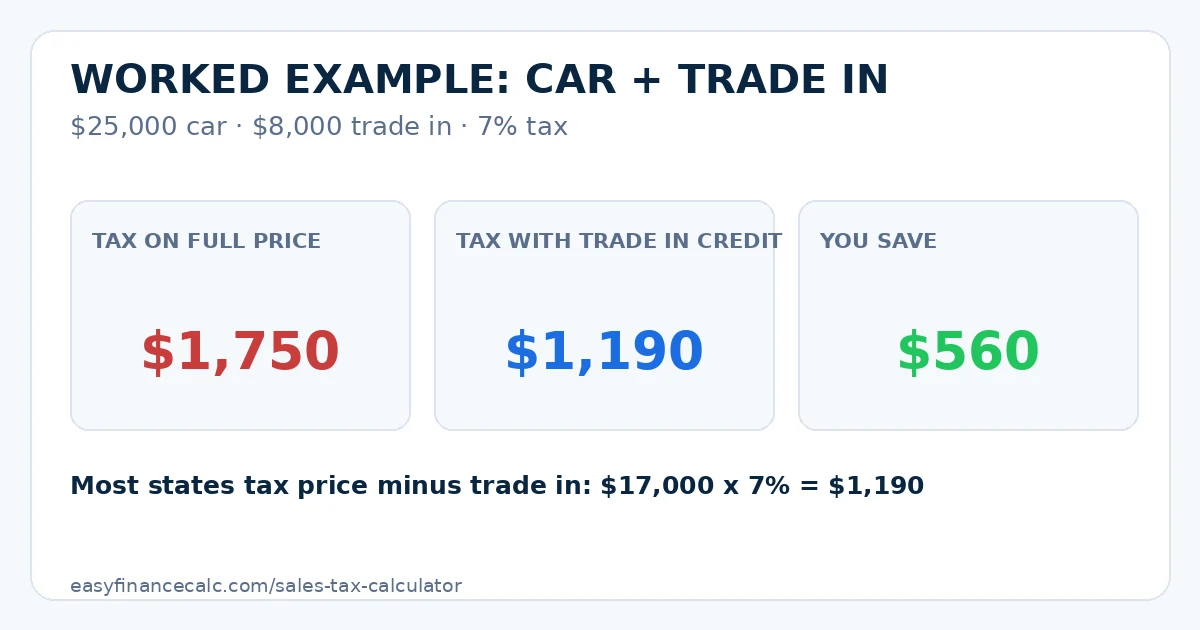
Meet Dan. He is buying a $25,000 car in a 7% tax area and trading in his old car for $8,000. This is how to calculate sales tax on a car with a trade in, step by step. Most states give a trade in credit: tax applies to the price minus the trade in. So Dan is taxed on $17,000, not $25,000.
Tax on full price: $25,000 × 7% = $1,750. Tax with trade in credit: $17,000 × 7% = $1,190. Dan saves $560 with the trade in. That $560 is real money left in his pocket.
But watch out: Texas, Virginia, Michigan, and Pennsylvania are among the states that tax the full purchase price with no trade in credit. Buying in one of those states? The credit vanishes. This is also why timing matters: trading in and buying at the same dealer in the same transaction is what triggers the credit in most states.
2026 Sales Tax Holidays
Seventeen states run sales tax holidays in 2026, mostly back to school events where clothing, school supplies, and sometimes computers go tax free for a few days. Why pay tax you can legally skip by shopping on the right weekend?
| State | 2026 dates | What is covered |
|---|---|---|
| Florida | July 20 to August 20 | Month long: clothing, supplies, computers |
| Texas | August 7 to August 9 | Clothing and footwear under $100 |
| Tennessee | July 31 to August 2 | Clothing, supplies, computers |
| Alabama | July 17 to July 19 | Clothing, supplies, computers, books |
| Mississippi | July 10 to July 12 | Clothing and footwear under $100 |
| Ohio, Oklahoma, South Carolina, Virginia, Missouri | August 7 to August 9 | Clothing and school supplies |
| Connecticut | August 16 to August 22 | Clothing and footwear under $100 |
| Maryland | August 9 to August 15 | Clothing and footwear under $100 |
| Massachusetts | August 8 to August 9 | Most retail items under $2,500 |
| Arkansas | August 1 to August 2 | Clothing, supplies, electronics |
| New Mexico | July 31 to August 2 | Clothing, supplies, computers |
| Iowa | August 7 to August 8 | Clothing and footwear |
| West Virginia | July 31 to August 3 | Clothing, supplies, computers |
Check dollar caps before you shop. Most holidays exempt items only under a set price, often $100 per clothing item. Buy the $120 jacket during the holiday and you pay full tax on it.
Online Orders: Who Collects and Where
Since the Supreme Court decided South Dakota v. Wayfair in 2018, every state with a sales tax requires online sellers with enough sales there to collect tax. That is why a site that never charged you tax five years ago does now. Economic nexus thresholds are typically $100,000 in sales or 200 transactions in the state. The sourcing rule is simple: online sales tax follows the delivery address, not the billing address. Ship a laptop to your cousin in Oregon and no tax applies. Ship it to yourself in California and you pay the California rate for your zip code.
Marketplaces like Amazon, eBay, and Etsy collect for their sellers under marketplace facilitator laws, so the tax line at checkout is normal now. Not sure which rate applies to your zip code? A free sales tax calculator with state presets answers it in seconds. Use tax is the backup. Buy from a seller who does not collect, and you technically owe the same amount directly to your state as use tax. States enforce it most visibly at vehicle registration: buy a car out of state and your home state collects its tax when you register it. So can you dodge car tax by buying across the state line? No. Your registration state wins every time.
5 Mistakes That Cost You at Checkout
Small errors, real dollars. A sales tax calculator 2026 with fresh rates beats last year's tables every time. Here are the five we see most.
- Subtracting instead of dividing. Backing tax out by subtracting the percent from the total gives the wrong price, as shown above. A reverse lookup tool exists precisely because this mistake is so common.
- Forgetting local add ons. The state rate is only the start. County, city, and special district taxes stack on top, which is how a 7.25% state rate becomes 10.25% in Los Angeles. Always check the combined rate for your zip code.
- Assuming the trade in credit applies everywhere. It does not. A handful of states tax the full car price. Confirm your state's rule before you negotiate.
- Paying tax you could have skipped. Seventeen states run 2026 sales tax holidays. A little calendar awareness is free money.
- Trusting stale rate tables. Rates change every year. If the page you are reading still shows Louisiana at 4.45%, close the tab. Our figures come from the Tax Foundation midyear 2026 table, linked below.
Car Sales Tax: What You Pay on a Vehicle
When you buy a car, car sales tax is charged at the rate of the state and county where the car will be registered, not the rate where you bought it. That is why buying across a state line does not change the tax you owe at registration.
A trade in credit lowers the taxable price in most states, as the worked example above shows, so you pay tax on the difference rather than the full sticker price. Title and registration fees are separate charges, added on top of the tax.
Frequently Asked Questions
Quick answers to the questions this sales tax calculator gets most.
Related Calculators
Try the sales tax calculator above with your own numbers, then explore the rest of the tax cluster.
Disclaimer: Estimates for planning only, not tax advice. Sales tax rates change often and vary by exact address. Confirm the rate for your zip code with your state revenue department or a tax professional.
Sources: Tax Foundation, State and Local Sales Tax Rates, Midyear 2026 · IRS, Topic 503, Deductible Taxes (SALT) · U.S. Supreme Court, South Dakota v. Wayfair (2018)