
This free 401k calculator totals what you and your employer will put into your 401(k), checks your contributions against the 2026 IRS limits, and estimates the tax you save with pre tax contributions. Enter your salary, contribution rate, and employer match. No signup, everything runs in your browser.
Calculate your 401(k) contributions and match
2026 IRS limits applied automatically. Everything runs in your browser.
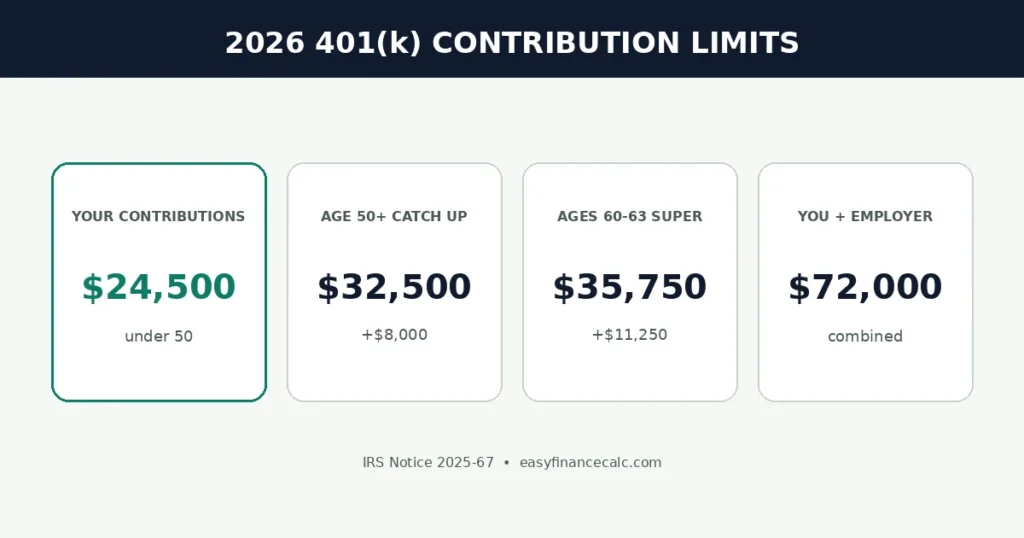
Totals count contributions and match only, with no investment growth assumed. Estimate for planning only. 2026 IRS limits: $24,500 employee deferral, $32,500 at 50+, $35,750 at 60 to 63.
How to Use This 401k Calculator
Using it takes less than a minute. Wondering where to start? Just follow these steps.
- Enter your salary and ages. Your current age and the age you plan to retire set the timeline.
- Set your contribution. Use a percent of salary or a dollar amount per year. Pick Traditional, Roth, or split between both.
- Add your employer match. A 401k calculator with match is far more accurate than one without, because the match is free money your employer adds on top of your own contributions. Enter your plan’s formula, like 50% up to 6%.
- Check the 2026 limits. The calculator caps your contribution at the 401k contribution limit 2026 automatically: $24,500 normally, $32,500 at 50+, $35,750 at 60 to 63.
- Read your totals. You get your own contributions, your employer’s contributions, the combined amount, and your estimated tax savings.
What Is the 401k Contribution Limit for 2026?
The 401k contribution limit 2026 is $24,500 of your own pay. If you are 50 or older you can add an $8,000 catch up, for $32,500 total. Ages 60 to 63 get a larger $11,250 super catch up instead, for $35,750 total. These figures come from IRS Notice 2025-67.
| Limit | 2026 |
|---|---|
| Your own contributions (elective deferral) | $24,500 |
| Catch up at 50+ | +$8,000 = $32,500 |
| Super catch up at 60 to 63 | +$11,250 = $35,750 |
| You plus employer combined | $72,000 |
| Salary counted to match formulas | $360,000 |
Two things people get wrong. First, the super catch up replaces the regular one, it does not stack. Second, your employer’s match never eats into your $24,500. So how much could you actually use? That depends on your match and any after tax contributions.
How the 401k Employer Match Works?
An employer match is money your company adds to your 401(k) when you contribute. The most common formula is 50% up to 6%: you put in 6% of salary, they add 3%. On an $80,000 salary that is $4,800 from you and $2,400 free from them, every single year. A 401k calculator with match adds up fast. Over 30 years, a $2,400 yearly match puts $72,000 of employer money into your account on top of your own contributions.
Skipping the match is like turning down a raise, so why do so many people do it? Usually they simply never calculated what it is worth.
True up: the trap nobody warns you about. Many plans match per paycheck. If you hit the $24,500 cap by October and your plan does not true up, your November and December paychecks get zero match. That is free money gone forever. Ask HR one question: does our plan true up? If the answer is no, spread your contributions across every paycheck of the year.
How the Totals Are Calculated
No formulas with returns in them, just addition. For each year from your current age to your retirement age, the calculator works out three numbers.
Your contribution is your percent of that year’s salary (or your fixed dollar amount), capped at the 401k contribution limit 2026 for your age. Salary rises by your raise % yearly.
The match applies your plan’s formula to that contribution, only on salary up to $360,000. A 50% match up to 6% means the employer adds 50 cents per dollar for the first 6% of salary you contribute.
Tax savings equals your total pre tax contributions times your marginal tax rate. It is the tax you do not pay today because Traditional contributions come out of your paycheck before tax. Roth versus Traditional does not change the contribution and match totals, only when you pay tax.
Worked Example: $90,000 Salary at Age 35, Totals to 65
Meet Priya. She is 35, earns $90,000, with 3% yearly raises, contributes 10% of salary, and gets a 50% match up to 6%. The calculator counts 30 years, from 35 to 65. What goes in?
Her own contributions over 30 years: $428,179
Employer match over 30 years: $128,454
Estimated tax savings at a 22% marginal rate: $94,199
Notice the match alone is six figures of employer money, and none of these numbers assumes a single dollar of investment growth. They are simply what Priya and her employer put in, plus the tax she saves along the way.
Want your own version? Run your numbers through a 401k calculator with match and watch the employer money column. If your contributions ever hit the IRS cap in a year, the calculator flags it and caps them for you.
Roth 401k vs Traditional 401k: Which Wins?
A roth 401k calculator question we hear constantly: should I pay tax now or later? Here is the simple version.
| Traditional 401(k) | Roth 401(k) | |
|---|---|---|
| Tax today | Deductible now | No deduction, after tax dollars |
| Tax in retirement | Withdrawals taxed as income | Qualified withdrawals tax free |
| 2026 limit | Shared $24,500 cap | Shared $24,500 cap |
Rule of thumb: in a higher bracket now than you expect in retirement, Traditional usually wins. Young or in a lower bracket now, Roth often wins. Many people split to hedge.
One 2026 change to know: if your prior year FICA wages topped $150,000, new SECURE 2.0 rules say your catch up contributions must go to Roth.
What Most Calculators Miss
We read the top ranking pages and found gaps. Here is what they leave out.
Mega backdoor Roth. If your plan allows after tax contributions plus in service rollovers, you can push up to the $72,000 combined cap into Roth. It needs three sub accounts: pre tax, Roth, and after tax. Ask your plan administrator if yours supports it.
401k loans. You can borrow 50% of your vested balance up to $50,000. But leave your job with a loan outstanding and the balance can become a taxable distribution. A 401k loan calculator is a future page on our site.
Vesting: cliff vs graded. Cliff vesting means 0% then 100% at year three. Graded means 20% per year. Leave early and the unvested match stays with your employer. Always check your schedule before switching jobs.
Rule of 55. Separate from your employer at 55 or later and you can withdraw without the 10% early penalty. You still owe income tax. This is separate from the usual 59 and a half rule.
Front loading vs spreading. Maxing out by summer feels productive, but in a no true up plan it forfeits match money. Spread it out unless your plan true ups.
Your 457(b) gets its own limit. 401(k), 403(b), and TSP share one $24,500 cap. A 457(b) gets a separate $24,500. Government workers, take note.
5 Mistakes That Shrink Your 401(k)
- Leaving match money on the table. Not contributing enough for the full 401k employer match is the costliest beginner mistake.
- Maxing out too early. In a no true up plan, early maxing forfeits later match. Spread contributions evenly.
- Ignoring fees. Plan fees and fund expense ratios come out of your account every year. A 1% expense ratio versus 0.1% is a real pay cut to your future self, so read your plan’s fee disclosure.
- Cashing out on a job change. Taxes plus the 10% penalty plus contribution years you can never get back. Roll it over instead.
- Using last year’s limits. Some pages still show $23,500. The 401k contribution limit 2026 is $24,500.
Frequently Asked Questions
How much can I contribute to my 401(k) in 2026?
$24,500 of your own pay, $32,500 at 50+, $35,750 at ages 60 to 63. Employer match does not count toward your $24,500.
How much should I contribute to my 401(k)?
At least enough to capture the full 401k employer match. Beyond that, 15% of income including the match is the standard benchmark. Just watch the true up trap described above.
Does the employer match count toward my limit?
No. The 401k employer match counts toward the separate $72,000 combined limit, not your $24,500.
Should I choose Roth or Traditional?
Higher bracket now points to Traditional, lower now points to Roth. Try a roth 401k calculator comparison with your own numbers, and run a second 401k calculator scenario at a lower retirement bracket to see the crossover point. And remember the $150,000 Roth catch up mandate for 2026.
What is a good 401k employer match?
50% up to 6% (3% of salary) is typical. Dollar for dollar up to 3 to 6% is generous.
What happens to my 401(k) when I change jobs?
Roll it directly into an IRA or your new plan. Direct rollovers have no tax and no withholding. Never cash out.
Can I withdraw early?
Expect a 10% penalty before 59 and a half plus income tax, except for the Rule of 55, hardship withdrawals, or 72(t) payments. A 401k early withdrawal calculator can estimate the damage.
Do bonuses count toward my match?
It depends on your plan. Some exclude bonuses or match per paycheck, which can shrink both the match and bonus checks. Check your plan’s summary description.
Related calculators
Disclaimer
These are estimates for planning only, not tax or investment advice. Limits change yearly. Confirm details with the IRS and your plan administrator.