
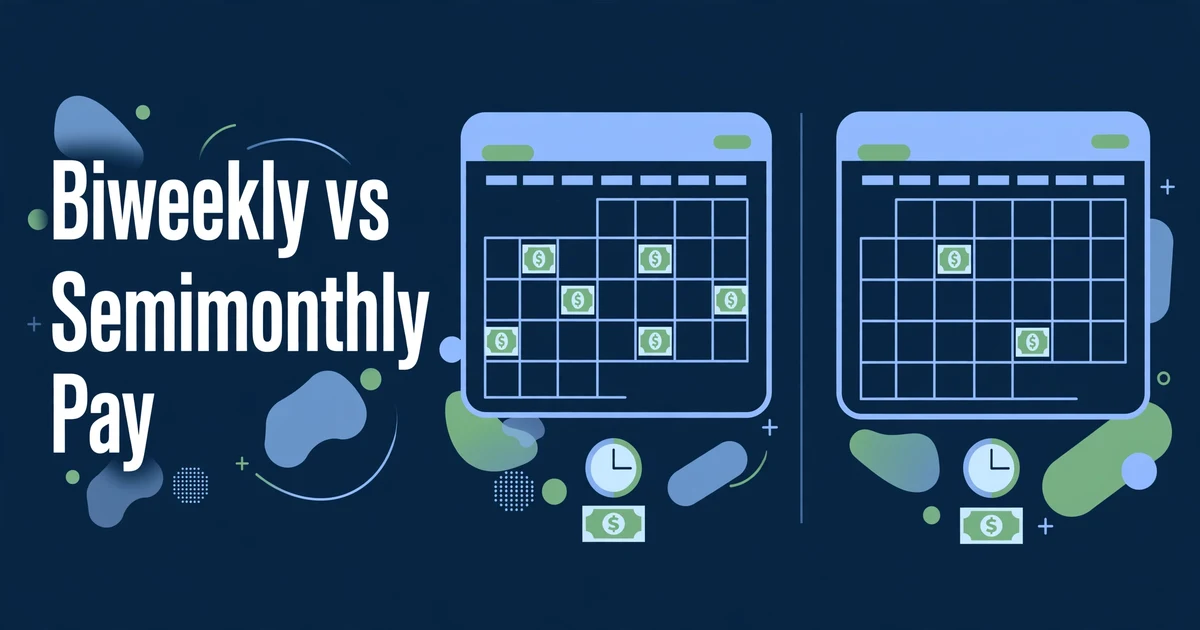
Biweekly vs Semimonthly Pay: Pick the Schedule That Fits Your Budget
Biweekly vs semimonthly pay comes down to timing, not total money. Biweekly pay means a paycheck every two weeks, which adds up to 26 paychecks a year. Semimonthly pay means a paycheck twice a month on fixed dates, which adds up to 24 paychecks a year. Your annual salary stays exactly the same on either schedule, so the real question is which rhythm fits your bills and your budget. So which one actually works better for real life? Keep reading, because the answer depends on how you get paid and how you spend.
Most American workers are paid on one of these two schedules, and many people never get to choose. Your employer picks the schedule, and you live with the rhythm. That makes it worth understanding, because the same salary can feel very different when the money lands on different days. A biweekly check is smaller but comes more often, while a semimonthly check is bigger and lands on the same dates every month.
Biweekly vs Semimonthly Pay: The Core Difference
Biweekly pay follows the calendar of weeks. You get paid every other week, usually on a Friday, and the date moves forward through the month as the weeks pass. Semimonthly pay follows the calendar of months. You get paid twice a month, usually on the 1st and the 15th or on the 15th and the last day of the month, and those dates never move. That one difference drives everything else, from the size of each check to how overtime gets counted.
| Schedule | Paydays per year | Pay dates | Gross per check on $72,000 |
|---|---|---|---|
| Biweekly pay | 26 | Every two weeks, dates shift | $2,769.23 |
| Semimonthly pay | 24 | Fixed, twice a month | $3,000.00 |
| Monthly pay | 12 | Once a month | $6,000.00 |
Notice the pattern in the table above. Fewer paychecks mean bigger paychecks, but the yearly total never changes. This is the single most misunderstood fact about pay schedules, and it trips up a lot of people when they switch jobs. If your new job pays semimonthly and your old job paid biweekly, your checks will look bigger, but you are not getting a raise.
How Much Do You Get in Each Paycheck?
Here is the math on a $72,000 salary, before taxes and deductions. On biweekly pay, you divide $72,000 by 26 paychecks and get $2,769.23 per check. On semimonthly pay, you divide $72,000 by 24 paychecks and get $3,000.00 per check. On monthly pay, you divide by 12 and get $6,000.00 per check. The gap between a biweekly check and a semimonthly check is $230.77, and that gap is pure timing. Over a full year, all three schedules pay exactly $72,000 in gross pay.
Meet Daniel, a warehouse supervisor in Texas earning $72,000 a year. On his old biweekly schedule, his gross pay was $2,769.23 every two weeks. On his new semimonthly schedule, his gross pay is $3,000.00 on the 1st and the 15th. His rent is due on the 1st, so the semimonthly schedule lines up neatly with his biggest bill, and that is a real quality of life win. But his annual gross pay did not change by a single dollar. When Daniel compared the two schedules, the biweekly vs semimonthly pay question came down to timing, not money, and the same is true for you.
Taxes work the same way. Your employer withholds a little more from each semimonthly check because each check is bigger, but your total tax for the year is based on your annual income, not your pay schedule. Your refund at tax time does not change because you switched schedules. If you want to see how much of each check you actually keep, run the numbers in our free paycheck calculator and compare the two schedules side by side.
What Are Three Paycheck Months?
Here is the fun part of biweekly pay. A year has 52 weeks, and 52 divided by 2 is 26 paychecks. Spread 26 paychecks across 12 months and two of those months will contain three paychecks instead of two. Those are three paycheck months, and they feel like bonus months, because your regular bills are already covered by the first two checks. On semimonthly pay, this never happens. You get exactly two checks every month, all year long, with no bonus month.
The smart move is to decide in advance what a third check is for. Treat it as a bonus, not as spending money, and send it straight to savings, to an emergency fund, or to extra debt payments. If you spend it like a normal check, the magic disappears, and you are back to living paycheck to paycheck. Which months have three paychecks depends on your payday, so check your own calendar at the start of the year and mark them.
How Does Overtime Work on Each Schedule?
Federal law sets the overtime rule, and it does not care about your pay schedule. Under the Fair Labor Standards Act, you earn overtime at time and a half for hours over 40 in a single workweek, and a workweek is seven consecutive days. Your employer must track your hours by workweek, no matter how often you get paid.
Biweekly pay lines up neatly with this rule, because a biweekly pay period holds exactly two workweeks. Overtime is simple to count, and your pay stub usually shows it clearly. Semimonthly pay is messier, because a pay period like the 1st through the 15th cuts workweeks in half. Your employer still has to track each workweek separately and pay the overtime you earned, but the math is less obvious on your pay stub. Either way, your overtime rights are identical. If you want the full breakdown, read our guide on how overtime is calculated.
One more detail matters for hourly workers. If you work a lot of overtime, biweekly pay shows it faster, because your check arrives every two weeks. On semimonthly pay, overtime from the second half of a pay period may land in the next check. The money is the same, but the timing can surprise you.
Which Schedule Is Better for Budgeting?
Semimonthly pay wins for simple budgeting. Your pay dates never move, so you can line up rent, car payments, and utility bills with the 1st and the 15th and set everything on autopay. There are no surprises, and no month where a payday drifts past a due date. If you like a fixed routine, semimonthly pay feels calm.
Biweekly pay wins for savers. Those two three paycheck months hand you extra money twice a year, and if you plan for them, they can fund a vacation, build an emergency fund, or knock out a credit card. The trade off is that pay dates drift, so a bill due on the 1st might land days before your check arrives. A small buffer in your checking account solves that problem. So which schedule is better? If you value predictability, choose semimonthly. If you value the bonus months, choose biweekly. Most people do fine on either one once they understand the rhythm.
Can Your Employer Switch Your Pay Schedule?
Yes, in most cases your employer can change the pay schedule, but they have to tell you in advance and they cannot use the switch to delay pay you already earned. Most states require employers to pay at least twice a month, and a few states set stricter rules, so the switch usually goes from biweekly to semimonthly or the other way around, not to something slower.
If your employer announces a switch, ask for the change in writing, check the dates of your last check on the old schedule and your first check on the new one, and watch for a gap where no check arrives for three weeks. That gap is the most common complaint when schedules change, and a small cash buffer covers it.
Common Mistakes to Avoid
These six mistakes cause most of the confusion around pay schedules.
- Thinking biweekly pay means more money per year. It does not. The annual total is identical, and the bigger semimonthly check only looks like a raise.
- Spending the third check in a three paycheck month. Treat it as a bonus for savings or debt, not as free spending money.
- Assuming your pay dates never move on biweekly pay. They shift every month, so check the calendar before you set up autopay.
- Forgetting that overtime is counted by workweek, not by pay period. Your overtime rights are the same on both schedules.
- Ignoring state payday laws when your employer changes schedules. You are owed the pay you earned, on time.
- Not adjusting your budget when you switch jobs. A new schedule changes the size and timing of every check, so rebuild your monthly plan in the first month.
Frequently Asked Questions
Q: Is biweekly or semimonthly pay better? A: Neither schedule pays more per year. Semimonthly pay is better for simple budgeting because pay dates never move. Biweekly pay is better for savers because of the two three paycheck months each year.
Q: How many paychecks do you get on biweekly pay? A: You get 26 paychecks a year on biweekly pay, one every two weeks. Two months of the year will have three paychecks.
Q: How many paychecks do you get on semimonthly pay? A: You get 24 paychecks a year on semimonthly pay, two every month on fixed dates such as the 1st and the 15th.
Q: Do you earn more money on biweekly pay? A: No. A $72,000 salary pays $72,000 a year on any schedule. Biweekly checks are smaller at $2,769.23 each, while semimonthly checks are larger at $3,000.00 each, but the yearly total is identical.
Q: What is a three paycheck month? A: A three paycheck month is a month with three biweekly paychecks instead of two. It happens twice a year on biweekly pay, because 26 paychecks spread across 12 months leave two extra checks.
Q: Is semimonthly pay the same as bimonthly pay? A: Not exactly. Semimonthly pay always means twice a month. Bimonthly is confusing, because some people use it to mean twice a month and others use it to mean every two months. Ask your employer which one they mean.
Q: How is overtime calculated on semimonthly pay? A: Overtime is calculated by workweek, not by pay period. Your employer must track each seven day workweek separately and pay time and a half for hours over 40, even when a semimonthly pay period splits a workweek in half.
Q: Can my employer change me from biweekly to semimonthly pay? A: Yes, in most cases, but they must tell you in advance and cannot delay pay you already earned. Most states require pay at least twice a month.
Q: Which pay schedule is best for monthly bills? A: Semimonthly pay lines up best with monthly bills, because the 1st and the 15th match common due dates. Biweekly pay needs a small buffer, because pay dates drift through the month.
Q: Does biweekly pay affect my taxes? A: No. Your annual tax is based on your yearly income, not your pay schedule. Withholding per check differs, because each check is a different size, but your total tax and your refund stay the same.
Read our gross pay vs net pay guide to see how much of each check you keep, and browse the full Paycheck Calculators hub for every pay tool in one place. That wraps up our biweekly vs semimonthly pay comparison, and the right schedule is the one that fits your bills.
See What Each Paycheck Really Looks Like
Run your salary through our free paycheck calculator and compare biweekly and semimonthly pay in seconds.
Calculate Your PaycheckDisclaimer: This guide is for education only and is not financial, tax, or legal advice. Pay rules vary by state and by employer, so check your state labor department or talk to a professional about your situation.
Sources: U.S. Department of Labor, Wage and Hour Division, Fair Labor Standards Act overtime rules. Bureau of Labor Statistics, pay period data. IRS Publication 15, federal income tax withholding.
By EasyFinanceCalc Team | Published October 25, 2026 | Last updated October 25, 2026
Written by Elena
Writes about paychecks, work hours, and overtime for Easy Finance Calc.