
Take-Home Pay as a Percentage of Gross Pay (2026)
Quick answer: Take-home pay as a percentage of gross pay is your net pay divided by your gross pay, times 100. For a single filer earning $75,000 with no state income tax, it works out to about 82% — meaning roughly 18 cents of every dollar goes to federal tax and FICA. Most US employees land between 70% and 85%, depending on income, state, and pre-tax deductions.
Run your own numbers in our free paycheck calculator — 60 seconds, no signup, 2026 figures.
The 3-Step Formula
Direct answer: You need three numbers — gross pay, total taxes, and pre-tax deductions — and about two minutes:
- Start with your gross pay. That’s the salary or wages before anything is taken out — e.g., $75,000 a year, or $2,884.62 biweekly. Find it on your pay stub as “gross.”
- Subtract every deduction. That includes federal income tax, state and local income tax, Social Security and Medicare (FICA), plus pre-tax deductions like 401(k) contributions, HSA contributions, and health insurance premiums. What’s left is your net (take-home) pay.
- Divide and multiply. Take-home pay ÷ gross pay × 100 = your percentage.
The formula in one line: (Gross pay − All taxes and deductions) ÷ Gross pay × 100.
That single line is the whole math behind your take-home pay as a percentage of gross pay.
The taxes part is where people get lost, so here’s what’s actually taken out of a typical US paycheck in 2026: federal income tax (progressive brackets — only part of your income hits the top rate), Social Security (6.2% on the first $184,500 of wages), Medicare (1.45% on all wages, plus 0.9% extra on wages over $200,000 single), and state/local income tax if your state has one (Texas, Florida, and seven others have none; California and New York are among the highest).
Worked Example: Jasmine Keeps 81.9%
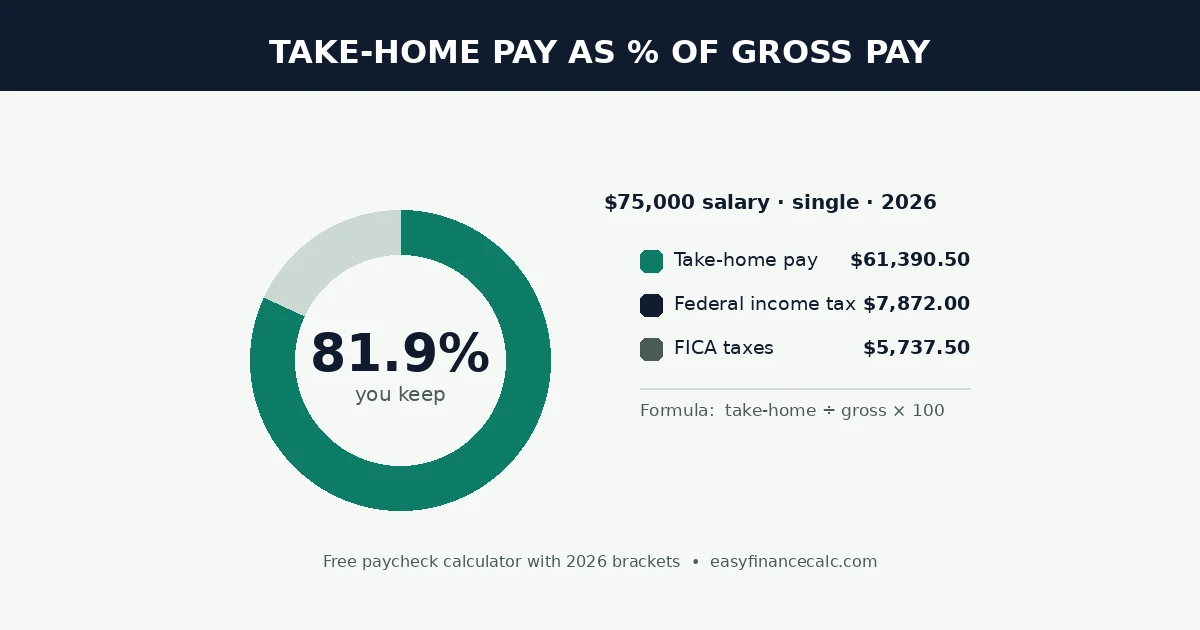
Meet Jasmine. She’s 29, single, a graphic designer in Austin, Texas, earning $75,000 a year. Texas has no state income tax, and she takes the standard deduction ($16,100 single for 2026). Here’s her math:
- Taxable income: $75,000 − $16,100 = $58,900
- Federal income tax: the first $11,925 at 10% ($1,192.50) + the next $36,550 at 12% ($4,386.00) + the remaining $10,425 at 22% ($2,293.50) = $7,872
- FICA: Social Security 6.2% × $75,000 = $4,650 + Medicare 1.45% × $75,000 = $1,087.50 = $5,737.50
- Take-home pay: $75,000 − $7,872 − $5,737.50 = $61,390.50
- Take-home as % of gross: $61,390.50 ÷ $75,000 × 100 = 81.9%
Jasmine keeps about 82 cents of every dollar. Her effective federal income tax rate is only 10.5% ($7,872 ÷ $75,000) — far below her 22% marginal rate, because the brackets tax only slices of her income, not the whole thing. That distinction trips up almost everyone; it’s the reason “I’m in the 22% bracket” never means “the government takes 22% of my pay.”
On a biweekly schedule, Jasmine’s take-home is $61,390.50 ÷ 26 = $2,361.17 per paycheck.
What Moves Your Percentage Up or Down
Direct answer: Your keep-rate isn’t fixed — five levers push it around:
| Lever | Effect on your % | Example |
|---|---|---|
| State taxes | Can swing it 5–10 points | $75K in Texas (no state tax): ~82%. Same job in California: closer to ~75% after ~9.3% marginal state tax. |
| Pre-tax deductions | Lowers taxable pay, but the deduction still counts against take-home | Maxing a 401(k) at $24,500 (2026 limit) cuts federal tax — but that $24,500 isn’t in your paycheck either. |
| Health insurance & HSA | Reduces take-home dollar-for-dollar | A $200/month premium costs $2,400/year of take-home, even though it’s pre-tax. |
| Filing status & W-4 | Changes withholding timing, not your true % | Under-withholding raises your paycheck % now but shrinks (or kills) your refund later — the annual math is identical. |
| Income level | Higher income → lower % (progressive brackets) | At $250,000 single, the 32% and 35% brackets bite hard — keep-rates drop toward the mid-70s before state tax. |
The state-tax lever is the one most people underestimate. Moving from California to Texas on the same $75,000 salary can be worth roughly $4,000–$5,000 a year in take-home — a bigger “raise” than most performance reviews.
Together, these levers decide your take-home pay as a percentage of gross pay — and most of them are at least partly in your control.
5 Mistakes That Wreck the Comparison
- Comparing gross salaries across states. A $90,000 offer in New York City vs. $82,000 in Dallas? Run the take-home percentage for each before deciding — the Dallas job often wins in actual paycheck dollars.
- Forgetting pre-tax deductions when job-hunting. Two $75,000 offers aren’t equal if one has a $400/month health premium and the other has $150/month. Your percentage captures what the offer letter doesn’t.
- Confusing your marginal rate with your effective rate. Jasmine’s 22% bracket doesn’t mean she keeps 78% — she keeps 81.9%, because most of her income was taxed at 10% and 12%.
- Reading one paycheck as your whole story. A biweekly stub with overtime looks generous, but how overtime is actually calculated — and withheld — can make that “big” check misleading. Annualize everything.
- Treating the percentage as fixed. It changes when you get a raise, move states, adjust your 401(k), or update your W-4. Recheck it once a year — five minutes that can surface a few thousand dollars.
Frequently Asked Questions
What is a good take-home pay percentage?
For most US employees, 70–85% is normal. Single filers with no state income tax and no big pre-tax deductions sit near 80–85%; high earners in high-tax states can land in the 60s.
How do I calculate take-home pay as a percentage of gross pay?
Subtract all taxes and deductions from your gross pay to get net pay, then divide net by gross and multiply by 100. Example: $61,390.50 ÷ $75,000 × 100 = 81.9%.
Why is my take-home pay so much less than my salary?
The gap is federal income tax, Social Security and Medicare, state/local taxes, and pre-tax deductions (401(k), health insurance, HSA). On $75,000 in Texas, the gap is about $13,610 — and that’s with no state tax.
Does contributing to a 401(k) increase my take-home percentage?
Technically no — the contribution itself comes out of your paycheck, so take-home dollars fall. But it lowers your taxable income, so your tax percentage falls. The real win is the tax savings plus the retirement money.
Is overtime taxed at a higher rate?
No — overtime is taxed at your normal marginal rate, the same as regular pay. It feels higher because withholding tables assume that bigger paycheck is your every-paycheck amount. (Bonus: for 2025–2028, the 0.5× overtime premium is federally deductible up to $12,500 single.)
How do I figure out my true hourly pay?
Take your annual take-home pay and divide by total hours actually worked (including unpaid overtime and commute time if you’re being honest with yourself). You can also convert your salary to an hourly rate with our free tool.
Does my W-4 change my take-home percentage?
It changes your per-paycheck percentage but not your annual one. Claiming more allowances (under-withholding) fattens each check and shrinks your refund; the total tax for the year is the same. The IRS Tax Withholding Estimator can help you get your withholding right.
What’s the difference between gross pay and net pay?
Gross pay is your full earnings before anything is removed. Net (take-home) pay is what’s left after taxes and deductions — the number that actually hits your bank account.
Do bonuses get taxed differently?
Bonuses are “supplemental wages” — employers typically withhold a flat 22% federal (37% over $1 million), which is often more than your effective rate. You get the difference back at filing time; it doesn’t change your true annual percentage.
Can my take-home percentage be over 100%?
Only in edge cases — like when refundable tax credits (EITC, Additional Child Tax Credit) exceed your total tax, which happens for some lower-income families with children. For most W-2 employees, 70–85% is the realistic band.
Try It: Paycheck Calculator — Free, No Signup
Don’t estimate — calculate. Our free paycheck calculator breaks your gross pay into federal tax, FICA, and state tax line by line, using 2026 brackets and your filing status. And if you’re comparing job offers by the hour, convert your salary to an hourly rate to see what each offer is really worth.
To find your own take-home pay as a percentage of gross pay, run your numbers through the calculator linked above.
Byline: EasyFinanceCalc Editorial Team · Published: October 18, 2026 · Last updated: October 18, 2026 · Category: Paycheck
Disclaimer: This guide is for educational purposes only and is not tax, financial, or legal advice. Tax figures use 2026 federal brackets, the $184,500 Social Security wage base, and the $16,100 single standard deduction; your situation may differ. Consult a qualified tax professional for advice.
Sources: IRS — 2026 federal income tax brackets and standard deduction; Social Security Administration — 2026 wage base ($184,500); Bureau of Labor Statistics — employer costs for employee compensation.
Written by Elena
Writes about paychecks, work hours, and overtime for Easy Finance Calc.



One Comment