
How Long Does a Tax Refund Take? 2026 Timeline
Quick answer: The IRS sends most e-filed refunds by direct deposit within 21 days of acceptance. A paper return takes 6–8 weeks just to process, and choosing a mailed check instead of direct deposit adds more time on top. If you’re still waiting after 21 days (e-file) or 6 weeks (paper), it’s time to check the status — delays almost always have an identifiable cause.
Want to know how big your refund will be first? Estimate your refund with our free tax refund calculator — it takes about 60 seconds, no signup.
The 2026 IRS Refund Timeline, Method by Method
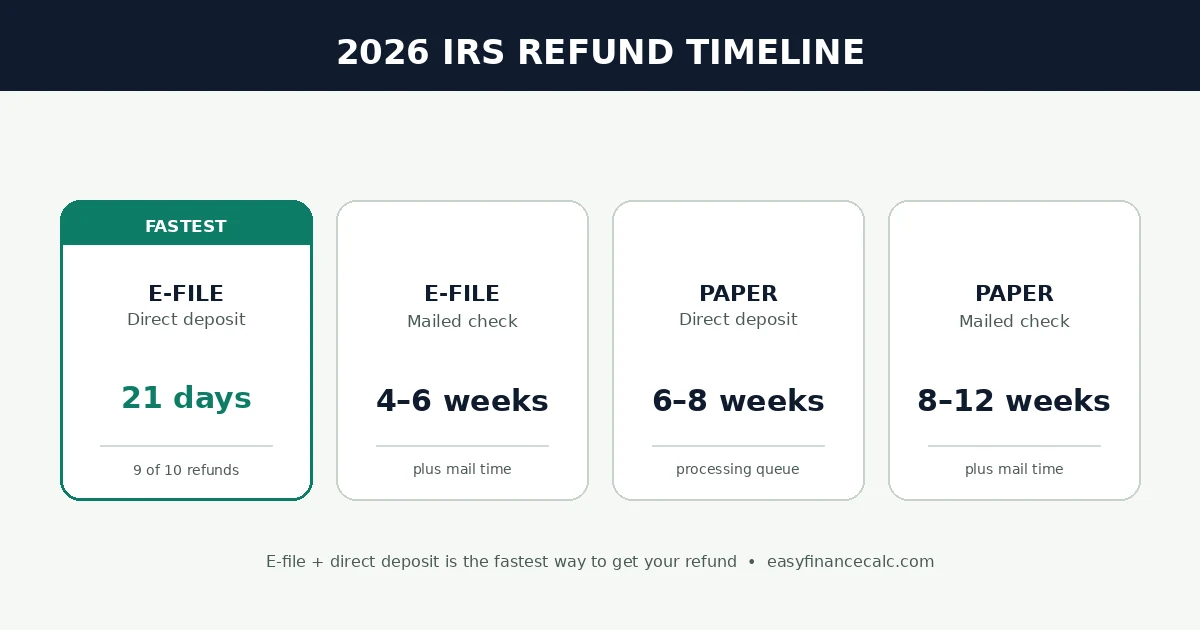
Direct answer: Your filing and delivery choices decide your wait. Here’s what the IRS says to expect for 2026 returns:
| How you file | How you get paid | Typical wait |
|---|---|---|
| E-file | Direct deposit | 21 days or less (9 out of 10 refunds) |
| E-file | Mailed check | ~4–6 weeks (check travels by mail after processing) |
| Paper return | Direct deposit | 6–8 weeks |
| Paper return | Mailed check | 8–12 weeks total |
The single biggest lever you control is e-filing with direct deposit. Filing on paper roughly triples your wait, and a mailed check adds mail transit on top of processing — checks can be lost, delayed, or stolen, which is why the IRS pushes direct deposit hard.
So how long does it take to get a tax refund? For most e-filers with direct deposit, the answer is under three weeks.
One more wrinkle worth knowing: the “21 days” clock starts when the IRS accepts your return, not when you hit “submit.” If you file on April 15 and acceptance takes a day, day one is the acceptance date. Most e-filed returns are accepted within minutes or hours, but it can take up to 48 hours.
The 3 Stages of an IRS Refund
Direct answer: Every refund passes through three stages, and the IRS’s tracking tool shows you exactly which stage you’re in:
- Return received (accepted): The IRS has your return and it’s entered in the system. The Where’s My Refund? tool shows “Return Received.” This says nothing about your refund’s correctness — only that it arrived.
- Refund approved: The IRS finished processing and approved your refund. You’ll see “Refund Approved” plus a personalized refund date. This is the stage where most delays happen — errors, missing forms, or credits requiring extra review (like the Earned Income Credit or Additional Child Tax Credit) are all flagged here.
- Refund sent: The IRS dispatched your money — a deposit to your bank account or a check in the mail. The tool shows “Refund Sent.” Direct deposits usually land the same day or within a few business days; checks take mail time.
Track your refund in 3 steps:
- Go to the IRS Where’s My Refund? tool at irs.gov (or the IRS2Go app). Status appears 24 hours after e-filing, or about 4 weeks after mailing a paper return.
- Enter your Social Security number, filing status, and the exact refund amount from your return.
- Read the status message — and check it once a day, not hourly. The tool updates overnight, and obsessive checking changes nothing.
Worked Example: Andre’s 2026 Refund Timeline
Meet Andre. He’s 41, single, works in warehouse logistics in Columbus, Ohio, and expects a $2,310 refund. Here’s how his timeline actually plays out when he e-files on January 28, 2026:
- Jan 28, 9:15 a.m. — Andre e-files through his tax software. Accepted by the IRS at 9:47 a.m. the same morning.
- Jan 29 — Where’s My Refund? shows “Return Received.”
- Feb 11 (day 14) — Status flips to “Refund Approved” with a scheduled date of Feb 14.
- Feb 14 (day 17) — $2,310 lands in Andre’s checking account via direct deposit.
Total: 17 days from filing to money in hand — comfortably inside the 21-day window. Had Andre mailed a paper return instead, the IRS would have needed until mid-to-late March just to process it, and a mailed check could have pushed arrival into April.
In other words, his experience shows exactly how long does it take to get a tax refund when nothing goes wrong.
What Delays a Tax Refund
If you’re asking how long does it take to get a tax refund once a delay hits, the answer depends on the cause.
Direct answer: If you’re past the 21-day mark, one of these is usually the reason — and each has a fix:
- You claimed the EITC or Additional Child Tax Credit. By law (the PATH Act of 2015), the IRS can’t issue these refunds before mid-February, even if you file in January. It’s automatic — no error on your part, and no action needed.
- Something doesn’t match. A typo in your Social Security number, a name misspelled the way your employer spelled it on the W-2, or math that doesn’t reconcile — any of these forces manual review, adding weeks.
- Unreported or mismatched income. If your return is missing a 1099 (the IRS has copies from payers), the system flags it. This is the most common cause of multi-month delays.
- Identity theft or fraud review. If someone else filed with your SSN, or the IRS’s filters suspect fraud, your refund freezes while they verify you — sometimes requiring an identity verification letter or in-person appointment.
- Refund offset. Debts like defaulted federal student loans, back taxes, or past-due child support can be seized from your refund through the Treasury Offset Program. You’d get a notice after the offset.
- Amended return. Form 1040-X corrections take 20+ weeks — a completely separate, much slower queue.
- Injured spouse claim. If your joint refund was offset for your spouse’s debt, Form 8379 claims typically take 11–14 weeks to process.
Rule of thumb: if Where’s My Refund? tells you to call the IRS, call. Otherwise, the tool’s message is your status — calling about a return still inside normal processing time won’t speed anything up.
5 Mistakes That Make You Wait Longer
- Filing on paper. It’s the single slowest choice you can make. E-filing a simple return is free for most people through IRS Free File — the paper habit is pure self-inflicted delay.
- Choosing a mailed check. Direct deposit skips mail transit entirely. If you move between filing and refund time, a check can literally end up at the wrong address.
- Guessing at your income instead of waiting for forms. Filing before all your W-2s and 1099s arrive invites mismatches — and the correction cycle takes far longer than the week you saved.
- Paying for a “refund advance.” Tax prep shops offer refund advances that aren’t the IRS being faster — they’re short-term loans against your refund, sometimes with fees. Your actual IRS timeline doesn’t change.
- Checking the tracker 40 times a day. The tool updates once overnight. Checking more often is harmless but tells you nothing new — and panicking early is how people file duplicate returns, which creates real delays.
Frequently Asked Questions
How long does it take to get a tax refund with direct deposit in 2026?
The IRS issues 9 out of 10 e-filed refunds by direct deposit within 21 days of acceptance. In practice, many arrive in 10–14 days when the return is clean.
How long does a paper check refund take?
A mailed check typically takes 4–6 weeks after e-filing, or 8–12 weeks total after mailing a paper return. Mail transit, lost checks, and address changes all add risk.
Why is my refund taking longer than 21 days?
The usual causes: an error or mismatch on the return, unreported income flagged by the IRS, an EITC/ACTC claim (held until mid-February by law), identity verification, or a refund offset for a debt. Check Where’s My Refund? — its message tells you which.
Does the IRS update refund status on weekends?
The Where’s My Refund? tool updates once per day, overnight — checking multiple times a day shows the same result. Weekend and holiday processing continues, but deposits post on banking days.
What if I never got my refund but it says “Refund Sent”?
For direct deposit: wait 5 banking days, then verify the account and routing numbers on your return — a wrong digit sends it to the wrong account. For checks: allow normal mail time, then request a payment trace with Form 3911 after 28 days (7 weeks for international addresses).
Can I speed up my IRS refund?
The honest answer: the main levers are filing early, e-filing, choosing direct deposit, and filing an error-free return. Nothing you do after filing — calling, checking hourly, filing again — moves you up the queue.
Do state tax refunds take as long?
It varies by state, but most states with e-filing process refunds in 1–3 weeks by direct deposit — often faster than the IRS. Each state has its own tracker.
What is the latest date I can get a 2026 refund?
Refunds are generally issued within weeks of processing, but you must file to claim one: you have 3 years from the filing deadline to file and still receive a refund — miss that window and the refund is forfeited to the Treasury.
Does filing early get my refund faster?
Usually, yes — you’re ahead of the late-season backlog, and e-filed returns are processed first-in, first-out within the system. The main exception is EITC/ACTC claims, which the IRS holds until mid-February regardless of filing date.
Why did the IRS reduce my refund?
Common reasons: you owed back taxes or other debts (offset), your return had a math error the IRS corrected, or a credit was disallowed. The IRS mails a notice explaining the change — and if your refund came in smaller than you expected, our breakdown of the 7 causes will help you find the missing dollars.
Try It: Tax Refund Calculator — Free, No Signup
Wondering how much is coming back before you file? Our free tax refund calculator estimates your 2026 federal refund in about 60 seconds — just your income, filing status, and withholding. Private, no signup, and it uses the current year’s brackets and standard deduction ($16,100 single / $32,200 joint for 2026).
Byline: EasyFinanceCalc Editorial Team · Published: October 18, 2026 · Last updated: October 18, 2026 · Category: Tax
Disclaimer: This guide is for educational purposes only and is not tax or financial advice. IRS processing times vary by individual return; verify your status with the official IRS Where’s My Refund? tool and consult a qualified tax professional for your situation.
Sources: IRS — “Where’s My Refund?” (irs.gov/refunds); IRS — refund timing FAQs; PATH Act of 2015 (EITC/ACTC mid-February hold); IRS Form 3911 (payment trace); U.S. Bureau of the Fiscal Service (Treasury Offset Program).
Written by Marcus
Tax editor at Easy Finance Calc, covering federal taxes, refunds, and credits.


One Comment