
Washington Paycheck Calculator: Find Your Exact Take Home Pay
This Washington Paycheck Calculator shows what actually lands in your bank account when you work in the Evergreen State. Washington charges no state income tax at all, so your paycheck only loses federal income tax, Social Security, Medicare, and one small state line most rival calculators miss: the WA Cares Fund premium. Ever wonder why a Washington paycheck can look bigger than the same salary paid in Oregon or California? The answer is simple: the state income tax line on a Washington pay stub reads zero, every single time.
Quick Answer
Here is the short version. Washington has no state income tax and no local income tax anywhere in the state. On an $80,000 salary, a single filer in Seattle takes home about $64,646 a year, roughly 81 percent of gross pay. Three federal taxes come out, federal income tax plus Social Security and Medicare, and one state premium: WA Cares at 0.58 percent of wages with no cap. A good washington take home pay calculator should always show the state income tax line as $0 and the WA Cares line separately. If a tool shows Washington state income tax above zero, it is wrong.
Washington Paycheck Calculator
Washington levies no personal income tax on wages. The WA Cares Fund premium (0.58% of wages in 2026) funds long-term care benefits and is withheld from paychecks — unlike the employer-paid taxes in some states. Federal figures use 2026 brackets and standard deduction ($16,100 single / $32,200 married / $24,100 head of household); FICA uses the 2026 Social Security wage base ($184,500). Estimate only — see the methodology.
The Washington Paycheck Calculator above takes your gross pay, pay frequency, and filing status, then subtracts federal income tax, the WA Cares premium, Social Security, and Medicare to give your net pay per check and per year. Add a 401k contribution or health premium to see how voluntary deductions change the result. It works as a paycheck calculator washington workers can rely on because the state income tax rate is locked at zero and the WA Cares premium is built in, just like real Washington payroll.
How to Use This Calculator
- Enter your gross salary or hourly wage.
- Pick how often you get paid, such as every 2 weeks.
- Choose your filing status: single, married filing jointly, or head of household.
- Add any 401k percentage or health premium you pay each period.
- Read your net pay per paycheck and per year, with each deduction listed.
Washington Tax Rules That Shape Your Paycheck
No state income tax, and the constitution keeps it that way
Washington levies no personal income tax on wages, salaries, bonuses, or self employment income. The reason sits in Article VII, section 1 of the state constitution, which requires all taxes to be uniform on the same class of property. Courts have long treated income as property, so a graduated income tax would violate that uniformity rule, and a 1933 state supreme court precedent has blocked personal income taxes ever since. Your employer therefore withholds $0 for Washington state income tax on every check, whether you earn $25,000 or $250,000.
No local income taxes either
Some states let cities add their own income tax on top of the state tax. Washington does not allow it. Seattle tried in 2017, passing a 2.25 percent tax on income above $250,000 for single filers and above $500,000 for joint filers. Courts struck it down, first in 2017 and again on constitutional grounds in 2019. Spokane, Tacoma, Bellevue, and every other Washington city take $0 in local income tax. Your location inside Washington never changes your paycheck math.
The one state line that DOES show on your check: WA Cares
Washington runs the WA Cares Fund, a state long term care insurance program funded by an employee premium of 0.58 percent of all wages, with no cap. Premium collection started in July 2023, so if you work in Washington today, this line already appears on your pay stub. On an $80,000 salary that is $464 a year, about $17.85 per biweekly check. Benefits became available in July 2026, with a lifetime maximum of $36,500 that grows with inflation. Most national paycheck calculators miss this line completely, which is why Washington workers are often surprised by it. This page includes it, because real Washington payroll does too. Workers with approved private long term care insurance can apply for an exemption from the program.
The 7 percent capital gains tax touches investments, not wages
You may have heard that Washington has a capital gains tax. It does, but it never appears on a paycheck. The tax is a 7 percent excise on long term capital gains, created in 2021 and upheld by the state supreme court in 2023. It applies only to gains above an annual deduction that was $278,000 for 2025 and adjusts for inflation each year. Wages, salaries, bonuses, and overtime are not capital gains, so nothing is withheld for this tax from your pay. Real estate sales and retirement accounts are exempt. It is filed on a separate annual return, not through payroll. If you sell a large block of stock, talk to a tax professional about it, but your regular paycheck is untouched.
The B&O tax is your employer’s tax, not yours
Washington has no corporate income tax. Instead, businesses pay the Business and Occupation tax, a gross receipts tax on what the business earns. That tax is paid by the business and never appears on an employee pay stub. If you see B&O mentioned in Washington tax discussions, it belongs to your employer’s return, not your paycheck.
How much tax is taken out of my paycheck in Washington?
Only federal taxes plus WA Cares come out by law. For 2026, federal income tax uses the standard deduction of $16,100 for single filers before the brackets apply. Social Security takes 6.2 percent of wages up to $184,500. Medicare takes 1.45 percent of all wages with no cap. The WA Cares premium takes 0.58 percent of all wages with no cap. Voluntary items like 401k contributions and health premiums come out only because you signed up for them.
The trade off Washington accepts
Washington gives up income tax revenue, so it leans on other taxes instead. The retail sales tax is the state’s biggest revenue source: 6.5 percent at the state level, with local areas adding their own rates for a combined rate between about 7 and 10 percent depending on where you shop. You feel both sides of the deal: a bigger paycheck every two weeks and a bigger number at the register.
Why a Washington Paycheck Calculator Matters for Seattle Tech Workers
Seattle’s economy runs on equity compensation. Amazon, Microsoft, and hundreds of startups pay large parts of total compensation in restricted stock units and stock options. Those RSUs are taxed as ordinary income by the federal government when they vest, and Washington takes $0 of that income as state tax. Run the vesting value through a washington salary calculator to see the after tax number before you compare it with an offer from a taxed state. The 7 percent capital gains tax only applies if you later sell shares at a gain above the annual threshold, and even then it is filed separately, never withheld from your check. So how much of a big Seattle offer do you actually keep? Run the full offer, salary plus expected equity value, through the calculator above and compare the net against an identical offer in California or Oregon to see the Washington advantage in dollars.
Worked Example: $80,000 Salary in Seattle
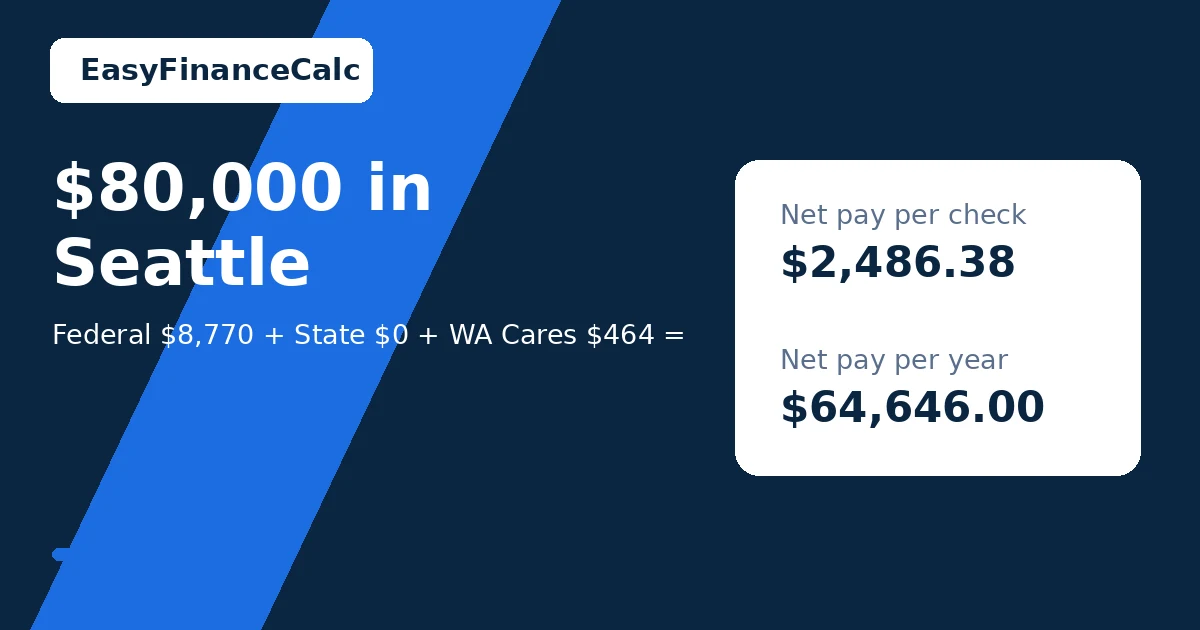
Numbers make this real. David earns $80,000 a year in Seattle, files as single, and gets paid every 2 weeks, which means 26 paychecks a year. Treat this Washington Paycheck Calculator example like a washington salary calculator in action: salary in, take home pay out. His federal taxable income is $63,900, which is $80,000 minus the $16,100 standard deduction. His federal tax is $8,770 for the year: 10 percent of $12,400 equals $1,240, plus 12 percent of $38,000 equals $4,560, plus 22 percent of $13,500 equals $2,970. His WA Cares premium is 0.58 percent of $80,000, which equals $464.
| Deduction | Per Paycheck | Per Year |
|---|---|---|
| Gross pay | $3,076.92 | $80,000.00 |
| Federal income tax | $337.31 | $8,770.00 |
| Washington state income tax | $0.00 | $0.00 |
| WA Cares Fund (0.58 percent) | $17.85 | $464.00 |
| Social Security (6.2 percent) | $190.77 | $4,960.00 |
| Medicare (1.45 percent) | $44.62 | $1,160.00 |
| Net pay | $2,486.38 | $64,646.00 |
David keeps $2,486.38 from every $3,076.92 paycheck. His take home pay is about 81 percent of his gross pay, and not one cent went to Washington state income tax. A washington take home pay calculator that leaves out the WA Cares line would show $464 too much, so always use one built for Washington rules.
Washington Paycheck Tips
Check your W-4 once a year. Your federal W-4 controls how much federal tax comes out. An old form can withhold too much or too little, and Washington has no state form, so the federal form does all the work.
Look for the WA Cares line before you panic. New Washington workers often spot a small unfamiliar deduction and assume payroll made an error. It is the 0.58 percent WA Cares premium, and it belongs there. If you hold qualifying private long term care insurance, check the exemption rules on the WA Cares Fund site.
Price equity offers in after tax dollars. A Seattle offer heavy on RSUs looks different once federal tax takes its share at vesting. Model the full number in the washington take home pay calculator above, then compare it against the same offer in a taxed state to see what zero state income tax is really worth.
Moving to Washington for the tax advantage? Run your current salary through this page first. The saving is real and shows up in every check, but price in the sales tax trade off before deciding the move pays off.
5 Common Mistakes Washington Workers Make
- Expecting a state tax refund. There is no Washington income tax, so there is no state return and no state refund. Your only filing is federal, plus a separate capital gains return only if you owe that tax.
- Thinking the capital gains tax hits their paycheck. The 7 percent tax applies to investment gains above the annual threshold, never to wages. No employer withholds it.
- Confusing the WA Cares premium with state income tax. WA Cares is long term care insurance at 0.58 percent of wages, not an income tax. It is a much smaller line with a specific purpose.
- Ignoring the Social Security cap. Once wages pass $184,500 in 2026, Social Security tax stops for the rest of the year and checks get bigger. Many high earners think payroll made an error.
- Judging a job offer on gross pay alone. Two offers with the same salary can net very different amounts once equity, benefits, and pay frequency change. Compare net pay, not gross pay, and remember a washington salary calculator already bakes in the zero state tax advantage.
Frequently Asked Questions
Why does Washington have no income tax?
The state constitution requires all taxes to be uniform on the same class of property, and courts have treated income as property since a 1933 state supreme court ruling. That blocks a graduated personal income tax. Washington employers therefore withhold $0 for state income tax on every paycheck, whatever you earn.
What is the WA Cares Fund line on my pay stub?
It is Washington’s state long term care insurance program. Employees pay 0.58 percent of all wages with no cap, and the money funds a lifetime long term care benefit that started paying out in July 2026. On $80,000 a year it costs $464. It is not an income tax, and it is separate from Social Security and Medicare.
Can I opt out of the WA Cares premium?
You can apply for an exemption if you hold approved private long term care insurance. The exemption rules and application live on the WA Cares Fund website. Without an approved exemption, Washington employers must collect the premium from every covered worker’s wages.
Does the 7 percent capital gains tax come out of my paycheck?
No. The capital gains tax applies to long term investment gains above the annual deduction, which was $278,000 for 2025 and adjusts for inflation. Wages, salaries, bonuses, and overtime are never subject to it, and no employer withholds it. It is filed on a separate annual return.
Could Seattle bring back its city income tax?
Seattle’s 2017 attempt at a 2.25 percent income tax on high earners was struck down by the courts, and the state constitution’s uniformity rule stands in the way of any graduated local income tax. No Washington city or county currently charges a local income tax, and your city never changes your paycheck math.
I get RSUs from a Seattle tech employer. Does Washington tax them?
Washington takes $0. RSUs are taxed as ordinary income by the federal government when they vest, and your employer withholds federal tax, Social Security, and Medicare on them. Washington charges no state income tax on that income. The 7 percent capital gains tax only matters if you later sell shares at a gain above the annual threshold.
What is the B&O tax, and does it come out of my check?
The Business and Occupation tax is Washington’s gross receipts tax on businesses, and it replaces the corporate income tax the state does not have. It is paid by the business out of its own revenue. It never appears on an employee pay stub and never reduces your take home pay.
How much tax is taken out of my paycheck in Washington?
Only federal taxes plus the WA Cares premium are required. On an $80,000 salary, a single filer loses $8,770 to federal income tax, $4,960 to Social Security, $1,160 to Medicare, and $464 to WA Cares per year. That leaves $64,646 in take home pay. Washington state income tax adds nothing.
Does Washington tax overtime pay?
Washington adds no tax of its own to overtime. Overtime wages face the same federal income tax, Social Security, Medicare, and WA Cares premium as regular wages. Overtime can push part of your income into a higher federal bracket for that check, so overtime checks can look lighter than expected.
I moved from Oregon to Washington. What changes on my pay stub?
The Oregon state income tax line disappears completely, which is the big win, since Oregon taxes wages at up to 9.9 percent. A new small line appears instead: the 0.58 percent WA Cares premium. Federal taxes stay the same. Most movers see a clear net gain on every check.
Do I need to file a Washington state tax return?
No. Washington has no personal income tax, so there is no state income tax return to file. The only state tax return an individual might file is the separate capital gains tax return, and only if you actually owe that tax.
Are bonuses taxed differently in Washington?
Washington takes $0 from a bonus, just like regular pay. Federally, many employers withhold a flat 22 percent, and Social Security, Medicare, and the WA Cares premium still apply to bonus wages. Any extra federal tax withheld comes back on your federal return.
Why is there no state income tax in my Washington paycheck?
Washington does not tax wages, so there is no state income tax withholding and no state return for pay. Two smaller deductions still appear: the WA Cares Fund takes 0.58% of wages, and Paid Family and Medical Leave takes an employee share of about 0.81% for 2026, capped at the Social Security wage base.
How do I use a paycheck calculator for Washington state?
Enter your salary or hourly pay, choose your pay frequency and filing status, and read the net pay result. Washington charges no state income tax, so the main deductions are federal income tax and FICA, plus the WA Cares premium at 0.58 percent of wages. In the worked example on the page, David earns $80,000 a year in Seattle, files as single and is paid every 2 weeks, and keeps $2,486.38 from each $3,076.92 paycheck, or $64,646 a year.
Related Calculators
- Paycheck Calculator
- Texas Paycheck Calculator
- Florida Paycheck Calculator
- California Paycheck Calculator
- Salary to Hourly Calculator
One last thought for Washington workers: this Washington Paycheck Calculator reflects 2026 rules, including the WA Cares premium most national tools leave out. Revisit it whenever your pay changes, and use the net figure, not the salary headline, when you compare offers.
Disclaimer
This page provides estimates for education only. Your actual withholding depends on your W-4, benefits, and employer payroll setup. This is not tax advice. For your own tax decisions, talk to a qualified tax professional.
Sources
IRS Publication 15-T (2026), Social Security Administration, Washington Department of Revenue capital gains tax, WA Cares Fund, Washington DOR sales tax FAQ, WA Attorney General on the constitutionality of an income tax.