
California Paycheck Calculator: Find Your Exact Take Home Pay
This California paycheck calculator shows what actually lands in your bank account when you work in the Golden State. California taxes your wages three ways on every check: federal income tax, nine progressive state income tax brackets, and State Disability Insurance at 1.3 percent of every dollar you earn. Ever wonder why two workers with the same salary in Texas and California take home such different amounts? The state tax line plus the SDI line on a California pay stub is the reason.
Quick Answer
Here is the short version. California has nine income tax brackets from 1 percent to 12.3 percent, a separate 1.3 percent SDI deduction with no wage cap, and a small standard deduction of $5,900 for single filers in 2026. On an $85,000 salary, a single filer in Los Angeles takes home about $63,849 a year, roughly 75 percent of gross pay. A good california take home pay calculator must show the SDI line separately from the state tax line. If a tool leaves SDI out, its net pay figure is too high.
California Paycheck Calculator
Enter your pay and see exactly what lands in your bank account for 2026.
| Per paycheck | Per year | |
|---|---|---|
| Gross pay | ||
| Federal income tax | ||
| California state income tax | ||
| State Disability Insurance (1.3%) | ||
| Social Security (6.2%) | ||
| Medicare (1.45%) | ||
| Take home pay |
California state income tax uses the 2026 FTB indexed brackets after the $5,900 standard deduction ($11,800 joint). State Disability Insurance (SDI) is 1.3% of all wages with no cap, shown as its own line. Estimates use 2026 IRS brackets and the 2026 Social Security wage base of $184,500. Your real withholding follows IRS Publication 15-T tables and your W-4, so your actual check can differ by a few dollars.
The California paycheck calculator above takes your gross pay, pay frequency, and filing status, then subtracts federal income tax, California state income tax through the real 2026 brackets, SDI, Social Security, and Medicare to give your net pay per check and per year. Add a 401k contribution or health premium to see how voluntary deductions change the result. It works as a paycheck calculator california workers can rely on because the bracket math and the SDI rate come straight from the FTB and EDD 2026 figures, just like real California payroll.
How to Use This Calculator
- Enter your gross salary or hourly wage.
- Pick how often you get paid, such as every 2 weeks.
- Choose your filing status: single, married filing jointly, or head of household.
- Add any 401k contribution or health premium you pay each period.
- Read your net pay per paycheck and per year, with each deduction listed, including the separate SDI line.
California Tax Rules That Shape Your Paycheck
Nine brackets, and only the slice in each band is taxed
California taxes income progressively. For 2026, the single filer brackets run 1 percent up to $11,456, 2 percent up to $27,157, 4 percent up to $42,861, 6 percent up to $59,498, 8 percent up to $75,197, 9.3 percent up to $384,109, 10.3 percent up to $460,927, 11.3 percent up to $768,213, and 12.3 percent above that. These are the FTB indexed figures for tax year 2026. Each rate touches only the income inside its own band, so most California workers pay a mix of rates well below their top bracket. Married filing jointly brackets are roughly double the single thresholds.
The 1.3 percent SDI line most calculators hide
State Disability Insurance is the deduction California workers notice but rarely understand. In 2026, your employer withholds 1.3 percent of ALL your wages for SDI, and there is no wage cap, so high earners keep paying on every dollar all year. The money funds Disability Insurance and Paid Family Leave through the EDD. SDI is employee paid only: your employer withholds and remits it but contributes nothing. The rate climbed from 1.2 percent in 2025, and the wage cap was eliminated in 2024, so your SDI line today is bigger than it used to be.
A small standard deduction, so taxable income runs high
California starts from your federal adjusted gross income, then subtracts a standard deduction that is far smaller than the federal one: $5,900 for single filers and $11,800 for married couples filing jointly in 2026. Because the deduction is small, more of your pay is exposed to the brackets than a worker from Texas or Florida might expect. You also get a personal exemption credit of $158 per person, which comes off the tax itself rather than the income.
How much tax is taken out of my paycheck in California?
Three layers come out by law. Federal income tax uses the 2026 standard deduction of $16,100 for single filers before the brackets apply. California income tax runs through the nine brackets above after the $5,900 deduction. Then SDI takes 1.3 percent of all wages with no cap, Social Security takes 6.2 percent of wages up to $184,500, and Medicare takes 1.45 percent of all wages with no cap. Voluntary items like 401k contributions and health premiums come out only because you signed up for them.
California withholding uses its own form
Your federal W-4 does not set your California withholding. California employers use EDD Form DE 4, the Employee’s Withholding Allowance Certificate, to figure the state line. New arrivals who fill out only the federal form often find their California withholding looks off, and the fix is a quick DE 4 update with payroll.
Worked Example: $85,000 Salary in Los Angeles
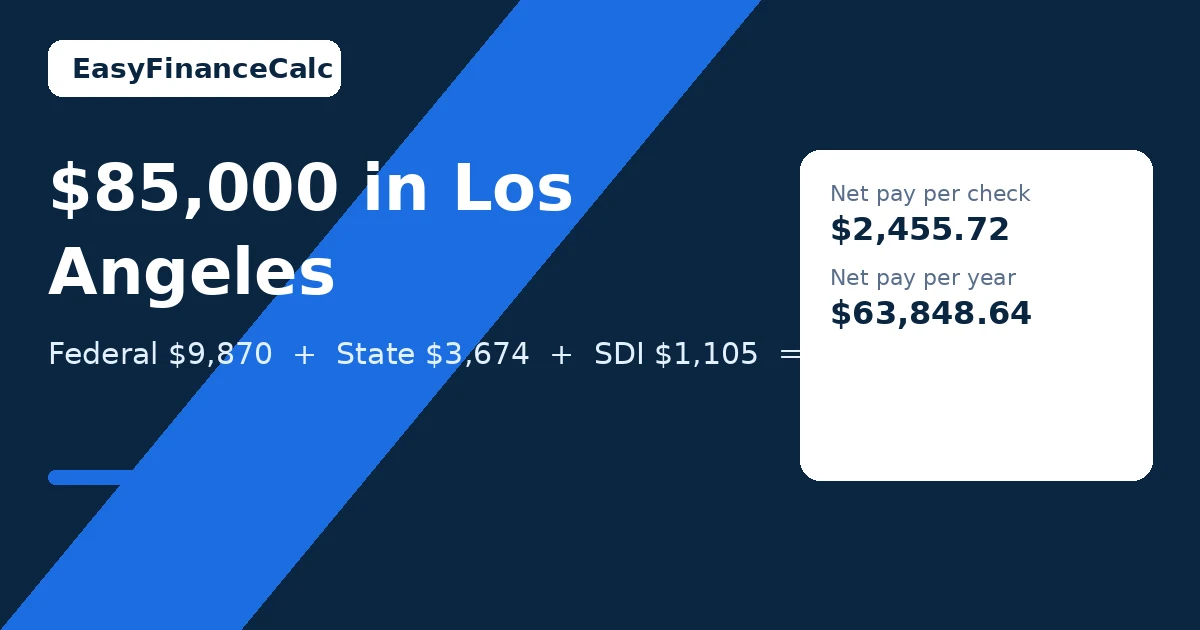
Numbers make this real. Daniel earns $85,000 a year in Los Angeles, files as single, and gets paid every 2 weeks, which means 26 paychecks a year. Treat this california paycheck calculator example like a california salary calculator in action: salary in, take home pay out. His federal taxable income is $68,900, which is $85,000 minus the $16,100 standard deduction. His federal tax is $9,870 for the year: 10 percent of $12,400 equals $1,240, plus 12 percent of $38,000 equals $4,560, plus 22 percent of $18,500 equals $4,070.
His California taxable income is $79,100, which is $85,000 minus the $5,900 state standard deduction. His California tax is $3,673.86 for the year: 1 percent of $11,456 equals $114.56, plus 2 percent of $15,701 equals $314.02, plus 4 percent of $15,704 equals $628.16, plus 6 percent of $16,637 equals $998.22, plus 8 percent of $15,699 equals $1,255.92, plus 9.3 percent of $3,903 equals $362.98. His SDI is $1,105.00 for the year, which is 1.3 percent of the full $85,000.
| Deduction | Per Paycheck | Per Year |
|---|---|---|
| Gross pay | $3,269.23 | $85,000.00 |
| Federal income tax | $379.62 | $9,870.00 |
| California state income tax | $141.30 | $3,673.86 |
| State Disability Insurance (1.3 percent) | $42.50 | $1,105.00 |
| Social Security (6.2 percent) | $202.69 | $5,270.00 |
| Medicare (1.45 percent) | $47.40 | $1,232.50 |
| Net pay | $2,455.72 | $63,848.64 |
Daniel keeps $2,455.72 from every $3,269.23 paycheck. His take home pay is about 75 percent of his gross pay, and the California lines alone, state tax plus SDI, take $4,778.86 a year.
California Paycheck Tips
File a DE 4 when your pay changes. The federal W-4 does nothing for California. After a raise, a new job, or a move across state lines, update your DE 4 with payroll so the state line tracks your real income.
Remember SDI has no cap. Social Security stops at $184,500 in 2026, but SDI keeps going on every dollar you earn. High earners should budget for the SDI line staying flat all year instead of shrinking in December.
Compare offers on net pay, not salary. A $95,000 offer in Sacramento and a $95,000 offer in Austin net very different amounts once California tax plus SDI come out. Run both through this california take home pay calculator before you sign.
5 Common Mistakes California Workers Make
- Ignoring the SDI line. Some workers spot California income tax and forget SDI exists. On $85,000 it is $1,105 a year, and it never stops because there is no cap.
- Assuming the W-4 covers California. The federal W-4 only drives federal withholding. Without a DE 4, your state line is a guess made by payroll software.
- Expecting a Social Security style cap on SDI. The cap was removed in 2024. Every dollar of wages is subject to the 1.3 percent rate in 2026.
- Forgetting that capital gains get no special rate. California taxes investment gains as ordinary income. A stock sale lands in the same brackets as your salary.
- Judging a move to California on gross pay alone. The same salary buys a smaller check here than in a no tax state. Run the full California calculation before you relocate.
Frequently Asked Questions
How is the California state income tax calculated on my paycheck?
Your employer estimates it from your gross pay, your pay frequency, and the allowances on your DE 4 using the EDD withholding schedules. The real liability is figured on your return: nine brackets from 1 percent to 12.3 percent applied to California taxable income after the standard deduction. Your actual tax can differ from withholding by a few hundred dollars either way.
What is the SDI deduction on my California pay stub?
State Disability Insurance. In 2026 your employer withholds 1.3 percent of all your wages for SDI with no wage cap. It funds the EDD programs that pay partial wage replacement if you cannot work because of a non work related illness, injury, or pregnancy, and Paid Family Leave for bonding with a new child. It is entirely employee paid.
Does California have a separate disability tax besides SDI?
No. SDI is the only state disability payroll deduction. Disability Insurance and Paid Family Leave both come out of the same 1.3 percent. Workers compensation is separate and is paid by your employer, never by you.
What is the California standard deduction for 2026?
For 2026 it is $5,900 for single filers and married couples filing separately, and $11,800 for married couples filing jointly and head of household. These are the FTB indexed amounts after 3.4 percent inflation from June 2025 to June 2026. They are far below the federal $16,100 single deduction, which is one reason California taxable income runs higher than people expect.
Do I owe the extra 1 percent Behavioral Health Services Tax?
Only if your California taxable income passes $1,000,000. Above that line, the extra 1 percent applies to the amount over $1,000,000, making the top marginal rate 13.3 percent. Almost no paycheck earner reaches it, but it is the reason California’s top rate is the highest of any state.
How do California tax brackets compare for married couples?
Married filing jointly brackets are roughly double the single thresholds at every rate. For 2026, the 9.3 percent bracket tops out at $768,213 for single filers, so the joint top is about twice that. Married filing separately uses the same brackets as single filers in California.
Does California tax my capital gains differently from wages?
No. California has no separate capital gains rate, so gains are taxed as ordinary income through the same nine brackets. A large stock sale in one year can push part of your income into the 9.3 percent bracket or higher, which is worth knowing before you sell.
Can I get the California renter’s credit?
If you rent in California and your income stays under the limit, you may qualify for the nonrefundable renter’s credit when you file. It reduces your tax but cannot create a refund. Check the current FTB income limits before you count on it.
Does California tax Social Security benefits?
No. California does not tax Social Security benefits, and it also excludes unemployment compensation from state tax. Federal rules may still tax part of your Social Security, so the two returns can look different.
What if I work remotely for a California company from another state?
California taxes residents on all income wherever it is earned, and it taxes nonresidents on wages for work physically done in California. If you live elsewhere and never set foot in California, California wages rules do not reach you. If you split time, the days you work in California count.
Can I use this if I am paid hourly instead of salary?
Yes. Enter your hourly wage and hours, and the california salary calculator logic works the same way: gross pay first, then federal tax, California tax, SDI, Social Security, and Medicare. Hourly workers pay SDI on overtime and bonuses too, since SDI covers all wages.
What should I do if my California paycheck looks wrong?
Start with the pay stub. Check gross pay, federal withholding, the California income tax line, the separate SDI line, and the two FICA lines, then compare them against a paycheck calculator california workers use for a second opinion. If the SDI line is missing or the state line looks like a guess, ask payroll whether your DE 4 is on file.
Related Calculators
- Paycheck Calculator
- Texas Paycheck Calculator
- Florida Paycheck Calculator
- Illinois Paycheck Calculator
- Salary to Hourly Calculator
Disclaimer
This page provides estimates for education only. Your actual withholding depends on your DE 4, benefits, and employer payroll setup. This is not tax advice. For your own tax decisions, talk to a qualified tax professional.
Sources
IRS Publication 15-T (2026), California Franchise Tax Board 2026 indexed tax rate schedules (3.4 percent inflation per September 2026 indexing memorandum), FTB 2026 Instructions for Form 540-ES (Behavioral Health Services Tax), California Employment Development Department 2026 State Disability Insurance contribution rate (1.3 percent), Social Security Administration.