
Illinois Paycheck Calculator: Find Your Exact Take Home Pay
This Illinois paycheck calculator shows what actually lands in your bank account when you work in the Land of Lincoln. Illinois taxes every paycheck with one flat rate: 4.95 percent on your Illinois income above the state exemption, no brackets and no climbing marginal rates. Ever wonder why a Chicago paycheck feels steadier than one from a state with nine brackets? The flat rate means your state tax is always a fixed share of your pay.
Quick Answer
Here is the short version. Illinois charges a flat 4.95 percent income tax in 2026, with an exemption of $2,925 that phases out at high incomes. On a $70,000 salary, a single filer in Chicago takes home about $54,755 a year, roughly 78 percent of gross pay. A good illinois take home pay calculator must apply the flat rate to income above the exemption, not to the full gross. If a tool taxes your whole salary without the exemption, it overstates your state tax.
Illinois Paycheck Calculator
Enter your pay and see exactly what lands in your bank account for 2026.
| Per paycheck | Per year | |
|---|---|---|
| Gross pay | ||
| Federal income tax | ||
| Illinois state income tax | ||
| Social Security (6.2%) | ||
| Medicare (1.45%) | ||
| Take home pay |
Illinois state income tax is a flat 4.95% on income above the $2,925 personal exemption (2026). There is no state standard deduction and no local income tax in Chicago or most Illinois cities. Estimates use 2026 IRS brackets and the 2026 Social Security wage base of $184,500. Your real withholding follows IRS Publication 15-T tables and your W-4, so your actual check can differ by a few dollars.
The Illinois paycheck calculator above takes your gross pay, pay frequency, and filing status, then subtracts federal income tax, Illinois state income tax at the flat rate, Social Security, and Medicare to give your net pay per check and per year. Add a 401k contribution or health premium to see how voluntary deductions change the result. It works as a paycheck calculator illinois workers can rely on because the flat rate and the 2026 exemption come straight from the Illinois Department of Revenue, just like real Illinois payroll.
How to Use This Calculator
- Enter your gross salary or hourly wage.
- Pick how often you get paid, such as every 2 weeks.
- Choose your filing status: single, married filing jointly, or head of household.
- Add any 401k contribution or health premium you pay each period.
- Read your net pay per paycheck and per year, with each deduction listed.
Illinois Tax Rules That Shape Your Paycheck
One flat rate for everyone
Illinois is one of the few flat tax states. In 2026, every dollar of Illinois taxable income is taxed at 4.95 percent, whether you earn $30,000 or $300,000. There are no brackets to climb and no surprise marginal rates. The rate has been unchanged since July 1, 2017, and voters rejected a 2020 amendment that would have replaced the flat tax with graduated rates, so the flat structure is protected by the state constitution.
The $2,925 exemption you should never skip
Before the flat rate touches your income, Illinois lets you subtract a personal exemption: $2,925 for 2026, up from $2,850 in 2025 because of inflation. You get one for yourself, one for your spouse if you file jointly, and one for each dependent child. Workers who are 65 or older or legally blind get an extra $1,000 each. The exemption phases out if your income passes $250,000 single or $500,000 joint. On a $70,000 salary, the exemption shields $2,925 from the 4.95 percent rate, saving you about $145 a year.
No standard deduction and no local income tax
Unlike the federal system, Illinois has no standard deduction. Instead it starts from your federal adjusted gross income, applies Illinois additions and subtractions, then subtracts the exemption. The good news for most workers: almost no Illinois city charges its own income tax. Chicago, Rockford, and the suburbs all take $0 in local income tax, so where you live inside Illinois does not change your paycheck math the way it does in Ohio or Pennsylvania.
How much tax is taken out of my paycheck in Illinois?
Three layers come out by law. Federal income tax uses the 2026 standard deduction of $16,100 for single filers before the brackets apply. Illinois income tax is 4.95 percent of your Illinois base income above the exemption. Then Social Security takes 6.2 percent of wages up to $184,500, and Medicare takes 1.45 percent of all wages with no cap. Voluntary items like 401k contributions and health premiums come out only because you signed up for them.
Illinois withholding uses the IL-W-4
Your federal W-4 does not set your Illinois withholding. Illinois employers use Form IL-W-4, and the 2026 withholding tables multiply your wages above the exemption by 4.95 percent per pay period. New arrivals who fill out only the federal form often find their Illinois line looks off, and the fix is a quick IL-W-4 update with payroll.
Worked Example: $70,000 Salary in Chicago
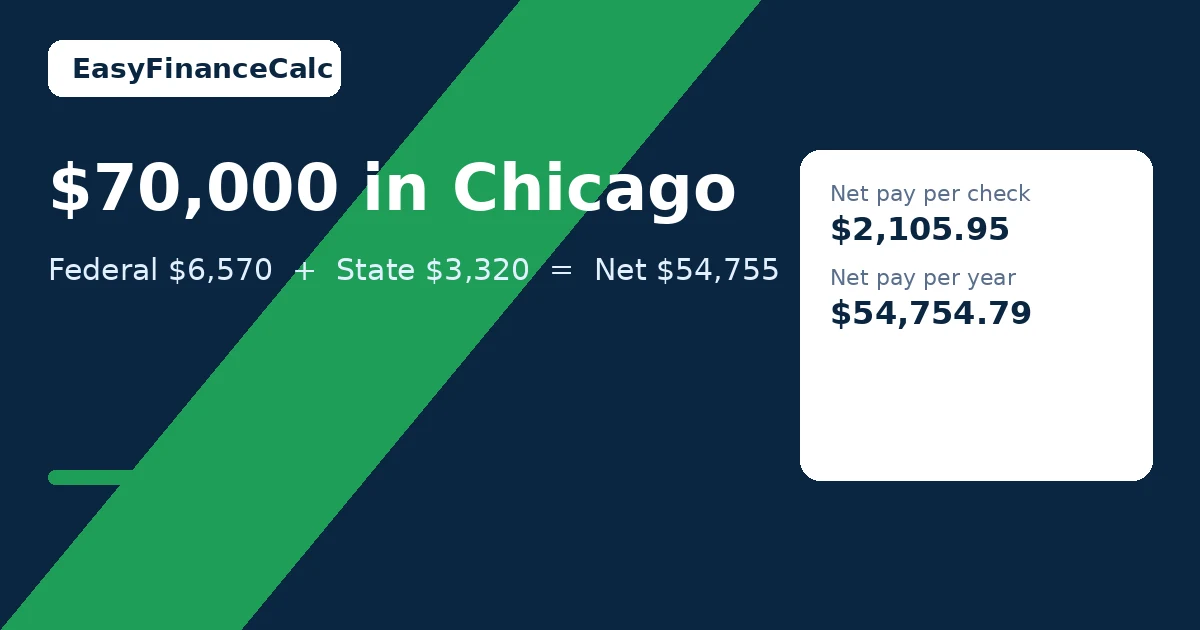
Numbers make this real. James earns $70,000 a year in Chicago, files as single, and gets paid every 2 weeks, which means 26 paychecks a year. Treat this illinois paycheck calculator example like an illinois salary calculator in action: salary in, take home pay out. His federal taxable income is $53,900, which is $70,000 minus the $16,100 standard deduction. His federal tax is $6,570 for the year: 10 percent of $12,400 equals $1,240, plus 12 percent of $38,000 equals $4,560, plus 22 percent of $3,500 equals $770.
His Illinois taxable income is $67,075, which is $70,000 minus the $2,925 exemption. His Illinois tax is $3,320.21 for the year, which is 4.95 percent of $67,075. There are no brackets to work through: one rate, one multiplication, done.
| Deduction | Per Paycheck | Per Year |
|---|---|---|
| Gross pay | $2,692.31 | $70,000.00 |
| Federal income tax | $252.69 | $6,570.00 |
| Illinois state income tax | $127.70 | $3,320.21 |
| Social Security (6.2 percent) | $166.92 | $4,340.00 |
| Medicare (1.45 percent) | $39.04 | $1,015.00 |
| Net pay | $2,105.95 | $54,754.79 |
James keeps $2,105.95 from every $2,692.31 paycheck. His take home pay is about 78 percent of his gross pay, and his Illinois line is a steady 4.95 percent of the income above the exemption, paycheck after paycheck.
Illinois Paycheck Tips
Claim your exemption on the IL-W-4. The $2,925 exemption only helps your withholding if payroll knows about it. Make sure your IL-W-4 reflects you, your spouse, and every dependent, or you will overpay Illinois a little all year.
Retirees get the best deal in the Midwest. Illinois exempts pension income, Social Security, and IRA and 401k distributions from state tax. If you are planning retirement income in Illinois, the state tax line on those dollars is $0.
Crossing state lines for work changes everything. Illinois has reciprocity with Iowa, Kentucky, Michigan, and Wisconsin, so you pay tax only to your home state. Work in Indiana or Missouri instead, and you may owe tax to both states before credits sort it out.
5 Common Mistakes Illinois Workers Make
- Letting payroll use only the federal W-4. Without an IL-W-4 on file, your Illinois withholding is a payroll software guess. File the state form and check the result.
- Forgetting the exemption. Some workers never claim their $2,925 exemption on the withholding forms, then wait a year to get it back at filing time. Claim it now and keep the cash in your checks.
- Assuming a flat tax means no tax planning. Retirement income is exempt and the exemption phases out above $250,000, so where your income comes from still matters in Illinois.
- Copying advice from graduated rate states. Tips about jumping brackets or bunching income to avoid a higher bracket do not apply in Illinois. The rate is 4.95 percent on every dollar above the exemption.
- Ignoring the property tax trade off. Illinois keeps its income tax flat and low, but property taxes in the Chicago area are among the highest in the country. Your total tax picture includes both.
Frequently Asked Questions
How is the Illinois state income tax calculated on my paycheck?
Your employer estimates it per pay period: your wages for the period minus the per period exemption amount, times 4.95 percent. The 2026 annual exemption is $2,925, so biweekly that is $112.50 per check. The real liability is figured on your return, and any difference shows up as a refund or a small balance due.
What is the Illinois income tax rate for 2026?
A flat 4.95 percent on all Illinois taxable income, with no brackets. The rate has been the same since July 1, 2017. Illinois voters rejected a 2020 proposal to switch to graduated rates, and the flat rate is protected by the state constitution, which makes it one of the most predictable state taxes in the country.
What is the Illinois personal exemption for 2026?
$2,925 per person, up from $2,850 in 2025 because of inflation. You get one for yourself, one for a spouse on a joint return, and one per dependent child, plus an extra $1,000 if you are 65 or older or legally blind. The exemption phases out if your income passes $250,000 single or $500,000 joint.
Does Illinois have a standard deduction?
No. Illinois does not follow the federal standard deduction. It starts from your federal adjusted gross income, makes Illinois specific additions and subtractions, then subtracts the personal exemption. The exemption is the only broad subtraction most wage earners get.
Do Illinois cities charge their own income tax?
Almost none do. Chicago, Rockford, and the suburbs charge $0 in local income tax, which keeps Illinois paychecks simpler than those in Ohio or Pennsylvania, where city taxes of 1 to 3 percent are routine. Your Illinois city changes your sales tax and property tax, not your income tax.
What if I live in Wisconsin but work in Illinois?
Illinois has reciprocity agreements with Iowa, Kentucky, Michigan, and Wisconsin. If you live in one of those states and your only Illinois income is wages, you pay income tax only to your home state. Tell your Illinois employer to stop withholding Illinois tax and withhold for your home state instead.
Does Illinois tax my retirement income?
No. Illinois fully exempts pension income, Social Security benefits, and IRA and 401k distributions from state income tax. That exemption is one of the most generous in the country and makes Illinois a friendly state for retirees, even with its high property taxes.
Why did Illinois stay a flat tax state?
In November 2020, voters rejected a constitutional amendment that would have replaced the flat 4.95 percent rate with graduated brackets. About 53 percent voted no. Changing the rate now requires changing it equally for everyone, so the flat structure is locked in unless voters decide otherwise again.
Does Illinois tax Social Security benefits?
No. Illinois exempts Social Security benefits from state income tax entirely. Federal rules may still tax up to 85 percent of your benefits, so your federal and Illinois returns can look very different.
Can I use this if I am paid hourly instead of salary?
Yes. Enter your hourly wage and hours, and the illinois salary calculator logic works the same way: gross pay first, then federal tax, Illinois tax at the flat rate above the exemption, Social Security, and Medicare. The flat rate makes hourly math especially simple: 4.95 percent of everything above $2,925 a year.
What should I do if my Illinois paycheck looks wrong?
Start with the pay stub. Check gross pay, federal withholding, the Illinois tax line, and the two FICA lines, then compare them against a paycheck calculator illinois workers use for a second opinion. If the Illinois line is exactly 4.95 percent of your full gross with no exemption subtracted, payroll may be missing your IL-W-4.
Related Calculators
- Paycheck Calculator
- California Paycheck Calculator
- Texas Paycheck Calculator
- Florida Paycheck Calculator
- Salary to Hourly Calculator
Disclaimer
This page provides estimates for education only. Your actual withholding depends on your IL-W-4, benefits, and employer payroll setup. This is not tax advice. For your own tax decisions, talk to a qualified tax professional.
Sources
IRS Publication 15-T (2026), Illinois Department of Revenue 2026 IL-700-T withholding tables (4.95 percent rate, $2,925 exemption), Illinois Comptroller Payroll Bulletin on 2026 state income tax exemptions, Social Security Administration.