
Percentage Difference Calculator: Compare Any Two Values in Seconds
This free percentage difference calculator compares any two numbers and tells you how far apart they are as a percent. Enter the two values and it divides their gap by their average, so neither value gets treated as the starting point. Shoppers use it to compare prices. Students and lab workers use it to compare measurements. It takes about five seconds, needs no signup, and runs in your browser.
Percentage Difference Calculator
Enter two values below. The results update as you type.
|80 − 100| ÷ 90 × 100 = 22.22%
Quick answer: A percentage difference states how far apart two values are against their average. Neither value is the base, so the answer stays the same when you swap the order. A percentage difference calculator is the right tool when the two values stand side by side as equals, like two prices or two lab readings. If one value came first and you track movement over time, you want percentage change instead. A percent difference calculator and a change calculator can give different answers for the same pair, and both can be right.
How to Use This Percentage Difference Calculator
Learning how to calculate percentage difference takes less than a minute. Why let a formula slow you down at the store or in the lab?
- Enter the first value. Type it exactly as you see it, a price, a score, or a measurement.
- Enter the second value. Order does not matter. That is the whole point of this measure.
- Read the headline result. The big number is the percentage difference between the pair.
- Check the supporting numbers. The tool also shows the absolute difference and the average it used, so you can follow the math. A percent difference calculator that hides its average hides half the story.
- Swap the values to test it. Enter them in reverse order and watch the result stay put. If the answer moves, you are looking at percentage change, not difference.
The Formula and Why It Uses the Average
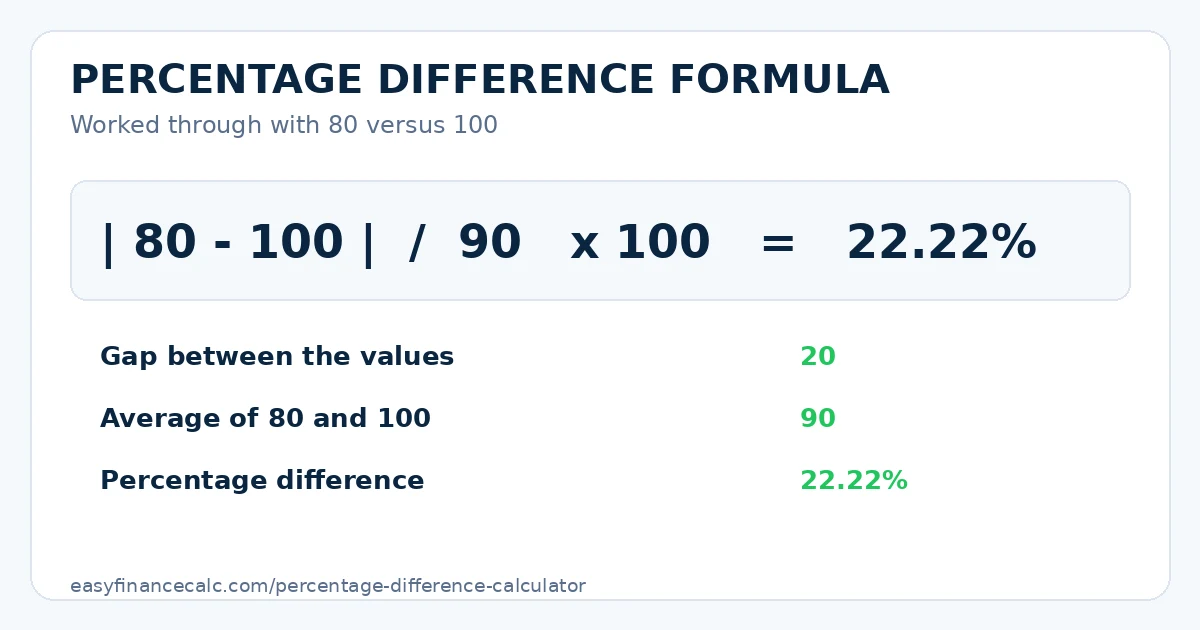
The percentage difference formula has three moves. Percentage difference = (|V1 − V2| ÷ ((V1 + V2) ÷ 2)) × 100. First, find the gap between the values and drop any minus sign. That gap is the absolute difference. Second, add the two values and cut the sum in half. That gives you the average. Third, divide the gap by the average and multiply by 100.
Why does the denominator use the average? Because neither value deserves to be the base. Think about two stores selling the same headphones. Store A is not the truth and Store B is not the error. They are two equal readings, so the fair base sits right between them. Dividing by the average also makes the formula symmetric. Run 80 against 100 or 100 against 80 and the answer never changes. That symmetry is what sets this measure apart, and it is why scientists reach for the percentage difference formula when two methods measure the same thing. Once you see why the base is the average, how to calculate percentage difference stops being a memory test and becomes plain logic.
Worked Examples
Three pairs, three lessons. Each one below follows the percentage difference formula from start to finish. Example 1: 80 versus 100. The absolute difference is 20. The average of 80 and 100 is 90. Divide 20 by 90 and multiply by 100, and you get 22.22%. So the two values sit 22.22% apart.
Example 2: the same headphones at two stores. Store A charges $45 and Store B charges $60. The absolute difference is $15. The average price is $52.50. Divide 15 by 52.50 and multiply by 100, and the prices sit 28.57% apart. Is one store ripping you off? That call is yours, but the gap now has an honest size.
Example 3: can the answer pass 100%? Take 10 versus 100. The absolute difference is 90 and the average is 55. Divide 90 by 55 and multiply by 100, and you get 163.64%. Yes, it can sail past 100%. It tops out at 200%, reached when one value is zero and the other is anything at all. Want to test a pair of your own? Run it through the percentage difference calculator above and check your hand math.
Worked example: exam scores
Adam scored 87 on an exam and Ted scored 67 on the same exam. The difference is 20 points. Using the average of 77 as the base, the percentage difference is 20 divided by 77, which is 25.97 percent.
Percentage Difference vs Percentage Change
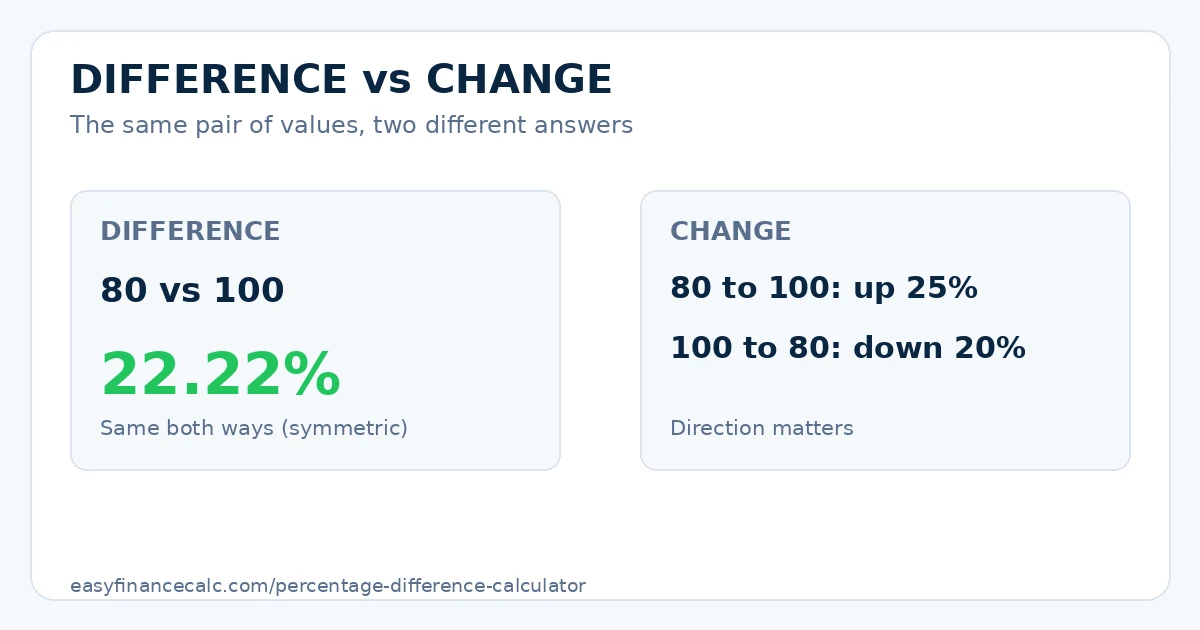
Here is the confusion that fills search results. Difference and change sound like twins, but they answer different questions and use different bases. Percentage change asks: how much did one value move from where it started? The base is the starting value. Because time gives the pair an order, change has a direction, and swapping the values changes the answer.
Percentage difference asks a flatter question: how far apart are these two values, period? The base is the average, with no starting point and no direction. Are the two numbers close cousins or strangers? Difference answers that. Watch the same pair do both jobs. Start at 80 and climb to 100, and the change is a 25% increase, since 20 divided by the starting 80 is 25%. Fall back to 80 and the change is a 20% decrease, since 20 divided by the starting 100 is 20%. The pair never changed, yet change gives two answers.
Difference gives one answer for the pair, 22.22%, either way. So which one belongs on your page, your report, or your receipt? If the values have a before and an after, use change. If they stand next to each other, use difference. Picking the wrong one is the most common error in this corner of math.
When to Use Difference and When to Use Change
Ask one question: did one of these values come first in time? If yes, change is your tool. If the pair is two readings of the same thing, difference is your tool. The table sorts the common cases.
| Situation | Use | Why |
|---|---|---|
| Two prices for the same headphones at two stores | Difference | Neither price came first, so neither is the base |
| Two lab measurements of the same water sample | Difference | Both readings stand as equals, neither is the known truth |
| Two salaries for the same role at two firms | Difference | You are comparing offers, not tracking growth |
| Your rent this year versus your rent last year | Change | Last year came first and is the natural base |
| A stock price at open versus its price at close | Change | The open is the start, and direction is the story |
Difference compares things that stand side by side. Change compares a thing with its own past.
5 Common Mistakes
Most wrong answers here come from the same five slips.
- Dividing by one value instead of the average. Divide the gap by 80 or by 100 and you have switched to percentage change without noticing. The average is the base here, every time.
- Giving the result a direction. A difference of 22.22% does not say which value is bigger. Writing that Store B costs 28.57% more, based on a difference result, mixes two measures. If you need the word more or less, you need change.
- Expecting the answer to stop at 100%. Plenty of people see 163.64% and assume an error. There is none. This scale runs to 200%.
- Mixing up percentage points and percent. A pass rate that moves from 10% to 12% climbs by 2 percentage points, yet the percentage difference between the rates is 18.18%, since the gap of 2 divided by the average of 11 gives 18.18%. Points and percent are different units.
- Skipping the absolute value. Subtract in the wrong order and the gap comes out negative, dragging the final percent with it. A percent difference calculator drops the sign at the first step, and your hand math should do the same.
Percent Difference vs Percent Change vs Percentage Points
These three sound alike and get mixed up constantly, but they answer different questions.
Percent difference compares two values, with no starting point
Percent difference divides the gap between two values by their average, so the order never matters. For 80 and 100: the gap is 20, the average is 90, and 20 divided by 90 is 22.22%. Use it when neither value is “the original,” for example when comparing two prices, two measurements, or two test scores.
Percent change has a direction
Percent change divides by the starting value, so direction changes the answer. Going from 80 to 100 is an increase of 25%. Going from 100 down to 80 is a decrease of 20%. Same two numbers, different answers, because the starting point changed.
Percentage points are not percent
If a rate moves from 10% to 12%, that is a rise of 2 percentage points. In relative terms it is a 20% increase, and the percent difference between the two rates is 18.18%. News stories often say “up 2%” when they mean 2 percentage points, which is where much of the confusion starts.
A common homework trap
“The difference in the price of 2 backpacks is $19.30. If one backpack costs $39.00, what could the other cost?” This question is not asking for a percent at all. The other backpack costs either $39.00 plus $19.30, which is $58.30, or $39.00 minus $19.30, which is $19.70. When a question gives you a dollar difference, answer in dollars.
Frequently Asked Questions
Quick answers to the most common questions about this percentage difference calculator.
Related Calculators
These tools cover the rest of the percent cluster.
- Percentage Calculator
- Percentage Decrease Calculator
- Paycheck Calculator
- Salary to Hourly Calculator
Results are estimates for learning and planning only. Percentage difference is a comparison measure, not a verdict on which value is right. For graded lab work or published research, follow the method your instructor or journal requires.
Sources: Khan Academy, percent change and difference · NIST, guidance on percent difference usage · Maths Is Fun, percentage difference