
Percentage Decrease Calculator: See Any Price Drop in Seconds
This percentage decrease calculator tells you how big a drop really is, in percent and in dollars. Type the original value and the new value, and it shows the percentage decrease, the amount lost, and the value that remains. Shoppers use it to check sale prices, workers use it after a pay cut, and owners use it when revenue dips. No signup, and everything runs in your browser.
Percentage Decrease Calculator
Enter your values below. The results update as you type.
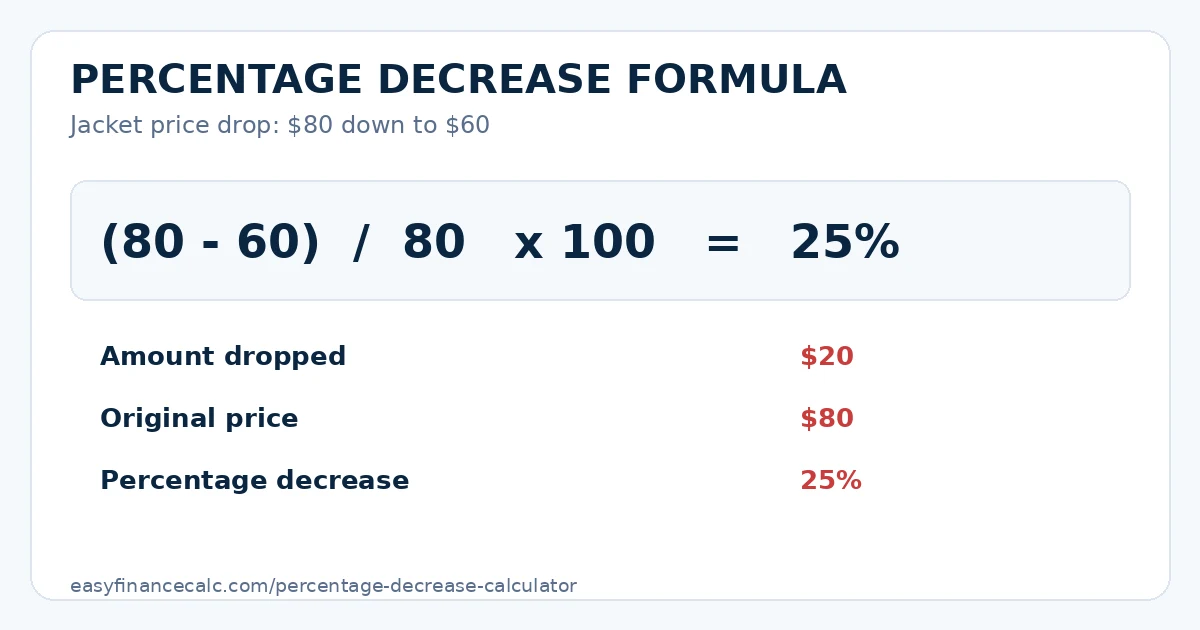
(80 − 60) ÷ 80 × 100 = 25%
Quick answer: A percentage decrease measures how much a value fell, relative to where it started. A fall from $80 to $60 is a 25 percent decrease, because the $20 drop is one quarter of the starting price. A percent decrease calculator matters because equal dollar drops are not equal in percent: $20 off a $40 item is half price, while $20 off a $400 item is only 5 percent. Same dollars, very different story.
How to Use This Percentage Decrease Calculator
Four quick steps, and you will know how to calculate percentage decrease for any number life throws at you.
- Enter the original value. The starting price, salary, weight, or revenue figure, before the drop happened.
- Enter the new value. What the number is now, after the drop.
- Read the percent. The tool shows the percentage decrease and the exact amount dropped, side by side.
- Try reverse mode. Know the percent but not the end value? Enter the original value and the percent, and the tool works out the new value for you. A $200 jacket at 15 percent off lands at $170, with no mental math needed.
The Percentage Decrease Formula
The formula itself fits on one line: Percentage decrease = ((Original − New) ÷ Original) × 100. Read it in plain words. First find the drop: original minus new. Then divide that drop by the original value. Then multiply by 100 to turn it into a percent. Why divide by the original and not the new value? Because a decrease is always measured against where you started. Divide by the new value and the math quietly inflates every drop. Students ask how to calculate percentage decrease on paper all the time, and this one choice is where most wrong answers begin.
The same percentage decrease formula powers both modes of the tool above. Mode A runs it forward from two values. Mode B runs it backward from a percent, using new value = original × (1 − percent ÷ 100). Two directions, one formula, zero guesswork. Check your own paper workings against the percentage decrease calculator above, and the method will soon feel automatic.
Worked Examples: Three Drops, Worked in Full
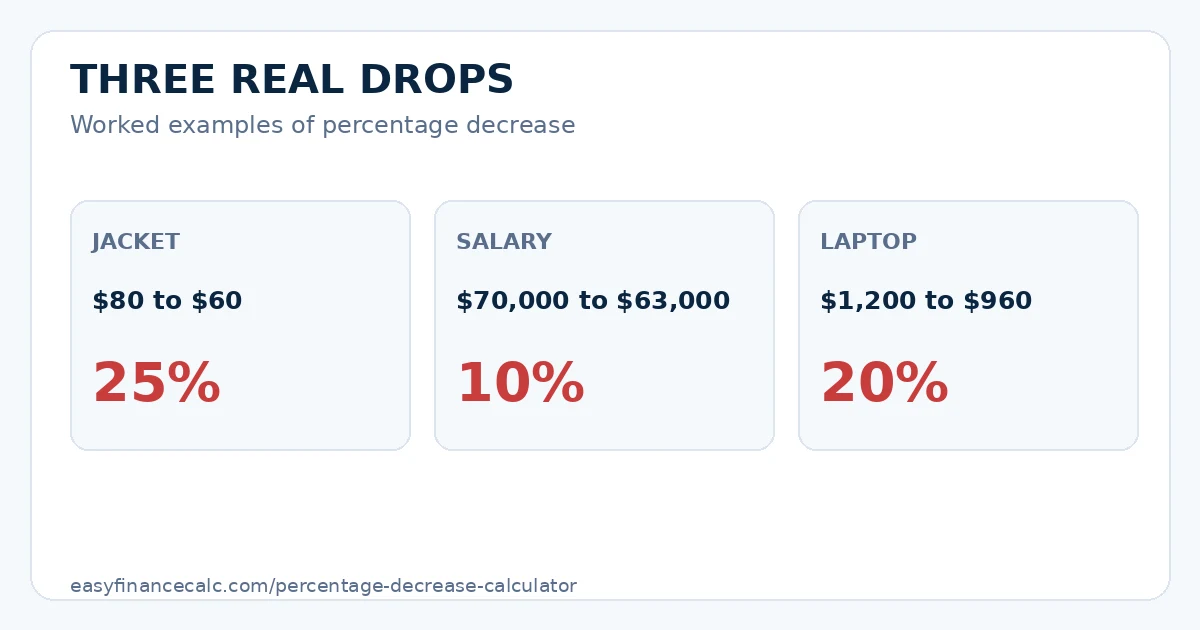
Three everyday drops, worked in full. Check each one with the percent decrease calculator logic: drop first, then divide by the start, then multiply by 100. Run the same numbers in the percentage decrease calculator above and you will land on the same answers.
Example 1: the jacket. A jacket falls from $80 to $60. The drop is $80 − $60 = $20. Divide by the start: $20 ÷ $80 = 0.25. Multiply by 100: a 25 percent decrease. A quarter of the price, gone.
Example 2: the salary. A salary falls from $70,000 to $63,000. The drop is $7,000. Divide by the start: $7,000 ÷ $70,000 = 0.10. The result is a 10 percent decrease. A smaller percent than the jacket, but far bigger dollars.
Example 3: the laptop. A laptop falls from $1,200 to $960. The drop is $240. Divide by the start: $240 ÷ $1,200 = 0.20. The result is a 20 percent decrease, exactly the kind of clean number stores love to print on a tag.
Two More Worked Examples, Step by Step
Two more drops, worked step by step with the same formula. Each one starts with the drop, divides by the original, and then turns the result into a percent.
Example 4: the television
A television falls from $250 to $175.
- Step 1: Find the drop: $250 minus $175 = $75.
- Step 2: Divide the drop by the original price: $75 divided by $250 = 0.30.
- Step 3: Turn it into a percent: 0.30 times 100 = 30%.
- Step 4: Answer: The television price fell by 30%.
Example 5: website visitors
A website had 4,800 visitors in March and 4,200 visitors in April.
- Step 1: Find the drop: 4,800 minus 4,200 = 600 visitors.
- Step 2: Divide the drop by the original number: 600 divided by 4,800 = 0.125.
- Step 3: Turn it into a percent: 0.125 times 100 = 12.5%.
- Step 4: Answer: Visitors fell by 12.5%.
Reverse Mode: Start From the Percent
Sometimes you know the percent and need the value. A landlord offers 10 percent off the rent. A store promises 30 percent off at the register. What will you actually pay? Reverse mode answers that. Enter the original value and the decrease percent, and the tool gives the new value plus the amount dropped.
The math: new value = original × (1 − percent ÷ 100). Take $200 with a 15 percent decrease. First, 1 − 0.15 = 0.85. Then $200 × 0.85 = $170. You pay $170 and save $30. Why does the same $20 drop feel bigger on a small price? Reverse mode shows why: a fixed percent always scales with the starting value, so big tickets shed big dollars while small prices barely move. That is the quiet strength of a percentage decrease calculator: it keeps every drop in proportion.
Real Life Uses for a Percentage Decrease
Drops show up everywhere money and goals move, and a percentage decrease calculator earns its keep in places like these:
| Situation | Example drop | Why the percent matters |
|---|---|---|
| Price drops and sales | Jacket from $80 to $60 | Tells you if a sale is real or just loud |
| Salary cuts and pay changes | Salary from $70,000 to $63,000 | Shows the true size of a pay cut before you react |
| Weight and fitness goals | Weight from 180 lb to 171 lb | Tracks progress as a share of your starting point |
| Portfolio value drops | Portfolio from $12,000 to $10,200 | Measures a rough month in proportion, not panic |
| Business revenue drops | Revenue from $50,000 to $42,500 | Puts a slow month in proportion for planning |
In every case the habit behind a good percent decrease calculator is the same: compare the drop with the start, never with the end.
5 Common Mistakes
- Dividing by the new value. The formula divides by the original. Divide by the new value instead and a true 25 percent drop turns into a phantom 33 percent.
- Reading a drop past 100 percent. A positive value can fall at most 100 percent, when it reaches zero. Any answer above 100 percent means the inputs went in backward.
- Confusing decrease with difference. Difference compares two values through their average and has no direction. Decrease starts from one value and moves to the other. Mixing them scrambles comparisons, which is why the percentage decrease formula keeps the starting value in charge.
- Adding percents that should stack. Two drops of 10 percent in a row are not a 20 percent drop. The first leaves 90 percent, the second cuts that to 81 percent, a 19 percent total decrease.
- Trusting the sticker percent. Stores round, stack conditions, and price from inflated anchors. Run the tag price and the sale price through the tool before the percent on the sign talks you into anything.
Percent Decrease Practice Questions, Solved Step by Step
These are the exact kinds of percent decrease questions students search for during homework. Each one uses the same rule: divide the decrease by the ORIGINAL value, never by the new value.
The price of a jacket was reduced from $20 to $12. By what percentage was the price reduced?
The decrease is $20 minus $12, which is $8. Divide by the original price: $8 divided by $20 is 0.40, so the price was reduced by 40%. The common trap is dividing by the new price instead: $8 divided by $12 gives 66.7%, which is wrong because percent decrease is always measured from where you started.
Anna bought a motorcycle 8 years ago for $5,320. It is now worth $2,840. What is the average decrease in value per year?
Total decrease first: $5,320 minus $2,840 is $2,480. Spread over 8 years: $2,480 divided by 8 is $310 per year. Notice this answer is in dollars, not percent. Questions worded “per year” usually want the dollar average, so read the question before reaching for the percent formula.
A store had 135 customers on Saturday and 90 on Sunday. What is the percent decrease?
The decrease is 45 customers. Divide by the original 135: 45 divided by 135 is 0.333, a decrease of about 33.3%.
A store had 120 items and sold 30, leaving 90. What is the percent decrease in items?
The decrease is the 30 items sold. Divide by the original 120: 30 divided by 120 is 0.25, a 25% decrease.
Run any of these in the calculator above: enter the original value first, then the new value.
Frequently Asked Questions
Related Calculators
Keep going with the rest of the percentage cluster and the money tools next door.
These are estimates for planning and learning only, not financial advice. Sale prices, pay terms, and portfolio values depend on the details of your situation. Confirm important numbers with the seller, your employer, or a qualified professional before you act on them.
Sources: Khan Academy, percent change lessons · Maths Is Fun, percentage decrease · National Institute of Standards and Technology