
Percentage Calculator: Every Percent Tool You Need in One Place
Percentages run your money more than you think. Rent, discounts, tips, grades, and price changes all speak percent. This percentage calculator answers the three percent questions everyone asks: what is X percent of Y, X is what percent of Y, and how much did a value increase or decrease. Pick a mode, type two numbers, and get a clear answer in seconds. No signup, and everything runs in your browser.
Percentage Calculator
Pick a mode, type two numbers, and the answer updates as you type.
Amount left over: 204
Decimal form: 0.25
Difference: 30
Quick answer: A percentage calculator runs on three formulas, and every percent question you will meet is one of these three shapes. Percent of a number: divide the percent by 100, then multiply by the number. That is how 20 percent of 150 becomes 30. What percent one number is of another: divide the part by the whole, then multiply by 100. That is how 30 out of 120 becomes 25 percent. Percent change: subtract the starting value from the ending value, divide by the starting value, then multiply by 100. That is how a jump from 80 to 100 becomes a 25 percent increase. Learn each percentage formula once, and the rest of this page is just practice.
How to Use This Percentage Calculator
- Pick a mode. Asking for a slice of a number? Mode 1. Comparing a part to a whole? Mode 2. Tracking a change between two values? Mode 3.
- Type your two numbers. The answer updates as you type, so you can test new numbers on the fly.
- Read the result, then check the helper line. Each mode shows a second line, like the amount left over or the decimal form, so you can sanity check the answer.
- Need one job done in depth? The dedicated tools below go further, with bigger worked examples for difference and decrease questions.
The Percentage Tools
Think of this percentage calculator as the front door. The three modes in the widget handle everyday questions, and the dedicated tools below handle the two jobs people search for most.
Percent of a Number (Mode 1)
Finds a slice of any value: discounts, tips, tax amounts, and parts of a budget.
What Percent (Mode 2)
Compares a part to a whole: grades, rent share, and how much of a savings goal you have hit.
Percent Change (Mode 3)
Measures growth or drop between two values. This mode does the work of a percentage increase calculator and a decrease tool in one place, since it labels the direction for you.
Percentage Difference Calculator
Compares two values side by side and reports the gap in percent, using the average of the two as the base. Reach for it when neither value is the starting point, like comparing two prices or two test scores.
Percentage Decrease Calculator
Shows how far a value has fallen in percent, from a price cut at the store to a smaller monthly bill. It also shows the dollar drop next to the percent drop.
Percent Off Calculator
Find the discount amount and the sale price when an item is marked down by a percentage.
Use calculator →More focused tools will join this page over time. Every tool here shows its formula, so you never have to trust a bare number.
How to Calculate a Percentage by Hand
The widget is fast, but the method is worth owning. Why? Because the day a receipt, a grade, or a pay stub looks wrong, you will want to check it yourself instead of trusting the printout. Every percentage formula on this page is one of three shapes. Shape one: percent of a number. Turn the percent into a decimal by dividing by 100, then multiply. For 20 percent of 150: 20 ÷ 100 = 0.20, and 0.20 × 150 = 30. Shape two: part over whole. Divide the part by the whole, then multiply by 100. For 30 out of 120: 30 ÷ 120 = 0.25, and 0.25 × 100 = 25 percent.
Shape three: change over start. Subtract the start from the end, divide by the start, then multiply by 100. A price that moves from 80 to 100 changed by 20, and 20 ÷ 80 = 0.25, so the increase is 25 percent. Once you see how to calculate percentage by hand, the pattern sticks: a percent is always a part of something, and your first job is naming that something. Try one by hand, then run it in the widget and compare.
Worked Examples
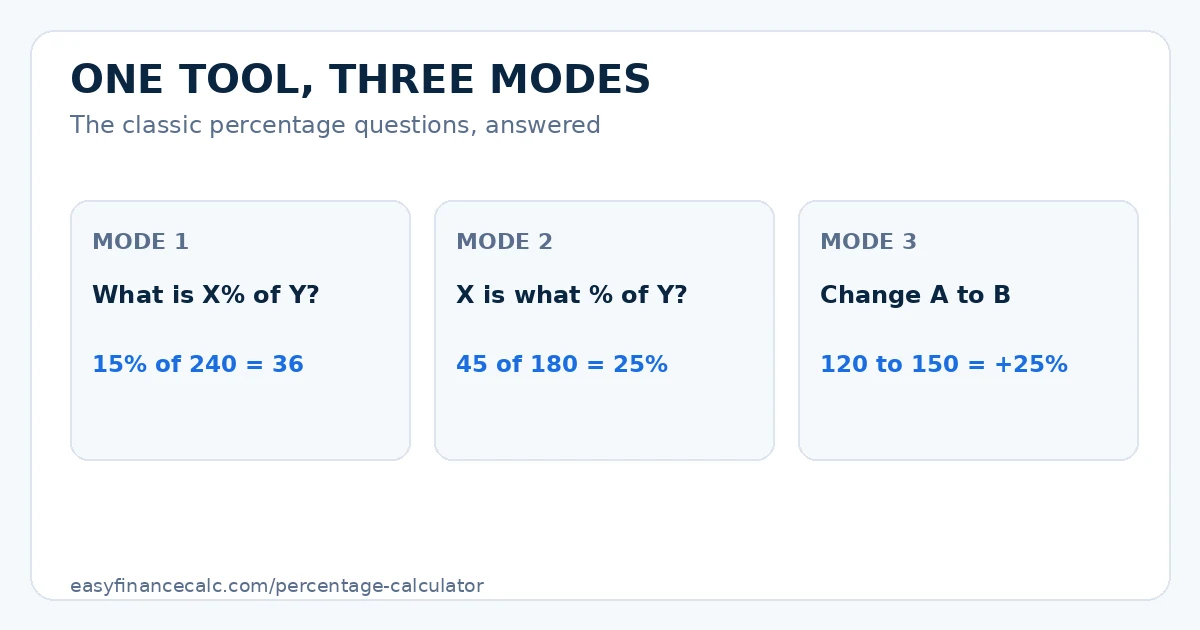
Here is the percentage calculator worked through the three questions people ask most, with every step shown. Example 1: What is 15 percent of 240? Divide 15 by 100 to get 0.15. Multiply 0.15 by 240. The answer is 36. Use this shape for tips, discounts, and tax on a purchase. Example 2: 45 is what percent of 180? Divide the part by the whole: 45 ÷ 180 = 0.25. Multiply by 100. The answer is 25 percent. Use this shape for grades, scores, and shares of a budget.
Example 3: A value rises from 120 to 150. What is the percent increase? The change is 150 minus 120, which is 30. Divide by the starting value: 30 ÷ 120 = 0.25. Multiply by 100. The answer is a 25 percent increase. Use this shape for raises, price changes, and growth. The next section runs the same three shapes on everyday money questions.
Percentages in Real Money Decisions
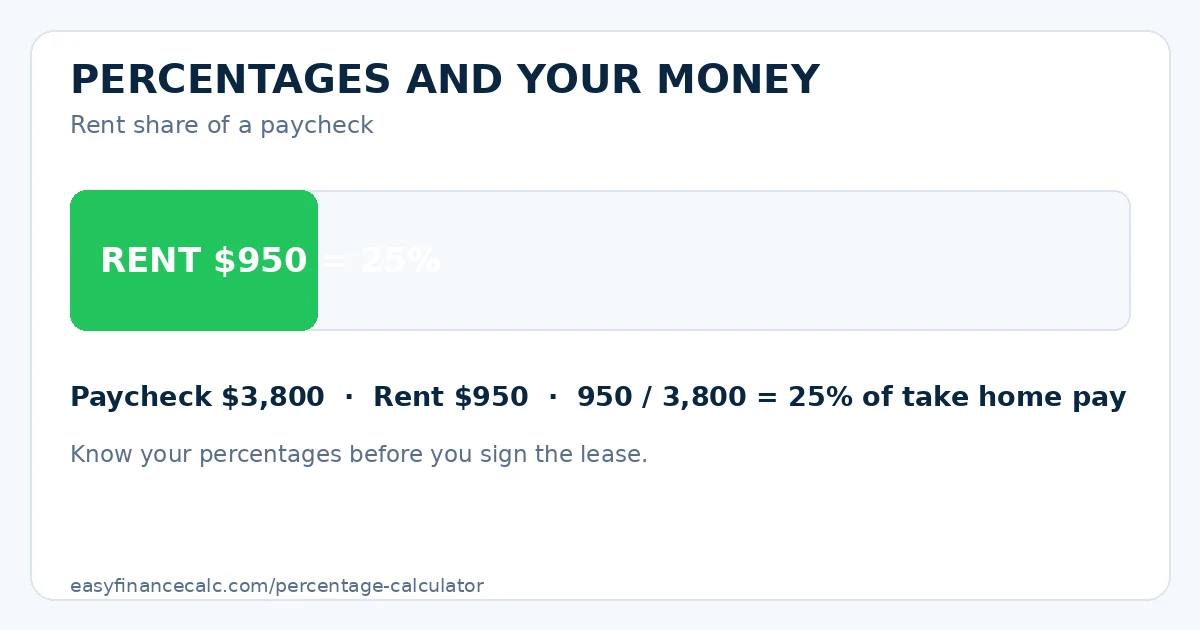
Money is where a percentage calculator earns its keep. Most money questions are percent questions in disguise. Rent share of a paycheck. Say your take home pay is $3,800 a month and your rent is $950. Divide 950 by 3,800 and you get 0.25, so your rent is exactly 25 percent of your take home pay. A common budgeting guideline puts housing near 30 percent of take home pay, so this rent sits under that line. What share of your paycheck goes to rent? Mode 2 answers it in one step.
Discount math. A $60 jacket is marked 25 percent off. The discount is 25 percent of 60, which is $15, so you pay $45. A percent off sign feels bigger than a dollar amount. Run the math and the feeling turns into a number. Tip math. Dinner comes to $50 and you want to leave 20 percent. Twenty percent of 50 is $10, so the tip is $10 and the total is $60. For splits, presets, and pre tax or post tax choices, use the Tip Calculator.
Grade percentages. You scored 42 out of 50 on a test. Divide 42 by 50 to get 0.84, so your score is 84 percent. Teachers, students, and parents all run this one, and it is the same part over whole shape as rent share.
Percentage Points vs Percent
These two phrases sound alike, mean very different things, and mixing them up is how headlines mislead. Say a sales tax rate moves from 4 percent to 5 percent. The rate rose by 1 percentage point. That part is simple subtraction: 5 minus 4 equals 1. But the percent increase of the rate itself is much bigger. The change is 1, the starting value is 4, and 1 ÷ 4 = 0.25, so the rate grew by 25 percent. Both statements are true. One describes the gap in points, the other describes the growth compared to the start. When a headline says a rate jumped 25 percent, ask yourself: points or percent? The answer changes the story.
5 Common Mistakes
Most wrong answers from a percentage calculator come from the setup, not the arithmetic. Watch for these five.
- Dividing by the new value. Percent change always divides by the starting value. Divide by the new one and every increase looks smaller than it is.
- Mixing up points and percent. A move from 4 percent to 5 percent is 1 point, not 1 percent. The section above shows why the gap matters.
- Adding percents with different bases. A 10 percent raise followed by a 10 percent cut does not cancel out. Start at 100, rise to 110, then fall 10 percent of 110 and you land on 99.
- Forgetting the multiply by 100 step. A result of 0.25 is the decimal form. As a percent it is 25 percent. A bare decimal on a test or a bill is a wrong answer waiting to be marked.
- Stacking discounts by adding them. Two discounts of 20 percent are not 40 percent off. The second discount applies to the already reduced price, so the total saving is 36 percent.
Salary Increase Percentage: A Worked Example
A salary that rises from $60,000 to $63,600 is a 6 percent increase. The difference is $3,600, and the formula is (difference / original) x 100, so ($3,600 / $60,000) x 100 = 6 percent.
Run your own raise with the percentage change mode above. Enter your old salary and your new salary, and the tool works out the increase percent for you.
Frequently Asked Questions
Related Calculators
Run the two dedicated percentage tools, or jump to the money tools readers pair with this page.
- Percentage Difference Calculator
- Percentage Decrease Calculator
- Tip Calculator
- Paycheck Calculator
- Sales Tax Calculator
Disclaimer: These are estimates and teaching examples for planning only, not financial advice. Percent results are only as good as the numbers entered, so double check figures on bills, grades, and contracts before acting on them.
Sources: Khan Academy, percentages · Maths Is Fun, percentages · National Institute of Standards and Technology (NIST)
Bookmark this percentage calculator and keep it close for everyday money math. A percentage calculator is only helpful when it shows its work, so every mode here pairs the answer with the formula behind it. Use this percentage calculator to check a discount before you buy, to split a tip fairly, or to see how a price change really stacks up. Teachers reach for a percentage calculator in class, renters use one to check housing costs, and shoppers use one at the register. One percentage calculator, three modes, and every percent question answered in seconds.