
Tennessee Paycheck Calculator: Find Your Exact Take Home Pay
This tennessee paycheck calculator shows what actually lands in your bank account when you work in the Volunteer State. Tennessee charges no state income tax on earned income at all, so your paycheck only loses federal income tax, Social Security, and Medicare. From the hospitals and health companies of Nashville to the logistics hubs of Memphis, Tennessee runs on an economy where keeping your whole paycheck is part of the pitch, and the state never touches any of it. Ever wonder why a Tennessee paycheck can look bigger than the same salary paid across the border in Kentucky or North Carolina? The answer is simple: the state tax line on a Tennessee pay stub reads zero, every single time.
Quick Answer
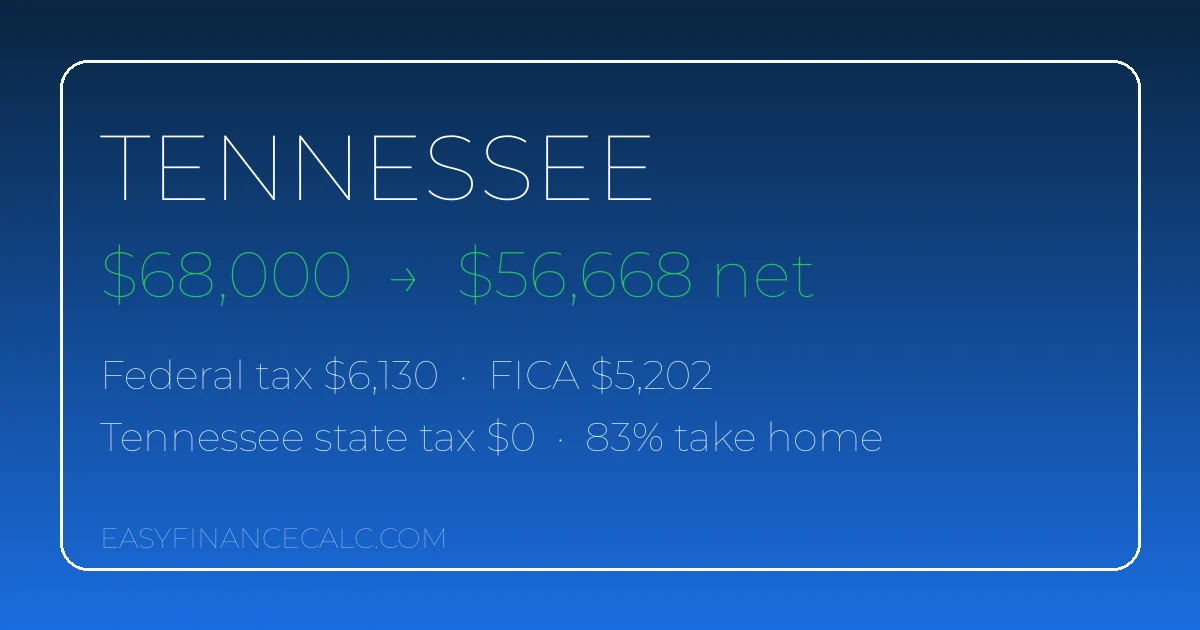
Here is the short version. Tennessee has no personal income tax and no local income tax anywhere in the state. On a $68,000 salary, a single filer in Nashville takes home about $56,668 a year, roughly 83 percent of gross pay. Only federal income tax and FICA come out. A good tennessee take home pay calculator should always show the Tennessee state tax line as $0. If a tool shows Tennessee state tax above zero, it is wrong.
Tennessee Paycheck Calculator
Enter your pay and see exactly what lands in your bank account for 2026.
| Per paycheck | Per year | |
|---|---|---|
| Gross pay | ||
| Federal income tax | ||
| Tennessee state income tax | ||
| Social Security (6.2%) | ||
| Medicare (1.45%) | ||
| Take home pay |
Tennessee state income tax is $0 on every paycheck. Estimates use 2026 IRS brackets and the 2026 Social Security wage base of $184,500. Your real withholding follows IRS Publication 15-T tables and your W-4, so your actual check can differ by a few dollars.
The tennessee paycheck calculator above takes your gross pay, pay frequency, and filing status, then subtracts federal income tax, Social Security, and Medicare to give your net pay per check and per year. Add a 401k contribution or health premium to see how voluntary deductions change the result. It works as a paycheck calculator tennessee workers can rely on because the state tax rate is locked at zero, just like real Tennessee payroll. For the sitewide federal only version, see our main paycheck calculator.
How to Use This Calculator
- Enter your gross salary or hourly wage.
- Pick how often you get paid, such as every 2 weeks.
- Choose your filing status: single, married filing jointly, or head of household.
- Add any 401k percentage or health premium you pay each period.
- Read your net pay per paycheck and per year, with each deduction listed.
Tennessee Tax Rules That Shape Your Paycheck
No state income tax on earned income, and no withholding
Tennessee does not tax wages, salaries, bonuses, commissions, or tips at the state level. The Tennessee Department of Revenue states it plainly: Tennessee has no state income tax on earned income and therefore has no withholding requirements. That means your employer withholds $0 for Tennessee tax on every check, and there is no state withholding form to fill out when you start a job. The federal W-4 alone controls your withholding.
The Hall Tax: the last income tax Tennessee ever had
Tennessee was not always fully income tax free. The state once taxed interest and dividends through the Hall Income Tax, enacted in 1929. It never touched wages, but it applied to dividends from stock and interest from bonds and notes. The state phased it down year by year, 4 percent for 2017, 3 percent for 2018, 2 percent for 2019, and 1 percent for 2020, then repealed it for tax periods that begin on January 1, 2021, or later.
The Department of Revenue now tells taxpayers plainly: please do not file a return for any tax year that begins on or after January 1, 2021. Old documents and tax software may still mention the Hall Tax, but for your paycheck and your investments alike, Tennessee tax is now zero across the board.
Where Tennessee gets its money instead
Tennessee gives up income tax revenue, so it leans on sales tax harder than almost any other state. The Department of Revenue calls the sales tax the principal source of state tax revenue, accounting for about 60 percent of all tax collections. The general state rate is 7 percent, and counties and cities can add a local rate of up to 2.75 percent.
In Memphis, the 7 percent state rate plus the full 2.75 percent local rate makes 9.75 percent at the register, one of the highest combined rates in the country. The trade off is real: your paycheck stays whole, but spending in Tennessee gets taxed hard. So is the move worth it? Run your salary through the numbers before you decide.
Food is taxed at 4 percent, not 7
One relief valve exists in the sales tax code. The Department of Revenue taxes sales of food and food ingredients at a state rate of 4 percent instead of 7. That covers groceries you cook at home, though prepared food, candy, dietary supplements, alcoholic beverages, and tobacco stay at the general 7 percent rate. The local tax still applies on top of the 4 percent, so the register total depends on your county and city.
No local income taxes either
Some states let cities add their own income tax on top of the state tax. Tennessee does not. Nashville, Memphis, Knoxville, Chattanooga, and every county in the state take $0 in local income tax on wages. Local governments fund themselves through the local share of sales tax and property tax instead. Your location inside Tennessee never changes your paycheck math.
Minimum wage is the federal $7.25
Tennessee has no state minimum wage law. The Tennessee Department of Labor and Workforce Development says there are no state laws regulating minimum wage and points workers to the U.S. Department of Labor. That means the federal $7.25 an hour applies statewide, and the federal tipped wage of $2.13 an hour applies to tipped workers, as long as tips bring total earnings to at least $7.25. No Tennessee city can set a higher local minimum wage either.
Does Tennessee tax overtime pay or bonuses?
Tennessee takes $0 from overtime and $0 from bonuses, just like regular pay. Federally, many employers withhold a flat 22 percent on bonuses, and Social Security and Medicare still apply to overtime. Any extra withheld comes back on your federal return.
Worked Example: Test the Tennessee Paycheck Calculator on a $68,000 Salary
Numbers make this real. Marcus earns $68,000 a year in Nashville, files as single, and gets paid every 2 weeks, which means 26 paychecks a year. Treat this tennessee salary calculator example like the widget in action: salary in, take home pay out. His federal taxable income is $51,900, which is $68,000 minus the $16,100 standard deduction. His federal tax is $6,130 for the year: 10 percent of $12,400 equals $1,240, plus 12 percent of $38,000 equals $4,560, plus 22 percent of $1,500 equals $330.
| Deduction | Per Paycheck | Per Year |
|---|---|---|
| Gross pay | $2,615.38 | $68,000.00 |
| Federal income tax | $235.77 | $6,130.00 |
| Tennessee state income tax | $0.00 | $0.00 |
| Social Security (6.2 percent) | $162.15 | $4,216.00 |
| Medicare (1.45 percent) | $37.92 | $986.00 |
| Net pay | $2,179.54 | $56,668.00 |
Marcus keeps $2,179.54 from every $2,615.38 paycheck. His take home pay is about 83 percent of his gross pay, and not one cent went to Tennessee.
Tennessee Paycheck Tips
Check your W-4 once a year. Your federal W-4 controls how much federal tax comes out. An old form can withhold too much or too little, and Tennessee has no state form, so the federal form does all the work.
Use pre tax benefits. A 401k contribution and many health premiums come out before federal tax, which lowers your taxable income. Test a higher 401k percentage in the tennessee paycheck calculator above and watch the net pay change before you commit.
Moving from a taxed state? Run your current salary through a tennessee take home pay calculator first. The saving is real and shows up in every check. On a $68,000 salary, a worker in a state with a 5 percent income tax loses roughly $3,400 a year that a Tennessee worker keeps. These are estimates, since other states use their own brackets, but price in the sales tax trade off before deciding the move pays off.
Budget the sales tax side of the deal. Tennessee taxes what you spend, not what you earn. Big purchases in Memphis carry a combined rate of 9.75 percent, so factor that into the real cost of living, not just the bigger paycheck.
Keep old Hall Tax records, not old habits. If you paid the Hall Tax in 2020 or earlier, keep those returns in case of an audit, but never file a new one. No Tennessee individual income tax return exists anymore.
5 Common Mistakes Tennessee Workers Make
- Expecting a state tax refund. There is no Tennessee income tax, so there is no state return and no state refund. Your only filing is federal.
- Filing a Hall Tax return out of habit. The Hall Tax ended with tax year 2020. Do not file a return for any tax year beginning on or after January 1, 2021.
- Copying advice from taxed states. Tips about state deductions or state W-4 forms do not apply in Tennessee. Check figures with a tennessee take home pay calculator built for Tennessee rules.
- Forgetting the sales tax trade off. Tennessee’s zero income tax is funded by one of the highest combined sales tax rates in the nation. Budget accordingly.
- Judging a job offer on gross pay alone. Two offers with the same salary can net very different amounts once benefits and pay frequency change. A tennessee salary calculator turns each offer into a per paycheck figure so you compare net pay, not gross pay.
Frequently Asked Questions
Why is there no Tennessee income tax on my paycheck?
Tennessee does not tax earned income at the state level. The Tennessee Department of Revenue states that Tennessee has no state income tax on earned income and therefore has no withholding requirements. Employers withhold $0 for state tax on every paycheck, whatever you earn.
What was the Hall Tax?
The Hall Income Tax was a Tennessee tax on interest from bonds and notes and dividends from stock. Enacted in 1929, it never applied to wages. The state phased it out from 2017 through 2020 and repealed it for tax periods beginning January 1, 2021, or later. Do not file a return for any tax year that begins on or after that date.
Do I need to file a Tennessee tax return for my wages?
No. Tennessee has no personal income tax return for individuals. If wages are your income, you file only a federal return. The Department of Revenue collects business taxes and sales tax, not individual income tax.
I earn dividends and interest in Tennessee. Do I owe state tax?
No. Before 2021, the Hall Tax covered dividends and interest above a threshold. Since the repeal took effect January 1, 2021, Tennessee taxes no form of individual income, including interest, dividends, and capital gains.
Why is the sales tax so high in Tennessee?
The sales tax is the principal source of state tax revenue, about 60 percent of all collections, because there is no income tax to share the load. The state rate is 7 percent plus up to 2.75 percent local, so combined rates reach 9.75 percent in places like Memphis.
Is food taxed at the grocery store in Tennessee?
Yes, but at a lower rate. Food and food ingredients carry a 4 percent state rate instead of the general 7 percent, plus the local tax. Prepared food, candy, alcohol, and tobacco stay at 7 percent.
What is the single article tax?
Tennessee charges a 2.75 percent state single article tax on the portion of a single item’s price between $1,600.01 and $3,200. The standard 7 percent state rate applies to the full price. For a $3,000 item, the single article portion adds $38.50.
Do Memphis or Nashville charge a local income tax?
No. No Tennessee city or county can charge a local income tax. Memphis and Nashville take $0 in local income tax on wages. They rely on the local share of sales tax and property tax instead.
What is the minimum wage in Tennessee?
There is no state minimum wage law in Tennessee. The federal $7.25 an hour applies statewide, and the federal tipped wage of $2.13 an hour applies to tipped workers as long as tips bring total pay to at least $7.25.
Does Tennessee tax overtime pay or bonuses?
Tennessee takes $0 from overtime and $0 from bonuses. Federally, employers often withhold a flat 22 percent on bonuses, and Social Security and Medicare still apply. Any extra withheld comes back on your federal return.
What should I do if my Tennessee paycheck shows state income tax withheld?
Ask payroll to fix it. Tennessee has no state income tax on earned income and no withholding requirements, so a state withholding line on a Tennessee paycheck is a payroll error. Compare each line against a paycheck calculator tennessee workers use for a second opinion.
Can I use this if I am paid hourly instead of salary?
Yes. Enter your hourly wage and hours, and the tennessee salary calculator logic works the same way: gross pay first, then federal tax, Social Security, and Medicare. Tennessee state tax stays $0 for hourly workers too.
What is a Tennessee paycheck calculator?
A Tennessee paycheck calculator estimates your take-home pay after federal deductions, with no Tennessee state income tax on wages.
How do I use a TN salary calculator to check my take home pay?
Enter your salary or hourly pay, choose your pay frequency and filing status, and read the net pay result. Tennessee charges no state income tax, so only federal income tax and FICA come out. In the worked example on the page, Marcus earns $68,000 a year in Nashville, files as single and is paid every 2 weeks, and keeps $2,179.54 from each $2,615.38 paycheck, or $56,668 a year.
Related Calculators
- Paycheck Calculator
- Texas Paycheck Calculator
- Florida Paycheck Calculator
- California Paycheck Calculator
- Illinois Paycheck Calculator
- Nevada Paycheck Calculator
- Washington Paycheck Calculator
- Salary to Hourly Calculator
- Tip Calculator
Disclaimer
Disclaimer: This page provides estimates for education only. Your actual withholding depends on your W-4, benefits, and employer payroll setup. This is not tax advice. For your own tax decisions, talk to a qualified tax professional.
Sources
Tennessee Department of Revenue, GEN-34 Income Tax Withholding; Tennessee Department of Revenue, Hall Income Tax; Tennessee Department of Revenue, Sales and Use Tax; Tennessee Department of Revenue, SUT-13 Sales and Use Tax Rates Overview; Tennessee Department of Revenue, Due Dates and Tax Rates; Tennessee Department of Labor and Workforce Development, minimum wage; IRS Publication 15-T (2026); Social Security Administration.