
New York Paycheck Calculator: See Your Real Take Home Pay
This new york paycheck calculator shows what actually lands in your bank account when you work in the Empire State. New York runs nine income tax brackets, from 3.9 percent to 10.9 percent, and most workers also see two small payroll lines for Paid Family Leave and disability. Add New York City tax on top if you live in the five boroughs, and a New York paycheck carries more lines than almost any other state in the country. So what does a New York check really look like after all of that? Run your salary through the numbers below and see it line by line.
Quick Answer
Here is the short version. New York taxes income on nine progressive brackets, and the 2026 rates start at 3.9 percent. On a $90,000 salary, a single filer in Rochester takes home about $67,455 a year, roughly 75 percent of gross pay. That figure includes $4,269.75 of New York state tax, $388.80 of Paid Family Leave, and $31.20 of disability. A good new york take home pay calculator must show all three state lines, not just the income tax. If a tool hides the leave and disability deductions, it overstates your pay.
New York Paycheck Calculator
Enter your pay and see exactly what lands in your bank account for 2026.
| Per paycheck | Per year | |
|---|---|---|
| Gross pay | ||
| Federal income tax | ||
| New York state income tax | ||
| Paid Family Leave (0.432%) | ||
| Disability Benefits | ||
| Social Security (6.2%) | ||
| Medicare (1.45%) | ||
| Take home pay |
New York state income tax uses the 2026 brackets after the $8,000 standard deduction ($16,050 joint, $11,200 head of household). Paid Family Leave is 0.432% of wages capped at $411.91 a year, and disability is 0.5% capped at $0.60 a week. New York City tax is not included: add 3.078 to 3.876 percent if you live in the five boroughs. Estimates use 2026 IRS brackets and the 2026 Social Security wage base of $184,500. Your real withholding follows IRS Publication 15-T tables and your W-4 and IT-2104, so your actual check can differ by a few dollars.
The new york paycheck calculator above takes your gross pay, pay frequency, and filing status, then subtracts federal income tax, New York state income tax, Paid Family Leave, disability, Social Security, and Medicare to give your net pay per check and per year. Add a 401k contribution or health premium to see how voluntary deductions change the result. It works as a paycheck calculator new york workers can rely on because the state brackets, the standard deduction, and both payroll lines use the 2026 figures from the New York Department of Taxation and Finance. For the sitewide federal only version, see our main paycheck calculator.
How to Use This Calculator
- Enter your gross salary or hourly wage.
- Pick how often you get paid, such as every 2 weeks.
- Choose your filing status: single, married filing jointly, or head of household.
- Add any 401k contribution or health premium you pay each year.
- Read your net pay per paycheck and per year, with each deduction listed.
New York Tax Rules That Shape Your Paycheck
Nine brackets from 3.9 percent to 10.9 percent, and a 2026 rate cut
New York taxes income in nine brackets. For a single filer in 2026, the rates are 3.9 percent up to $8,500, 4.4 percent to $11,700, 5.15 percent to $13,900, 5.4 percent to $80,650, 5.9 percent to $215,400, 6.85 percent to $1,077,550, then 9.65 percent to $5 million, 10.3 percent to $25 million, and 10.9 percent above that. Married joint thresholds run about double the single amounts through the middle brackets. The top three rates apply at the same income levels for every filing status. Only the income inside each bracket pays that bracket rate, so a raise never taxes your whole salary at the higher rate. The 2026 rates are also a little lower than 2025: the state cut the first five bracket rates as the first half of a two year 0.2 point reduction that finishes in 2027. If an old calculator still shows 5.5 percent and 6 percent in the middle brackets, it is using last year numbers.
The standard deduction is 8,000 dollars for single filers
Before any bracket rate applies, New York subtracts a standard deduction. Single filers get $8,000, married couples filing jointly get $16,050, and heads of household get $11,200. New York also gives a $1,000 exemption for each dependent. That deduction is much smaller than the federal $16,100 single standard deduction, so your New York taxable income is usually higher than your federal taxable income on the same salary. One useful quirk: you can itemize on your New York return even if you take the standard deduction on your federal return. If your mortgage interest, property taxes, and charitable gifts add up past $8,000, run both ways and take the larger deduction on each return separately.
The supplemental tax can add money back above 107,650 dollars
New York recaptures the benefit of its lower brackets once your New York adjusted gross income passes $107,650. The state calls this the supplemental tax, and it phases the benefit out as income rises. A single filer at $150,000 pays a few hundred dollars more than the bracket math alone suggests, and the recapture grows with income. The widget on this page uses the published bracket schedule without the recapture, so it is exact for most workers and slightly low for high earners. If your New York adjusted gross income is above $107,650, treat the result as a close estimate and check the supplemental tax computation in the IT-201 instructions.
New York City adds its own tax, and so does Yonkers
Live in the five boroughs and you pay a second income tax. New York City charges 3.078 percent to 3.876 percent on top of the state tax, depending on income, and it is collected on the same IT-201 return. A single filer in Manhattan earning $90,000 pays roughly $3,050 more a year to the city before credits than the same worker in Rochester. Yonkers charges its own smaller city tax too. The calculator on this page shows the state lines only, because city tax depends on where you live, not where you work. If you live in New York City, add the city tax to the state figure before you judge a job offer.
Two small lines on every stub: Paid Family Leave and disability
New York funds two programs straight from employee paychecks. Paid Family Leave takes 0.432 percent of your gross wages in 2026, capped at $411.91 for the year. It pays up to 12 weeks of job protected leave at 67 percent of your average weekly wage if you bond with a new child, care for a seriously ill family member, or handle a military deployment need. Short term disability takes 0.5 percent of wages, capped at $0.60 a week, which is $31.20 a year at most. Neither line is large, but both appear on nearly every New York pay stub, and most national calculators leave them out entirely. Your employer pays nothing toward either program. The cost comes only from your check.
Minimum wage is 17 dollars downstate and 16 dollars upstate
New York sets two minimum wages. From January 1, 2026, the rate is $17.00 an hour in New York City, Long Island, and Westchester County, and $16.00 an hour everywhere else in the state. Fast food workers in New York City earn $17.00 an hour as well. Tipped food service workers have a lower cash wage with a tip credit, $11.34 an hour downstate and $10.70 upstate. From 2027 onward, the minimum wage rises with inflation instead of by a fixed schedule.
Overtime and bonuses are taxed like regular wages
New York taxes overtime pay, bonuses, and commissions at the same bracket rates as your salary. There is no special state rate for supplemental pay, though your employer may withhold federal tax on a bonus at a flat 22 percent. Tips count as wages for New York tax, and the state added a subtraction for qualifying tip income starting in 2026. If your pay varies week to week, enter your best annual estimate in the new york salary calculator above and check the per check figure against a real stub.
Worked Example: Test the New York Paycheck Calculator on a $90,000 Salary
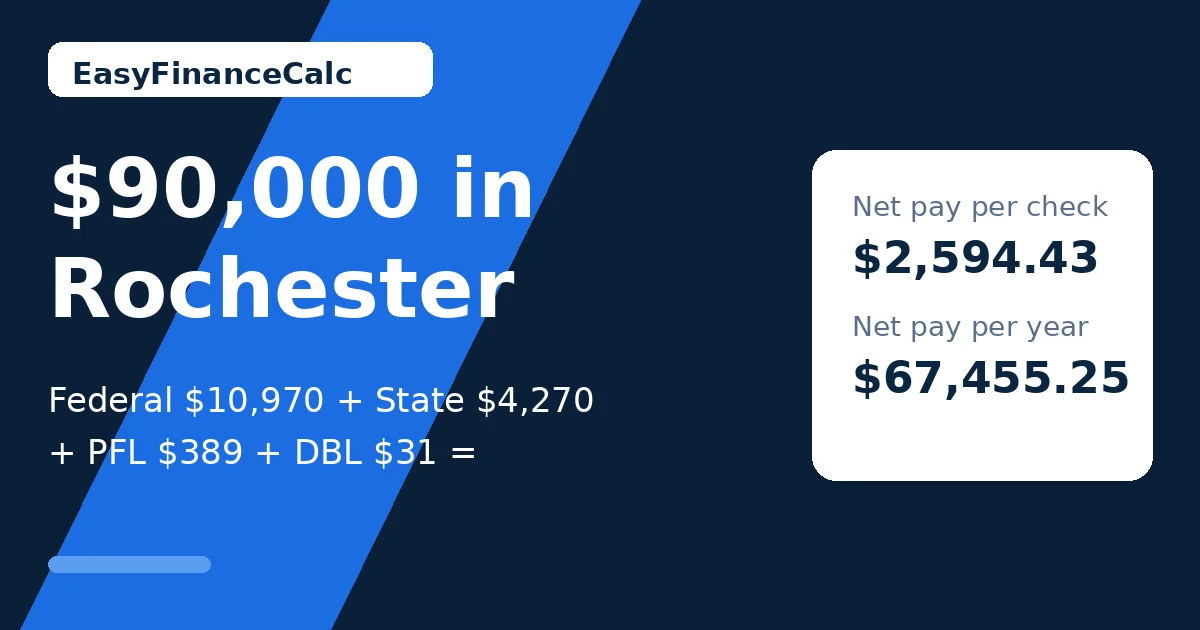
Numbers make this real. Daniel earns $90,000 a year in Rochester, files as single, and gets paid every 2 weeks, which means 26 paychecks a year. Treat this new york salary calculator example like the widget in action: salary in, take home pay out. His federal taxable income is $73,900, which is $90,000 minus the $16,100 federal standard deduction. His federal tax is $10,970 for the year: 10 percent of $12,400 equals $1,240, plus 12 percent of $38,000 equals $4,560, plus 22 percent of $23,500 equals $5,170. His New York taxable income is $82,000, which is $90,000 minus the $8,000 New York standard deduction. His New York tax is $4,269.75: 3.9 percent of $8,500 equals $331.50, plus 4.4 percent of $3,200 equals $140.80, plus 5.15 percent of $2,200 equals $113.30, plus 5.4 percent of $66,750 equals $3,604.50, plus 5.9 percent of $1,350 equals $79.65.
| Deduction | Per Paycheck | Per Year |
|---|---|---|
| Gross pay | $3,461.54 | $90,000.00 |
| Federal income tax | $421.92 | $10,970.00 |
| New York state income tax | $164.22 | $4,269.75 |
| Paid Family Leave (0.432 percent) | $14.95 | $388.80 |
| Disability Benefits | $1.20 | $31.20 |
| Social Security (6.2 percent) | $214.62 | $5,580.00 |
| Medicare (1.45 percent) | $50.19 | $1,305.00 |
| Net pay | $2,594.43 | $67,455.25 |
Daniel keeps $2,594.43 from every $3,461.54 paycheck. His take home pay is about 75 percent of his gross pay. The state lines alone take $4,689.75 a year, and the New York City tax would add roughly $3,050 more before credits if he lived in the five boroughs instead of Rochester. Per paycheck figures are rounded to the cent, so the rounded lines can differ from the net by a cent.
New York Paycheck Tips
File IT-2104 when you start a job. New York has its own withholding certificate, Form IT-2104, separate from the federal W-4. Fill it out with your employer so the state withholding matches your real tax. A wrong IT-2104 is the most common reason New York workers owe money in April.
Check the city tax before you move. A job in Manhattan pays the same state tax as a job in Buffalo, but living in the five boroughs adds thousands a year in city tax. Run the new york paycheck calculator above first, then add the city tax before you compare offers.
Use pre tax benefits. A 401k contribution and many health premiums come out before federal and New York tax, which lowers your taxable income on both returns. Test a higher 401k percentage in the new york take home pay calculator above and watch the net pay change before you commit.
Plan leave before you need it. Paid Family Leave pays 67 percent of your average weekly wage for up to 12 weeks, but you must meet the tenure rule first: 26 consecutive weeks for full time workers, 175 days for part time workers. Know the rule before a baby arrives or a parent falls ill.
Watch the recapture if you get a big raise. Cross $107,650 of New York adjusted gross income and the supplemental tax starts adding money back. A raise that looks like $10,000 can net less than you expect once the recapture bites.
5 Common Mistakes New York Workers Make
- Forgetting the New York City tax. State calculators show the state lines only. If you live in the five boroughs, the city tax adds 3.078 to 3.876 percent on top. Compare the full bill, not half of it.
- Using last year bracket rates. The 2026 middle brackets dropped to 5.4 percent and 5.9 percent from 5.5 percent and 6 percent. Old tables overstate your tax by a little on every check.
- Applying the federal standard deduction to New York. New York gives single filers $8,000, not $16,100. Using the federal figure understates your New York taxable income by $8,100.
- Ignoring the Paid Family Leave and disability lines. They are small, $419.99 a year combined on a $90,000 salary, but they are real deductions. A calculator that skips them overstates your take home pay.
- Filing only a federal W-4. New York withholding runs on Form IT-2104. Skip it and your employer withholds at the default, which is often wrong for married couples and workers with two jobs.
Frequently Asked Questions
What are the New York income tax rates for 2026?
New York has nine brackets for 2026. Single filers pay 3.9 percent to $8,500, 4.4 percent to $11,700, 5.15 percent to $13,900, 5.4 percent to $80,650, 5.9 percent to $215,400, 6.85 percent to $1,077,550, 9.65 percent to $5 million, 10.3 percent to $25 million, and 10.9 percent above that. Married joint thresholds run about double through the middle brackets. The 2026 rates reflect the first half of a two year 0.2 point cut in the first five brackets.
Do I pay New York City tax on top of state tax?
Yes, if you live in New York City. The city charges 3.078 percent to 3.876 percent on top of the state tax, collected on the same IT-201 return. Yonkers charges its own smaller city tax. The calculator on this page shows state lines only, so add the city tax separately if you live in the five boroughs.
What is the Paid Family Leave deduction on my New York paycheck?
Paid Family Leave is an employee paid program that takes 0.432 percent of your gross wages in 2026, capped at $411.91 for the year. It funds up to 12 weeks of job protected leave at 67 percent of your average weekly wage. Your employer does not contribute. The deduction stops once you hit the annual cap.
What is the disability deduction on my New York paycheck?
New York short term disability takes 0.5 percent of your wages, capped at $0.60 a week, or $31.20 a year. It is a separate program from Paid Family Leave, and you cannot collect both at the same time. Combined, the two programs cap at 26 weeks of benefits in any 52 week period.
What is the New York standard deduction for 2026?
Single filers get $8,000, married couples filing jointly get $16,050, and heads of household get $11,200. New York also gives a $1,000 exemption for each dependent. You may itemize on your New York return even if you take the standard deduction federally.
What is the New York supplemental tax?
The supplemental tax recaptures the benefit of the lower brackets once your New York adjusted gross income passes $107,650. It adds tax on top of the bracket calculation, and the amount grows with income. Most workers under that threshold never see it. The widget on this page uses the bracket schedule without the recapture.
What is the minimum wage in New York in 2026?
From January 1, 2026, the minimum wage is $17.00 an hour in New York City, Long Island, and Westchester County, and $16.00 an hour in the rest of the state. Tipped food service workers earn a lower cash wage with a tip credit: $11.34 an hour downstate and $10.70 an hour upstate.
Does New York tax tips?
Yes. Tips count as wages for New York income tax, and employers must report them. New York added a subtraction for qualifying tip income starting in 2026, which can lower the state tax on tips for workers who qualify. Check the IT-201 instructions for the current rules.
Do I need to file a New York tax return if I live in another state but work in New York?
Yes, if you earn income from New York sources. Nonresidents file Form IT-203 and pay New York tax on the income earned in the state. Your home state may give you a credit for the tax paid to New York, so you usually do not pay twice on the same dollar.
How much New York tax will I pay on a 90,000 dollar salary?
A single filer in Rochester with no dependents pays $4,269.75 of New York state tax on a $90,000 salary in 2026, plus $388.80 of Paid Family Leave and $31.20 of disability. The total state lines come to $4,689.75 a year. A New York City resident would add roughly $3,050 of city tax before credits on top.
Can I use this calculator if I am paid hourly instead of salary?
Yes. Enter your hourly wage and hours, and the new york salary calculator logic works the same way: gross pay first, then federal tax, New York tax, Paid Family Leave, disability, Social Security, and Medicare. The same brackets and payroll lines apply to hourly workers.
Why does my New York paycheck show a state tax line when my friend in Florida has none?
Florida has no state income tax at all, so a Florida paycheck carries only federal lines. New York taxes income on nine progressive brackets and adds Paid Family Leave and disability deductions. The same $90,000 salary nets about $4,690 a year less in New York than in Florida before any city tax.
How do I use a New York state paycheck calculator to check my NYS paycheck?
Enter your salary or hourly pay, choose your pay frequency and filing status, and read the net pay result. New York taxes income on nine progressive brackets and adds Paid Family Leave and disability lines, plus New York City tax if you live in the five boroughs. In the worked example on the page, Daniel earns $90,000 a year in Rochester, files as single and is paid every 2 weeks, and keeps $2,594.43 from each $3,461.54 paycheck, or $67,455.25 a year.
Related Calculators
- Paycheck Calculator
- Texas Paycheck Calculator
- Florida Paycheck Calculator
- California Paycheck Calculator
- Illinois Paycheck Calculator
- Nevada Paycheck Calculator
- Washington Paycheck Calculator
- Tennessee Paycheck Calculator
- South Dakota Paycheck Calculator
- Salary to Hourly Calculator
- Tip Calculator
Disclaimer
This calculator is an educational estimate for 2026 tax rates and rules. It is not tax advice, and it does not account for New York City tax, Yonkers tax, local taxes, the supplemental tax recapture, tip income rules, or your exact withholding elections. Check your pay stub and talk to a tax professional before you make a financial decision.
Sources
New York State Department of Taxation and Finance, Instructions for Form IT-201; New York State Department of Taxation and Finance, Personal income tax rates and the 2026 rate reduction; New York State Department of Labor, History of the Minimum Wage in New York State; New York State Paid Family Leave program, 2026 contribution rate 0.432 percent and $411.91 annual cap; New York State Workers Compensation Board, disability benefits contribution capped at $0.60 per week; IRS Publication 15-T (2026); Social Security Administration