
Claiming Dependents on Taxes: Who Qualifies in 2026
Claiming dependents on taxes does not give you a fixed refund amount per child. A dependent can unlock several different credits at once, each with its own rules, and the total depends on your income, your tax bill, and the dependent’s age and Social Security number. So how much will you actually get back? Let’s run the numbers.
A tax dependent is a person you can claim on your return because they meet the IRS definition of a qualifying child or a qualifying relative. There is no personal exemption deduction for a dependent anymore, so claiming someone does not lower your taxable income by a set dollar figure. What it does is open the door to credits, to head of household filing status in some cases, and to a larger standard deduction when you file as head of household. This guide covers the 2026 rules, the credit amounts, and the mistakes that cost families real money.
What Does Claiming Dependents on Taxes Actually Get You?
Here is the short answer first. A dependent affects up to four things at once: the Child Tax Credit, the Additional Child Tax Credit, the Credit for Other Dependents, and the Earned Income Tax Credit. It can also qualify you for head of household status and for the child and dependent care credit when you pay for care so you can work. None of these is a flat amount per dependent, and they do not all work the same way.
| Credit or benefit | 2026 amount | Refundable? |
|---|---|---|
| Child Tax Credit, per qualifying child under 17 | Up to $2,200 | Partly, through the Additional Child Tax Credit |
| Additional Child Tax Credit, per qualifying child under 17 | Up to $1,700 | Yes |
| Credit for Other Dependents, per other dependent | $500 | No |
| Earned Income Tax Credit, 2 qualifying children | Up to $7,316 | Yes |
| Earned Income Tax Credit, 3 or more qualifying children | Up to $8,231 | Yes |
A nonrefundable credit can only reduce your tax bill to zero. A refundable credit can come back to you as a refund even when you owe no tax. That distinction is why two families with the same number of children can walk away with very different refunds, and why a tax estimator and a finished return sometimes disagree. The estimator and the return must receive the same inputs, or the answers will differ.
Who Counts as a Qualifying Child?
A qualifying child must pass five tests: relationship, age, residency, support, and joint return. Every test must pass. Miss one, and the child does not qualify under this category, although the qualifying relative category below may still apply.
Relationship: the child must be your son, daughter, stepchild, foster child, sibling, half sibling, stepsibling, or a descendant of any of those people, such as a grandchild or a niece.
Age: the child must be under 19 at the end of the year, or under 24 if a full time student for at least five months of the year, or any age if permanently and totally disabled. Note the age test for the Child Tax Credit is stricter: the child must be under 17 at the end of the year to count for that credit.
Residency: the child must have lived with you for more than half the year. Time away for school, medical care, military service, or vacation still counts as time at home, so a college student away at school still meets this test.
Support: the child must not have provided more than half of their own support during the year. This test looks only at what the child spent on their own support, not at how much they earned. A teenager with a part time job can still qualify as long as the income they spent on their own expenses stays below half of their total support.
Joint return: the child must not have filed a joint return with a spouse, unless the return was filed only to claim a refund of withheld tax.
There is no income limit for a qualifying child. A 17 year old who earned $40,000 can still be your qualifying child as long as they did not provide more than half of their own support. That surprises a lot of parents, and it is one of the most common questions tax preparers hear every spring.
Who Counts as a Qualifying Relative?
A qualifying relative is the second category, and it works very differently. It has four tests: the person cannot be anyone’s qualifying child, they must meet a relationship or household test, their gross income must be below a limit, and you must provide more than half of their support.
The relationship or household test is satisfied in one of two ways. Either the person is on the IRS list of relatives, which includes parents, grandparents, siblings, stepparents, aunts, uncles, nieces, nephews, and in laws, or the person lived with you all year as a member of your household. A cousin is not on the relative list, so a cousin must meet the household test instead. Parents do not have to live with you to qualify.
The gross income test is the one that trips people up. For 2026, the person’s gross income must be less than $5,300. One dollar over disqualifies them entirely, with no partial credit and no phase out. Gross income here means taxable income: wages, taxable interest, dividends, rental income, and pensions count, but nontaxable Social Security benefits do not. That is why a parent living mostly on Social Security can still qualify.
Consider Carlos, who supports his 68 year old mother in Florida. She receives $18,000 a year in Social Security, which is nontaxable, plus a $4,000 taxable pension and $500 in interest. Her gross income for this test is $4,500, which is below $5,300, so she passes the income test. Carlos also pays more than half of her total support, so she is his qualifying relative. She brings him a $500 Credit for Other Dependents, which is nonrefundable, so it can reduce his tax bill but cannot create a refund by itself.
How Much Is Each Dependent Credit Worth in 2026?
The Child Tax Credit for 2026 is up to $2,200 per qualifying child under 17, and up to $1,700 of that amount per child may be refundable as the Additional Child Tax Credit. The refundable part requires at least $2,500 of earned income and equals 15 percent of earned income above $2,500, capped at $1,700 per child. The credit begins to phase out at $200,000 of modified adjusted gross income, or $400,000 for married couples filing jointly, shrinking by $50 for every $1,000 over the threshold.
The Credit for Other Dependents is $500 per dependent who does not qualify for the Child Tax Credit. That covers a 17 year old child, a full time college student age 19 to 23, a parent, or another qualifying relative. It is nonrefundable and phases out at the same $200,000 and $400,000 thresholds.
The Earned Income Tax Credit is fully refundable and is calculated from earned income and the number of qualifying children, not from a flat amount per dependent. For 2026, the maximum is $664 with no qualifying children, $4,427 with one child, $7,316 with two children, and $8,231 with three or more children. The income limits for 2026 are $62,974 for a single or head of household filer with three or more children, and $70,244 for married couples filing jointly with three or more children.
Head of household status is a separate benefit worth knowing about. If you are unmarried and pay more than half the cost of keeping up a home for a qualifying person, you can file as head of household, which carries a 2026 standard deduction of $24,150, compared with $16,100 for a single filer. That $8,050 difference directly reduces taxable income.
Worked Example: Jessica and the Age 17 Cliff
Jessica is a single mother in Ohio who files as head of household. She earned $38,000 in 2026 and has two qualifying children, ages 8 and 12, both with Social Security numbers. Her standard deduction is $24,150, so her taxable income is $13,850, and her tax before credits is $1,385 at the 10 percent rate.
Her Child Tax Credit is 2 times $2,200, which is $4,400. The nonrefundable part covers her $1,385 tax bill, and the remaining $3,015 comes back as the Additional Child Tax Credit, because 15 percent of her earned income above $2,500 is $5,325, well above the $1,700 per child cap of $3,400. Her total credit benefit is the full $4,400. On top of that, she may also qualify for the Earned Income Tax Credit, which is calculated separately and could add to her refund.
Now watch what happens the year her older child turns 17. That child no longer qualifies for the Child Tax Credit and moves to the $500 Credit for Other Dependents. Jessica’s credits become $2,200 plus $500, which is $2,700, a drop of $1,700 even though nothing else changed. Her tax bill is still $1,385, so $1,385 is covered by the nonrefundable part and $1,315 comes back as the Additional Child Tax Credit. This age 17 cliff is the reason so many parents ask why their refund fell from one year to the next, and the answer is usually sitting right here in the dependent rules.
Divorced or Separated? Tiebreaker Rules and Form 8332
Only one parent can claim a child as a dependent in any given tax year, no matter how custody is divided. When parents disagree, the IRS uses tiebreaker rules, and the parent the child lived with for more nights during the year generally wins. If the nights are equal, the parent with the higher adjusted gross income wins. A divorce decree saying the other parent claims the child does not override the IRS tiebreaker rules on its own.
There is one formal exception. The custodial parent can sign Form 8332 to release the dependency claim to the noncustodial parent. But Form 8332 transfers only the Child Tax Credit, the Additional Child Tax Credit, and the Credit for Other Dependents. The custodial parent keeps the Earned Income Tax Credit, head of household status, and the dependent care credit. Listing a child for the Earned Income Tax Credit but not as a dependent, or claiming the same child on two returns, triggers duplicate Social Security number rejections and delays both refunds.
SSN, ITIN, and Why Some Dependents Only Qualify for $500
Identification numbers decide which credit a dependent can bring. For the Child Tax Credit, the child must have a Social Security number issued before the return due date. A child with only an Individual Taxpayer Identification Number cannot qualify for the Child Tax Credit, but may still qualify as another dependent worth the $500 Credit for Other Dependents, which accepts a Social Security number, an Individual Taxpayer Identification Number, or an adoption taxpayer identification number.
For the Earned Income Tax Credit, the federal rule is stricter: the taxpayer, the spouse, and each qualifying child must all have a Social Security number valid for employment. An Individual Taxpayer Identification Number does not qualify for the federal Earned Income Tax Credit, although some states, such as California with its CalEITC, accept Individual Taxpayer Identification Numbers for their own state credit. If your return was rejected for a dependent mismatch, check the identification numbers first, because that is the most common cause.
Refunds that include the Earned Income Tax Credit or the Additional Child Tax Credit are held until mid February under the PATH Act, even when you file in January. That hold is normal, and it is not a sign that anything went wrong with your return.
Common Mistakes When Claiming Dependents on Taxes
The first mistake is treating a dependent as a fixed refund amount. Your refund is not broken down by how much you get for each dependent, because one dependent can affect several credits at once and the total depends on your income and tax bill.
The second mistake is mixing up the two categories. A qualifying child has no income limit but has strict age and residency tests. A qualifying relative has no age limit but has the $5,300 gross income test and a support test you must provide. Applying the wrong set of tests is how eligible dependents get left off returns.
The third mistake is using old numbers. Content still circulating online describes a $4,050 personal exemption per dependent and a $1,000 Child Tax Credit. Both are pre 2018 law. The personal exemption is gone, and the 2026 Child Tax Credit is $2,200.
The fourth mistake is claiming a child on two returns, or claiming a child for the Earned Income Tax Credit while someone else claims the same child as a dependent. Both trigger rejections and delays, and the IRS tiebreaker rules, not a private agreement, decide who was right.
The fifth mistake is forgetting the age 17 cliff. If your refund drops sharply in the year a child turns 17, check the Child Tax Credit first before assuming an error, because a $1,700 drop per child is built into the law.
How to Claim Dependents Step by Step
Start by listing every person you support and running each one through the qualifying child tests first, then the qualifying relative tests. Keep notes on ages at year end, months lived with you, and support amounts, because those are the facts the IRS asks about.
Next, enter each dependent in the dependents section of Form 1040 with their name, Social Security number or Individual Taxpayer Identification Number, relationship, and whether they qualify for the Child Tax Credit or the Credit for Other Dependents. Complete Schedule 8812 to calculate the Child Tax Credit and the Additional Child Tax Credit.
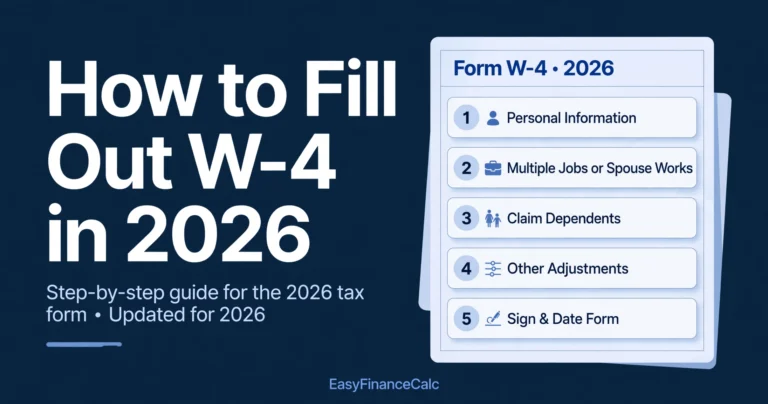
Then check your W-4. Step 3 of the current W-4 lets you claim $2,200 per qualifying child under 17 and $500 per other dependent, but only when your total income is $200,000 or less, or $400,000 or less for married couples filing jointly. Getting Step 3 right means less of a surprise at filing time, and our guide on how to fill out a W-4 walks through it line by line.
Finally, run your numbers through a tax refund calculator before you file, so you can compare the estimate with your finished return. If the two differ by a lot, treat the gap as a data entry red flag and recheck your inputs, especially dependent ages, Social Security numbers, and withheld amounts, before you submit.
FAQs
How much do you get back for each dependent in 2026?
There is no flat amount per dependent. A qualifying child under 17 can bring up to $2,200 through the Child Tax Credit, with up to $1,700 of that refundable, plus possible Earned Income Tax Credit. Another dependent brings a $500 nonrefundable credit. The total depends on your income, your tax bill, and which credits you qualify for.
Can I claim my 19 year old college student as a dependent?
Yes, if they are a full time student under 24, lived with you for more than half the year, and did not provide more than half of their own support. They count as a qualifying child for dependency, but at 19 they no longer qualify for the Child Tax Credit, so they bring the $500 Credit for Other Dependents instead.
Can my child earn income and still be my dependent?
Yes. A qualifying child has no income limit. The test is whether the child provided more than half of their own support, not how much they earned. A child who earned a lot but saved most of it can still qualify.
Can I claim my parent who lives on Social Security?
Possibly. A parent is a qualifying relative if their gross income is less than $5,300 for 2026, you provide more than half of their support, and they are not anyone’s qualifying child. Nontaxable Social Security benefits do not count toward the $5,300 limit, but taxable pensions and interest do.
What happens if both parents claim the same child?
The IRS rejects the second return or delays both refunds, and the tiebreaker rules decide the rightful claimant. The parent the child lived with for more nights generally wins, and Form 8332 is the only formal way for a custodial parent to release the claim.
Does my child need a Social Security number for the Child Tax Credit?
Yes. The child must have a Social Security number issued before the return due date. A child with only an Individual Taxpayer Identification Number cannot qualify for the Child Tax Credit, although they may qualify for the $500 Credit for Other Dependents.
Can I claim a dependent with an ITIN?
Yes, for dependency itself and for the Credit for Other Dependents, which accepts an Individual Taxpayer Identification Number. An Individual Taxpayer Identification Number does not qualify for the federal Earned Income Tax Credit or the Child Tax Credit.
What happens when my child turns 17?
The child moves from the Child Tax Credit to the $500 Credit for Other Dependents, which is a drop of $1,700 per child before any other changes. That single birthday explains many year to year refund drops.
Can I claim a dependent if someone can claim me?
No. If you can be claimed as a dependent on someone else’s return, you cannot claim dependents of your own, even if you otherwise meet the tests.
Do I get a tax deduction for each dependent?
No, not anymore. The personal exemption was suspended and then made permanent, so there is no deduction amount per dependent. The value now comes through credits and, in some cases, head of household filing status.
Try the Calculator
Claiming dependents on taxes correctly is mostly about running the right tests in the right order: qualifying child first, qualifying relative second, then the credit amounts for the people who pass. Do that, and the refund number stops being a surprise.
Use our free tax refund calculator to estimate your 2026 refund with your own dependents, income, and withholding before you file. It takes about a minute, needs no signup, and shows you how each credit changes the result.
Estimate your refund with dependents included: Tax Refund Calculator, free, no signup, 2026 figures.
Disclaimer
This guide is for education only and is not tax, legal, or financial advice. Tax rules change, and your situation may differ from the examples here. Verify your return with a qualified tax professional, especially for split claims, tiebreaker disputes, and identification number questions.