How to Fill Out W-4 in 2026: Every Step Explained
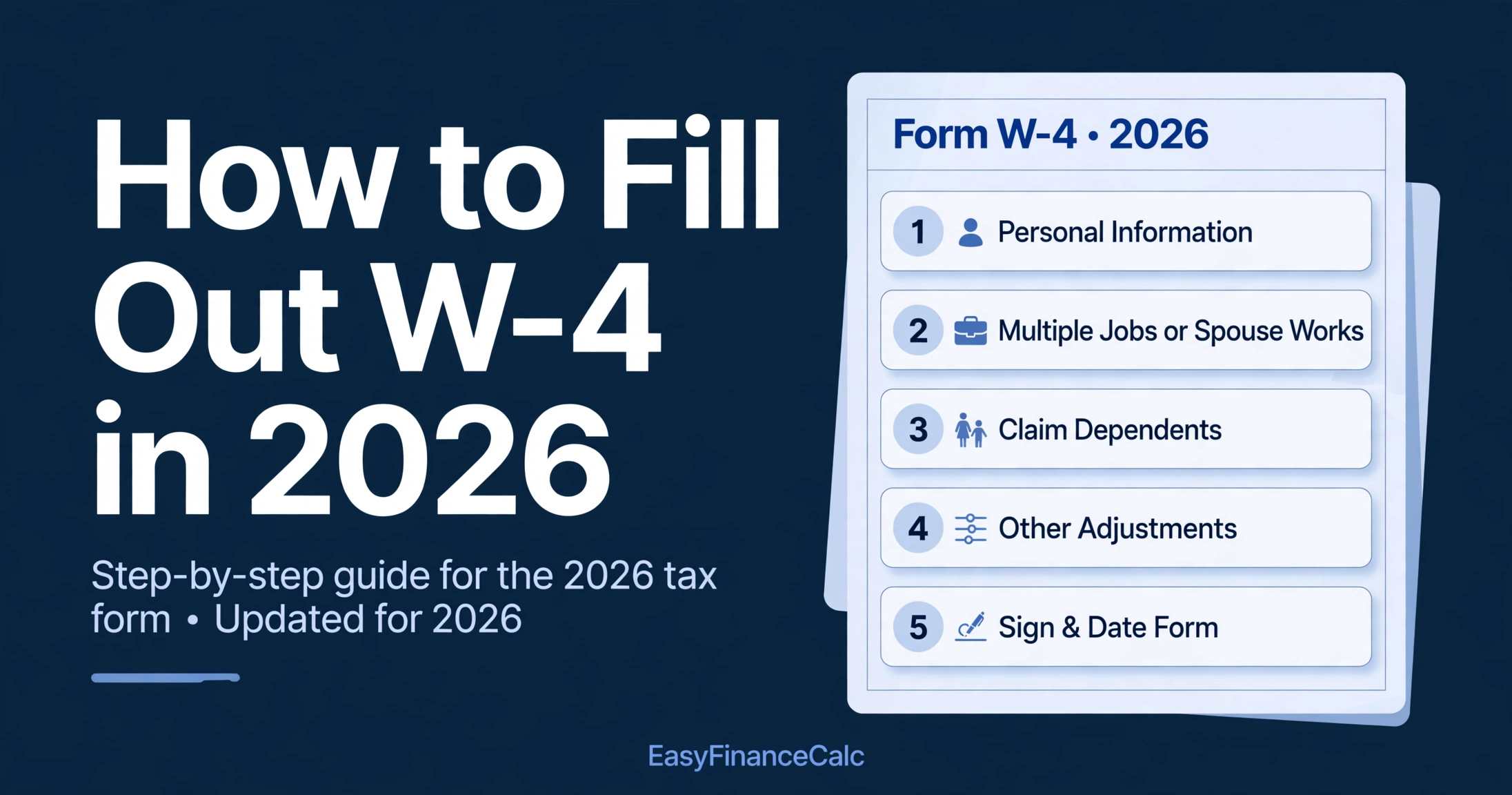
Learning how to fill out W-4 takes about ten minutes, and it decides how much federal income tax comes out of every paycheck. The form has five steps: your personal information, multiple jobs, dependents, other adjustments, and your signature. This guide walks through each step with the 2026 numbers, so your withholding lands close to your real tax bill.
Get the form right and your paychecks stay steady all year, with no nasty surprise in April and no giant refund that was your money all along. Get it wrong and you either lend the government money for free or owe a bill plus interest. So how do you fill it out correctly? Start at Step 1 and work down, one step at a time.
What Is a W-4 Form?
A W-4 form, officially the Employee’s Withholding Certificate, is the form you give your employer so payroll knows how much federal income tax to take out of each paycheck. It is not a tax return, and you do not send it to the IRS. Your employer keeps it and uses it to set your withholding.
The current form has five steps and no allowances. Before 2020, the old W-4 asked you to claim a number of allowances, and more allowances meant less withholding. That system is gone. The new form works with dollar amounts instead: credits for your dependents, deductions beyond the standard deduction, and any extra amount you want withheld.
If you start a job and never submit a W-4, your employer must withhold as if you were single with no adjustments. That usually means too much tax comes out of every check. Filling out the form is always better than leaving it blank. If you have never done this before, learning how to fill out W-4 is mostly about knowing which steps apply to you and which ones to leave blank.
How to Fill Out W-4 Step 1: Your Personal Information
Step 1 is required for everyone, and it is the simplest part of the form. Enter your first name, middle initial, last name, and home address, then your Social Security number. The name must match your Social Security card exactly, because a mismatch causes reporting problems later.
Then pick your filing status. The choices are single or married filing separately, married filing jointly or qualifying surviving spouse, and head of household. Choose the status you expect to use on your tax return, not the one you used last year if your life has changed. Your filing status sets the tax tables your employer uses, so it is the single biggest lever on your withholding after your pay itself.
If your name changed recently, because of a marriage for example, update it with the Social Security Administration first, then use the new name on the form.
Step 2: Multiple Jobs or a Working Spouse
Complete Step 2 only if you hold more than one job at the same time, or you are married filing jointly and your spouse also works. If neither applies, leave it blank and move on.
You have three options, and you only need one of them. The most accurate is the IRS Tax Withholding Estimator on the IRS website, which walks through your income and hands you a finished W-4. The second option is the Multiple Jobs Worksheet on page 3 of the form: you work through the table, then enter the result in Step 4(c) as extra withholding. The third option is the checkbox in Step 2(c), which works when there are exactly two jobs that pay about the same amount. It is simpler but less precise, so use it only when the two paychecks are close in size.
One rule that trips people up: when Step 2 applies, complete Steps 3 and 4 using information from your highest paying job only. And if you or your spouse has self employment income, use the estimator, because the worksheet does not handle it well. Getting Step 2 wrong is the most common reason two income households end up owing money in April.
Step 3: Claim Your Dependents
Step 3 is where your dependents turn into dollars that lower your withholding. You can use it if your total income is $200,000 or less, or $400,000 or less if you file jointly. Above those amounts the credit starts to phase out, and you should use the estimator instead.
The math has two lines. On line 3(a), multiply the number of qualifying children under age 17 by $2,200. On line 3(b), multiply the number of other dependents by $500. Add the two lines together and enter the total on the Step 3 line. The $2,200 figure is new for 2026, up from $2,000 in prior years, so if you are copying numbers from an old W-4, update them.
| Dependent type | Amount each | Example |
|---|---|---|
| Qualifying child under 17 | $2,200 | 2 children = $4,400 |
| Other dependent | $500 | 1 parent = $500 |
| Total for 2 children plus 1 parent | $4,900 |
Age is measured on December 31 of the tax year. A child who turns 17 at any point during 2026 is not under 17 at year end, so that child moves from the $2,200 line to the $500 line, assuming the child still meets the dependent tests. A child 17 or older, an aging parent, or another qualifying relative all go on the $500 line.
Two details matter here. First, the W-4 does not ask for your dependents names or Social Security numbers. You only enter dollar amounts. Their identifying information goes on your tax return later. Second, on a joint return only one spouse should complete Step 3. If both spouses claim the same children, you will underwithhold all year and owe the difference in April.
Step 4: Other Adjustments
Step 4 is optional, and it is where you fine tune the result. It has three parts, and you can use any combination of them.
In Step 4(a), enter other income you expect that will not have withholding, such as interest, dividends, rental income, or retirement distributions. This tells payroll to withhold a little extra to cover that income.
In Step 4(b), enter deductions you plan to claim beyond the standard deduction, using the Deductions Worksheet on page 3 of the form. This is for mortgage interest, large charitable gifts, and other itemized deductions that exceed the standard deduction. For 2026, the worksheet adds new lines from the 2025 tax law: qualified tips, qualified overtime, passenger vehicle loan interest, a $6,000 deduction for taxpayers age 65 and older, and the raised state and local tax cap of $40,400. If any of those apply to you, the worksheet is where they change your withholding.
In Step 4(c), enter any extra flat dollar amount you want withheld from every paycheck. This is the simplest tool on the form. Owe a little extra because of a side gig? Put $100 in Step 4(c) and it comes out of every check, no worksheet needed. Want a bigger refund next spring? Same box, same idea, though a bigger refund means you lent the government your money for free.
Step 5: Sign and Date
Step 5 is short and it is not optional. Sign and date the form. Without a signature the form is not valid and your employer cannot use it to set your withholding.
Then hand the form to your employer or payroll department. Do not mail it to the IRS. Your employer keeps it on file and applies it to your next paycheck, usually within one or two pay periods. Ask payroll to confirm the change took effect, because a form sitting in a drawer does not change any paycheck.
Worked Example: Maria, Nurse in Ohio
Maria is a nurse in Ohio. She is a single filer earning $68,000 a year, paid biweekly, with two children under 17 and her mother living with her as a dependent. Here is her W-4, step by step.
Step 1: single, with her name, address, and Social Security number. Step 2: blank, because she has one job. Step 3: two qualifying children times $2,200 is $4,400, plus one other dependent times $500, for a Step 3 total of $4,900. Step 4: blank, because she takes the standard deduction and has no other income. Step 5: signed and dated.
What does that $4,900 do to her paychecks? Her employer spreads it across her 26 biweekly paychecks, which is $188.46 less federal income tax withheld per check. That is the whole point of Step 3: the credit reaches her during the year instead of waiting for her refund.
Check the math against her real tax bill. Her taxable income is $68,000 minus the 2026 single standard deduction of $16,100, which is $51,900. Her income tax is $1,240 on the first $12,400 at 10 percent, plus $4,560 on the next $38,000 at 12 percent, plus $330 on the last $1,500 at 22 percent, for a total of $6,130. Subtract her $4,900 in credits and her net federal income tax is $1,230 for the year, about $47.31 per paycheck. If she had left Step 3 blank, about $235.77 would come out of every check instead, and she would get the extra $4,900 back as a refund next spring. Same money, one year late.
Now compare James, a single filer earning $52,000 with no dependents. He completes Steps 1 and 5 only. His taxable income is $52,000 minus $16,100, which is $35,900. His income tax is $1,240 plus 12 percent of $23,500, which is $2,820, for a total of $4,060, or about $156.15 per biweekly paycheck. Two forms, two minutes each, and both paychecks land close to the real bill.
When Should You File a New W-4?
You do not need a new W-4 every year, but you should file one whenever your life changes. The common triggers are a new job, a marriage or divorce, a child born or adopted, a spouse starting or stopping work, a second job, a big raise, or a child turning 17 and aging out of the $2,200 credit.
Also file one if last year ended with a surprise. A large refund means you overwithheld, so a new W-4 can put that money back in your paychecks. A large balance due means you underwithheld, so a new W-4 with extra withholding in Step 4(c) can spread the fix across the year instead of landing in one April payment.
The best time to check is early in the year, or right after any of those life changes. Run the IRS Tax Withholding Estimator with your latest pay stub, and if it says your withholding is off by more than a few hundred dollars, hand payroll a new form. That is the right moment to learn how to fill out W-4 again with your new numbers, instead of letting the old form keep running.
Can You Claim Exempt on Your W-4?
You can claim exempt only if you had no federal income tax liability last year and you expect to have none this year. That is a narrow test. Students with a small part time job and retirees with very low income sometimes qualify. Most workers with a full time job do not.
To claim it, write EXEMPT in the space under Step 4(c). Your employer will then withhold no federal income tax from your pay. State tax withholding is separate, so check your state form too.
Exempt status expires every year. You must file a new W-4 by February 15 to stay exempt for the new year. If you claim exempt when you actually owe tax, you will face a bill in April plus a possible underpayment penalty, so be sure you pass both parts of the test before you write EXEMPT.
6 Mistakes That Cost You Money
The first mistake is claiming exempt when you owe tax. The test is strict, no liability last year and none expected this year, and failing it means an April bill plus a possible penalty.
The second mistake is both spouses claiming the same children in Step 3. Only one spouse completes Step 3 on a joint return. Double claiming underwithholds all year.
The third mistake is using the old $2,000 child credit figure. For 2026 the amount is $2,200 per qualifying child. Copying last year numbers leaves $200 per child on the table until refund time.
The fourth mistake is skipping Step 2 when you have two jobs. Each employer withholds as if that job were your only income, which understates the total, and the shortfall lands in April.
The fifth mistake is mailing the W-4 to the IRS. The form goes to your employer, not the IRS. A form the IRS never sees does nothing, and your withholding stays wrong.
The sixth mistake is filing the form once and forgetting it. A raise, a new baby, a spouse who stops working, a child who turns 17: each one changes the right answer, and the form you filed two years ago does not know about any of them.
Frequently Asked Questions
Do I need to fill out a new W-4 every year?
No. A W-4 stays in effect until you replace it. File a new one only when your situation changes: a new job, a marriage or divorce, a child, a second job, or a big refund or balance due last year. Exempt status is the exception, and it must be renewed by February 15 each year.
What happens if I do not fill out a W-4?
Your employer must withhold as if you were single with no adjustments. That usually means too much tax comes out of every paycheck. You get the extra money back as a refund, but you wait months for it. Filling out the form takes ten minutes and fixes the problem.
Can I claim exempt on my W-4?
Only if you had no federal income tax liability last year and you expect none this year. Write EXEMPT under Step 4(c) and give the form to your employer. The status expires each year, so file a new W-4 by February 15 to stay exempt.
How do I fill out a W-4 if I have two jobs?
Complete Step 2. Use the IRS Tax Withholding Estimator for the most accurate result, or complete the Multiple Jobs Worksheet on page 3 and enter the result in Step 4(c). If the two jobs pay about the same, you can check the box in Step 2(c) instead. Then complete Steps 3 and 4 using your highest paying job only.
What if my spouse and I both work?
Complete Step 2, because two incomes in one household change the withholding math. Only one of you should complete Step 3 for your shared dependents. Many couples run the IRS Tax Withholding Estimator together and file new W-4 forms at the same time.
Do I write my dependents names on the W-4?
No. The W-4 never asks for dependent names or Social Security numbers. You only enter dollar amounts in Step 3: $2,200 per qualifying child under 17 and $500 per other dependent. Their names and Social Security numbers go on your tax return.
How much extra should I withhold in Step 4(c)?
Enough to cover the tax on income your paychecks do not cover. A side gig that nets $10,000 a year adds roughly $1,200 to $2,200 of tax, depending on your bracket, so $50 to $85 extra per biweekly paycheck is a reasonable starting point. Run the estimator with the side income included for an exact figure.
Does my employer send my W-4 to the IRS?
No. Your employer keeps the form and uses it to set your withholding. The IRS can ask your employer for it, but you never mail it to the IRS yourself. Give it to your employer or payroll department.
What changed on the 2026 W-4?
The five steps are the same, but the numbers moved. The child tax credit in Step 3 is now $2,200 per qualifying child, up from $2,000. The Deductions Worksheet in Step 4(b) adds new lines for qualified tips, qualified overtime, vehicle loan interest, a $6,000 deduction for taxpayers 65 and older, and the raised state and local tax cap of $40,400.
How do I know if my withholding is right?
Use the IRS Tax Withholding Estimator with a recent pay stub. It compares what you have paid so far with what you will owe, and it tells you what to put on a new W-4. A quick check: if last year refund or balance due was more than a few hundred dollars, your withholding is off and a new W-4 can fix it.
Check Your Take Home Pay Now
Run your salary through our free paycheck calculator and see exactly what lands in your account after tax.
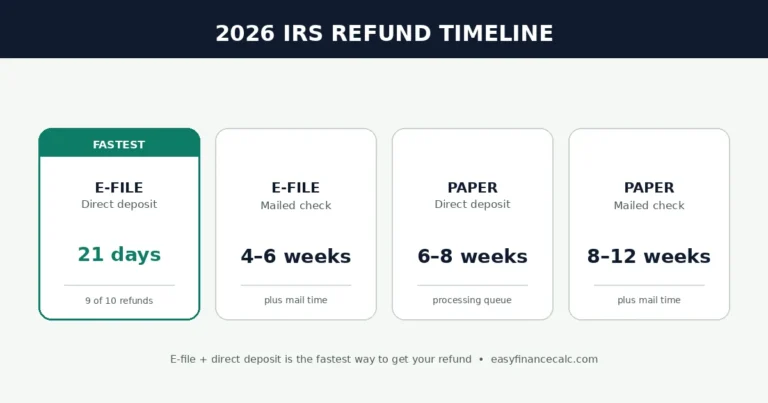
Calculate Your PaycheckOnce your W-4 is right, check what it means for your money. Our paycheck calculator shows your exact take home pay after withholding, our gross pay vs net pay guide explains every line on your pay stub, and our take home pay percentage guide shows how to work out what share of your pay you actually keep. If you are expecting money back, the tax refund calculator estimates your refund and when it arrives. Those are the steps for how to fill out W-4 correctly, and the habit that pays off is checking your withholding once a year, not once a decade.
Disclaimer: This guide is for education only and is not financial, tax, or legal advice. Tax rules change, and your situation may differ from the examples here. Check the instructions for Form W-4 and Publication 505, and talk to a qualified tax professional before you act.
Sources: Internal Revenue Service, Form W-4 (2026) Employee’s Withholding Certificate and instructions. Internal Revenue Service, Publication 505, Tax Withholding and Estimated Tax. Internal Revenue Service, Revenue Procedure 2025-32, 2026 inflation adjustments. Internal Revenue Service, Tax Withholding Estimator.
By EasyFinanceCalc Team | Published October 28, 2026 | Last updated October 28, 2026
Written by Marcus
Tax editor at Easy Finance Calc, covering federal taxes, refunds, and credits.