Quarterly Estimated Taxes: Dates, Amounts, and Safe Harbor for 2026
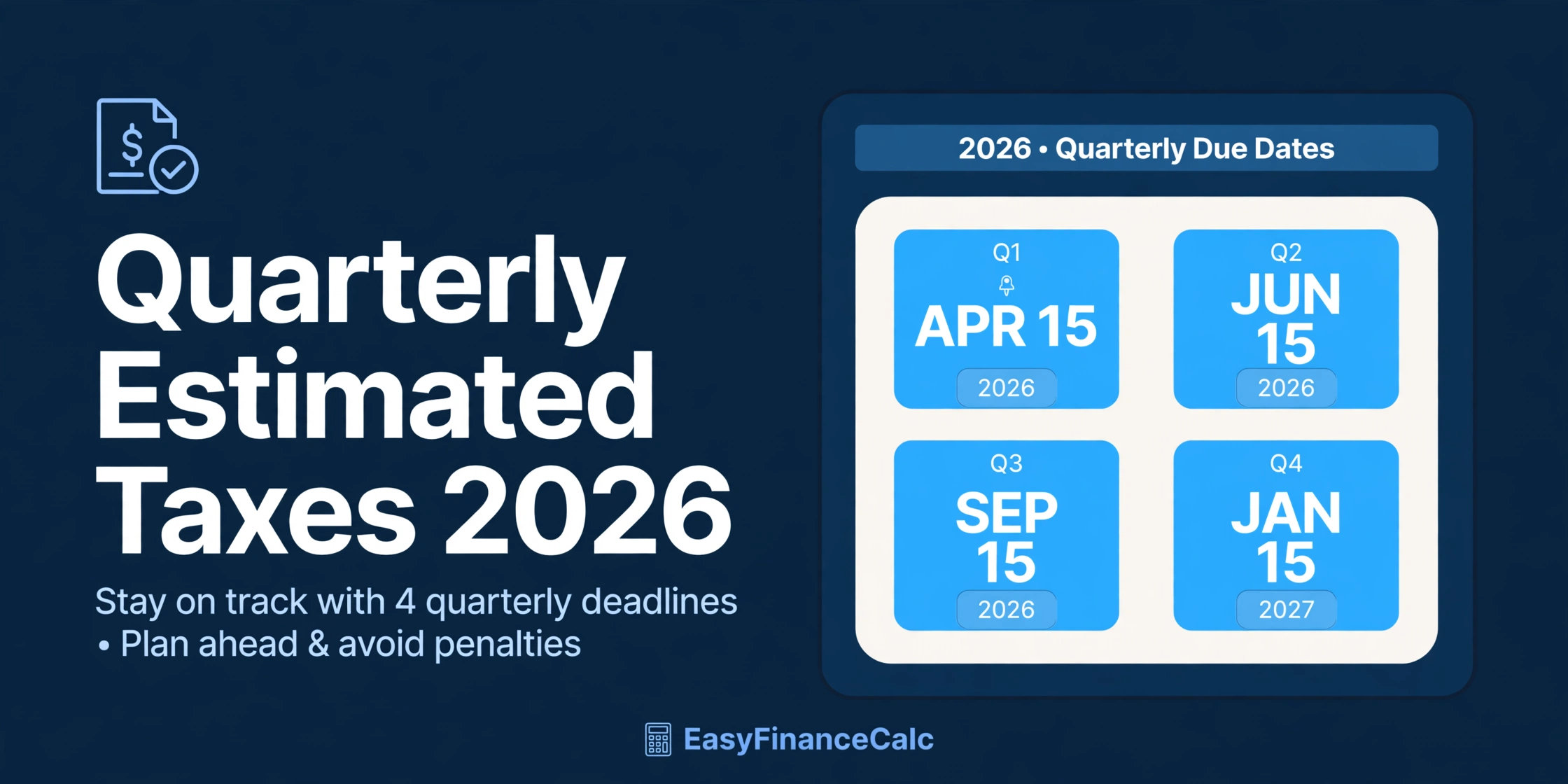
Quarterly estimated taxes are the four payments self employed people make to the IRS during the year, because nobody withholds tax from their income for them. For 2026 the payments are due April 15, June 15, and September 15, 2026, and January 15, 2027. This guide shows who has to pay, how much each payment should be, the safe harbor rules that remove the penalty risk, and a full worked example with real 2026 numbers.
If you earn money without withholding, the tax system still expects you to pay as you go. Employees pay a little with every paycheck. Freelancers, contractors, landlords, and side business owners pay in four installments instead. Miss those installments and the IRS charges a penalty, even if you pay the full tax bill in April. The fix is simple once you know the dates and the amount, and that is what this guide covers.
What Are Quarterly Estimated Taxes?
Quarterly estimated taxes are advance payments of your federal income tax, plus self employment tax if you have self employment income. You estimate your total tax for the year, divide it into four payments, and send each one by its due date using Form 1040-ES. The payments are credits against your final tax bill. When you file your return, the total you already paid is subtracted, and you pay only the balance, or you get a refund if you overpaid.
The word quarterly is slightly misleading, because the four payment periods are not equal calendar quarters. The second period covers only April 1 to May 31, two months, while the third covers June 1 to August 31, three months. The due dates are what matter, not the calendar quarters, so put the four dates on your calendar and ignore the word quarterly after that.
Estimated payments cover more than freelance income. They also cover rental income, capital gains, dividends, and any other income that arrives without withholding. If you have a W-2 job and a side business, your paycheck withholding covers the job, and estimated payments cover the side income. The two systems work together, and the $1,000 test below decides whether you need the estimated side at all.
Who Has to Pay Quarterly Estimated Taxes?
You generally must make estimated payments for 2026 if both of these are true. First, you expect to owe at least $1,000 in federal tax for the year after subtracting withholding and refundable credits. Second, your withholding and credits will total less than the smaller of 90 percent of your 2026 tax or 100 percent of your 2025 tax, with 110 percent instead of 100 percent if your 2025 adjusted gross income was over $150,000.
In plain terms, if you are a full time freelancer with no W-2 withholding, you almost certainly have to pay. If you are an employee with a small side gig, check the $1,000 test first. A side project that nets $3,000 might add only a few hundred dollars of tax, and then no estimated payments are needed at all. A side project that nets $15,000 will cross the line, and estimated payments become part of the job.
Corporations have their own rule, with a $500 threshold instead of $1,000, and farmers and fishermen have a special schedule, covered below. Everyone else in this guide is an individual filer, and the $1,000 rule is the one that decides it.
Quarterly Estimated Tax Due Dates for 2026
Here are the four due dates for the 2026 tax year, with the income period each payment covers.
| Payment | Income period | Due date |
|---|---|---|
| First | January 1 to March 31, 2026 | April 15, 2026 |
| Second | April 1 to May 31, 2026 | June 15, 2026 |
| Third | June 1 to August 31, 2026 | September 15, 2026 |
| Fourth | September 1 to December 31, 2026 | January 15, 2027 |
If a due date falls on a weekend or a federal holiday, the payment is on time if you make it on the next business day. For 2026, all four dates fall on weekdays, so no adjustment applies.
Two shortcuts are worth knowing. You can pay the full year estimate by the first due date instead of splitting it into four payments, if you prefer to get it done early. And you can skip the January 15, 2027 payment entirely if you file your 2026 return by February 1, 2027 and pay the entire balance with it. That second shortcut only works if your records are ready early, which is a good reason to keep them tidy through December.
One common mistake is the January payment itself. The payment due January 15, 2027 is the fourth installment for 2026, not the first installment for 2027. Check the tax year every time you pay, because applying it to the wrong year is one of the most common estimated tax errors.
How Much Should Each Quarterly Payment Be?
The method has four steps. First, estimate your total income for 2026, including freelance profit, wages, rent, and anything else. Second, subtract your deductions to get taxable income, then work out the income tax using the 2026 brackets. Third, add self employment tax if you have self employment income. Fourth, divide the total by four. That is your quarterly payment.
The 2026 standard deduction is $16,100 for single filers and $32,200 for married couples filing jointly. The 2026 single filer brackets are 10 percent up to $12,400 of taxable income, 12 percent up to $50,400, and 22 percent up to $105,700. Only the dollars inside each bracket are taxed at that rate.
Self employment tax is 15.3 percent on 92.35 percent of your net self employment earnings: 12.4 percent for Social Security up to the $184,500 wage base for 2026, plus 2.9 percent for Medicare with no cap. Half of the self employment tax is deductible above the line, which lowers your income tax but not the self employment tax itself.
If your income is steady through the year, four equal payments are the right answer. If your income is lumpy, with a big project landing in November, for example, the annualized income installment method on Form 2210 lets you pay in line with when the income actually arrived, instead of pretending it was earned evenly. That method needs more paperwork, but it is the correct tool for uneven income, and it is the one the IRS expects you to use in that case.
Worked Example: Daniel, Freelance Designer in Texas
Daniel is a freelance designer in Texas. He is single, and his net profit for 2026 is $80,000 after business expenses. Texas has no state income tax, so this example covers federal tax only. Here is his full calculation.
First, his net earnings for self employment tax are 92.35 percent of $80,000, which is $73,880. His self employment tax is 15.3 percent of $73,880, which is $11,303.64. Half of that, $5,651.82, is deductible above the line.
Second, his adjusted gross income is $80,000 minus $5,651.82, which is $74,348.18. Subtract the 2026 single standard deduction of $16,100, and his taxable income is $58,248.18.
Third, his income tax is worked out bracket by bracket. Ten percent of $12,400 is $1,240. Twelve percent of the next $38,000 is $4,560. Twenty two percent of the remaining $7,848.18 is $1,726.60. His income tax is $7,526.60.
Fourth, his total 2026 tax is $11,303.64 of self employment tax plus $7,526.60 of income tax, which is $18,830.24. Each quarterly payment is $18,830.24 divided by four, which is $4,707.56, rounded up to $4,708 per quarter.
Daniel pays $4,708 on April 15, June 15, and September 15, 2026, and on January 15, 2027. If his profit ends up higher than $80,000, he can raise the later payments to match, or pay the extra with his return. If his profit ends up lower, he can lower the later payments, and any overpayment comes back as a refund.
The Safe Harbor Rules: How to Avoid the Penalty
The safe harbor rules give you a target that removes the underpayment penalty, even if your final tax bill is higher than you expected. You are protected if your withholding plus timely estimated payments equal at least one of these amounts.
| Your situation | Safe harbor target |
|---|---|
| 2025 AGI of $150,000 or less | 90 percent of your 2026 tax, or 100 percent of your 2025 tax |
| 2025 AGI over $150,000 | 90 percent of your 2026 tax, or 110 percent of your 2025 tax |
| Married filing separately, 2025 AGI over $75,000 | 90 percent of your 2026 tax, or 110 percent of your 2025 tax |
You only need to meet one of the two tests, so you can pick the smaller number. The prior year test is usually the safer choice, because it is a fixed number you already know. The current year test is a guess until December.
Here is the prior year test in numbers. Suppose your total tax last year was $12,000 and your adjusted gross income was under $150,000. Your safe harbor is $12,000, so you pay $3,000 per quarter. If your adjusted gross income was over $150,000, your safe harbor is 110 percent of $12,000, which is $13,200, so you pay $3,300 per quarter. Either way, meeting the target on time means no underpayment penalty, even if your 2026 tax turns out to be much higher.
Two details people miss. First, the test uses last year adjusted gross income, not this year. A household that earned $140,000 last year and $600,000 this year can still use 100 percent of last year tax. Second, the prior year return must have covered a full 12 months. A short year return does not qualify.
Safe harbor removes the penalty, not the tax. If your income grows, you will still owe the extra tax when you file. Pay the balance by the April filing deadline, because interest and the failure to pay penalty start running after that date. A safe harbor plan and a savings plan are two different things, and you need both.
How to Pay Quarterly Estimated Taxes
You have four ways to pay, and they all count the same as long as the money arrives by the due date.
The fastest free route is IRS Direct Pay, on the IRS website, where you select estimated tax as the reason and 2026 as the tax year. The Electronic Federal Tax Payment System, known as EFTPS, is the second online route, and it is the one businesses use for payroll taxes too, so it is handy if you later form an S corporation. You can also pay by debit or credit card through an IRS approved card processor, but that route charges a fee, a flat fee for debit cards and a percentage for credit cards, so it only makes sense if your card rewards beat the fee. The old route still works: mail a check with the Form 1040-ES payment voucher for that quarter, write your name, Social Security number, 2026 Form 1040-ES, and a phone number on the check, and mail it early enough that the postmark falls on or before the due date.
Whichever route you pick, keep a record of every payment, the date, the amount, and the confirmation number. The IRS record of estimated payments is the page of your return where mistakes surface, and your own record is what fixes them. Apply last year refund to this year estimated tax on your return if you want, it counts as paid on April 15.
State estimated taxes are separate. If your state has an income tax, it has its own estimated payment rules, its own due dates, and its own payment portal. Federal payments never cover state tax, so put both on the same calendar.
What Happens If You Miss a Payment?
The underpayment penalty is charged as interest on each late installment, from its due date until you pay it. The rate is set quarterly by the IRS, based on the federal short term rate plus three percentage points. The penalty is calculated separately for each quarter, so missing one deadline does not void the quarters you paid on time, and paying late stops the clock from that day forward.
If the IRS finds an underpayment, it usually figures the penalty and sends you a bill. You do not normally need to file Form 2210 yourself. You file it when you want to use the annualized income installment method, when you want withholding treated as paid on its actual dates, or when you are asking for a waiver.
There are also two special cases. If at least two thirds of your gross income is from farming or fishing, you can make a single payment by January 15, 2027, or skip it by filing your 2026 return and paying in full by March 1, 2027. And if you owe less than $1,000 after withholding and refundable credits, no underpayment penalty applies at all.
5 Mistakes That Cost Freelancers Money
The first mistake is treating quarterly payments as optional. They are not. The IRS charges a penalty for underpayment even when you pay the full tax bill in April, because the system is pay as you go, and April is months late for income earned in January.
The second mistake is paying on last year income when this year is much bigger. The prior year safe harbor protects you from the penalty, but the balance due in April can still be a shock. If your income jumps, raise the later payments and set the extra aside in a separate account, so April is a payment, not a crisis.
The third mistake is forgetting the January payment belongs to the old year. The payment due January 15, 2027 is the fourth installment for 2026. Applying it to 2027 leaves 2026 short and starts the penalty clock on that installment.
The fourth mistake is paying the income tax and forgetting the self employment tax. Your estimated payments must cover both. A freelancer who sets aside 15 percent of each payment for income tax and forgets the 15.3 percent self employment tax is short by half. Many freelancers set aside 25 to 30 percent of every payment they receive, in a separate account, so the money is there when each due date arrives.
The fifth mistake is ignoring state estimated tax. Federal payments do not cover your state. If your state has an income tax, a federal only plan leaves a state balance and a state penalty waiting in April.
Frequently Asked Questions
Do I have to pay quarterly estimated taxes if I have a full time job?
It depends on your side income. Your paycheck withholding covers your salary. If your side income leaves you owing at least $1,000 after withholding and credits, estimated payments cover the side income. If the side income is small enough that you owe less than $1,000, you can skip estimated payments entirely.
What if my income is different every month?
Use the annualized income installment method on Form 2210. It lets your payments follow when the income actually arrived, instead of pretending it was earned evenly through the year. It needs more paperwork, but it is the correct method for uneven income, and it avoids penalties on quarters where you had not earned the money yet.
Can I pay all four quarters at once?
Yes. You can pay the full year estimate by the first due date, April 15, 2026. You can also pay more than one quarter at a time. The IRS accepts any payment schedule as long as each installment is paid by its due date.
What happens if I overpay my estimated taxes?
The overpayment comes back as a refund when you file, or you can apply it to next year estimated tax on your return. Applied refunds count as paid on April 15 of the new year.
Do I need to file Form 1040-ES, or just pay?
The form is the worksheet and the voucher. If you pay online through Direct Pay or EFTPS, you do not need to mail the voucher. The worksheet on the form is still the best way to work out how much you owe, especially in your first year.
Does the safe harbor protect me if I pay late?
No. The safe harbor target must be paid on time, a quarter by each due date. A payment made after its due date leaves that installment underpaid for the days it was late. Withholding is the exception, because it is treated as paid evenly through the year unless you show otherwise.
Are estimated tax payments deductible?
No. Estimated payments are not a deduction. They are advance payments of your own tax bill, and they are credited against the total tax on your return. The underlying expenses that reduce your income, like business deductions, are separate, and they are claimed on the return itself.
What is the difference between estimated tax and self employment tax?
Estimated tax is when you pay. Self employment tax is what you pay on self employment income, 15.3 percent on 92.35 percent of net earnings. Your quarterly estimated payments cover both your income tax and your self employment tax in one payment.
Do I still owe estimated taxes if I am retired?
Possibly. If you have income without withholding, like required minimum distributions, rental income, or capital gains, and you expect to owe at least $1,000 after withholding and credits, estimated payments apply. Many retirees meet the safe harbor through withholding from a pension or IRA distribution instead.
What if I start freelancing in September?
You only owe estimated payments for the income you actually earn, and only from the quarter it arrives. Use the annualized income installment method on Form 2210 to show the income arrived late in the year, and pay the September and January installments on time. Income earned before you started freelancing does not create a payment obligation.
Work Out Your Self Employment Tax First
Run your numbers through our free self employment tax calculator, then set your four quarterly payments from the result.
Calculate Your Self Employment TaxStart with the self employment tax calculator to work out your self employment tax for the year, then use the numbers in this guide to set your four payments. If you are expecting a refund instead of a bill, the tax refund calculator shows what is coming back and when. Those are the quarterly estimated taxes in plain terms, and the habit that pays off is paying on time every quarter, not catching up in April.
Disclaimer: This guide is for education only. It is not tax, legal, or financial advice. Tax law changes, and your situation may differ from the examples here. Check the IRS instructions for Form 1040-ES and Publication 505, and talk to a qualified tax professional before you act.
Sources: IRS Form 1040-ES and instructions for 2026. IRS Publication 505, Tax Withholding and Estimated Tax. IRS Revenue Procedure 2025-32, 2026 inflation adjustments. IRS Topic No. 306, Penalty for Underpayment of Estimated Tax.
By EasyFinanceCalc Team | Published October 28, 2026 | Last updated October 28, 2026
Written by Marcus
Tax editor at Easy Finance Calc, covering federal taxes, refunds, and credits.