
Pennsylvania Paycheck Calculator: Your Real Take Home Pay
This pennsylvania paycheck calculator shows what actually lands in your bank account when you work in the Keystone State. Pennsylvania charges one flat rate, 3.07 percent, on every dollar of pay, with no brackets, no standard deduction, and no phase outs. That simplicity hides two surprises: the state taxes your 401k contributions too, and most workers also pay a local wage tax to their city or school district. So what does a Pennsylvania check really look like after the state and the local lines? Run your salary through the numbers below and see it line by line.
Quick Answer
Here is the short version. Pennsylvania taxes pay at a flat 3.07 percent, whatever you earn. On a $75,000 salary, a single filer in Harrisburg takes home about $59,290 a year, roughly 79 percent of gross pay. That figure includes $2,302.50 of Pennsylvania state tax. A good pennsylvania take home pay calculator must use the flat rate with no deduction, because Pennsylvania gives no standard deduction at all. If a tool applies a federal style deduction before the state tax, it understates your Pennsylvania tax.
Pennsylvania Paycheck Calculator
Enter your pay and see exactly what lands in your bank account for 2026.
| Per paycheck | Per year | |
|---|---|---|
| Gross pay | ||
| Federal income tax | ||
| Pennsylvania state income tax | ||
| Social Security (6.2%) | ||
| Medicare (1.45%) | ||
| Take home pay |
Pennsylvania charges a flat 3.07% on your pay with no standard deduction, and it taxes 401(k) contributions too, so the state line uses your gross pay. Local earned income tax is not included: most Pennsylvania workers pay about 1% more to their city and school district, and Philadelphia charges its own wage tax. Estimates use 2026 IRS brackets and the 2026 Social Security wage base of $184,500. Your real withholding follows IRS Publication 15-T tables and your W-4, so your actual check can differ by a few dollars.
The pennsylvania paycheck calculator above takes your gross pay, pay frequency, and filing status, then subtracts federal income tax, Pennsylvania state income tax, Social Security, and Medicare to give your net pay per check and per year. Add a 401k contribution or health premium to see how voluntary deductions change the result. It works as a paycheck calculator pennsylvania workers can rely on because the state line uses the flat 3.07 percent rate from the Pennsylvania Department of Revenue, with no brackets and no standard deduction. For the sitewide federal only version, see our main paycheck calculator.
How to Use This Calculator
- Enter your gross salary or hourly wage.
- Pick how often you get paid, such as every 2 weeks.
- Choose your filing status: single, married filing jointly, or head of household.
- Add any 401k contribution or health premium you pay each year.
- Read your net pay per paycheck and per year, with each deduction listed.
Pennsylvania Tax Rules That Shape Your Paycheck
One flat rate: 3.07 percent on every dollar
Pennsylvania taxes personal income at a single flat rate of 3.07 percent. There are no brackets, no higher rate for higher earners, and no lower rate for lower earners. A worker earning $30,000 and a worker earning $300,000 both pay 3.07 percent of their Pennsylvania taxable income. The rate has not changed since 2004, which makes Pennsylvania one of the most predictable state tax systems in the country. Your state tax is simply your pay times 0.0307, and that is the whole calculation.
No standard deduction and no brackets to plan around
Pennsylvania gives no standard deduction. Federal tax lets a single filer subtract $16,100 before brackets apply, but Pennsylvania starts taxing from the first dollar of taxable pay. The state also has no personal exemption. That means the state tax on a $75,000 salary is $2,302.50, not a smaller figure reduced by a deduction. The only relief for low earners is Tax Forgiveness, covered below, which can wipe the tax out entirely for households under the income limits. For everyone else, the math stays flat and simple.
Your 401k contributions are taxed in Pennsylvania
Here is the surprise most workers miss. Pennsylvania taxes the money you put into a 401k, even though the federal government does not. Your 401k deferrals count as taxable compensation on your Pennsylvania return, so the state line in the widget uses your gross pay, not your pay after 401k contributions. Health savings account contributions are taxed in Pennsylvania too. Employer paid health insurance is not taxed, and neither are most employer retirement contributions. The practical point: raising your 401k contribution lowers your federal tax and your take home pay, but it does not lower your Pennsylvania tax by a cent.
Local taxes add a second line for most workers
Pennsylvania lets cities, boroughs, and school districts levy their own earned income tax, and most of them do. The typical local rate is 1 percent, split between the municipality and the school district, and it comes out of your check alongside the state tax. Philadelphia charges its own wage tax instead, and Pittsburgh levies a city wage tax plus a school district tax. The calculator on this page shows the state line only, because the local rate depends on where you live and work. A Philadelphia resident can pay several thousand dollars a year in city wage tax on top of the 3.07 percent state rate, so check your local rate before you judge a job offer.
Tax Forgiveness can wipe the state tax out for low earners
Pennsylvania runs a Tax Forgiveness program, filed on Schedule SP, that refunds or reduces the state tax for low income households. A single filer with no dependents qualifies for full forgiveness with eligibility income up to $6,500, and partial forgiveness at higher amounts. A family of four, a couple with two dependent children, can earn up to $34,250 and still qualify. Nearly one in five Pennsylvania households qualifies for some Tax Forgiveness. If your income is low, file Schedule SP with your return, because the forgiveness is not automatic. Retired people and workers with little or no withholding can have the whole liability forgiven.
Retirement income is exempt in Pennsylvania
Pennsylvania is one of the few states that does not tax retirement income. Social Security benefits, pensions, and distributions from 401k plans and IRAs are exempt from Pennsylvania income tax once you meet the age and service rules. That makes Pennsylvania unusually friendly to retirees, even though workers pay tax on every dollar they earn, including 401k contributions. If you are planning a move for retirement, the exemption is worth more than the flat rate costs you while working.
Reciprocity with six neighboring states
Pennsylvania has reciprocity agreements with Indiana, Maryland, New Jersey, Ohio, Virginia, and West Virginia. If you live in one of those states and work in Pennsylvania, your employer withholds tax for your home state, not Pennsylvania, and you do not owe Pennsylvania tax on those wages. The same works in reverse for Pennsylvania residents working across the border. File the right exemption certificate with your employer, Form REV-420 for most cases, so the withholding goes to the right state from the first check.
Minimum wage is the federal 7.25 dollars
Pennsylvania has not raised its minimum wage above the federal floor. The rate stays $7.25 an hour, and the tipped minimum is $2.83 an hour, as long as tips bring total pay to at least $7.25. Neighboring states pay more: New Jersey, New York, Maryland, and Ohio all set higher state minimums. Pennsylvania workers in border towns often cross the line for higher paying jobs, which is one more reason to compare the full paycheck, not just the hourly rate.
Worked Example: Test the Pennsylvania Paycheck Calculator on a $75,000 Salary
Numbers make this real. Sarah earns $75,000 a year in Harrisburg, files as single, and gets paid every 2 weeks, which means 26 paychecks a year. Treat this pennsylvania salary calculator example like the widget in action: salary in, take home pay out. Her federal taxable income is $58,900, which is $75,000 minus the $16,100 federal standard deduction. Her federal tax is $7,670 for the year: 10 percent of $12,400 equals $1,240, plus 12 percent of $38,000 equals $4,560, plus 22 percent of $8,500 equals $1,870. Her Pennsylvania tax is $2,302.50, which is 3.07 percent of her full $75,000 salary, with no deduction and no bracket math.
| Deduction | Per Paycheck | Per Year |
|---|---|---|
| Gross pay | $2,884.62 | $75,000.00 |
| Federal income tax | $295.00 | $7,670.00 |
| Pennsylvania state income tax | $88.56 | $2,302.50 |
| Social Security (6.2 percent) | $178.85 | $4,650.00 |
| Medicare (1.45 percent) | $41.83 | $1,087.50 |
| Net pay | $2,280.38 | $59,290.00 |
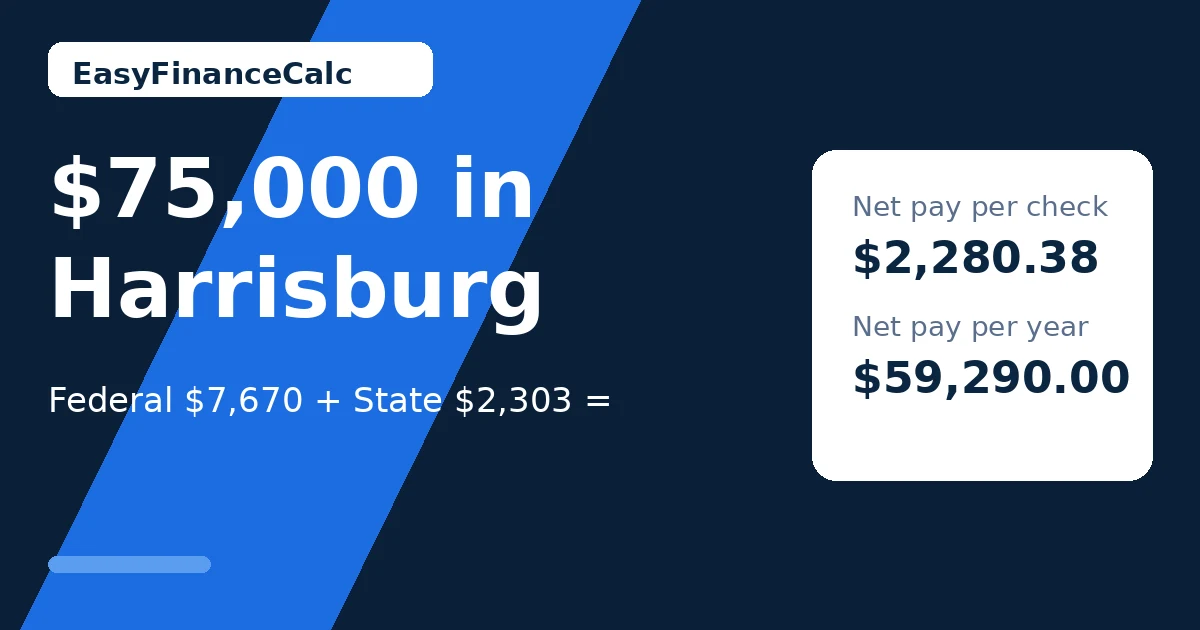
Sarah keeps $2,280.38 from every $2,884.62 paycheck. Her take home pay is about 79 percent of her gross pay. The state line takes $2,302.50 a year, and a 1 percent local earned income tax would take another $750 a year on top of that.
Pennsylvania Paycheck Tips
Check your local rate before you accept an offer. The state tax is the same everywhere in Pennsylvania, but the local earned income tax is not. A job in Philadelphia carries a city wage tax that a job in Harrisburg does not. Run the pennsylvania paycheck calculator above first, then add your local rate.
File Schedule SP if your income is low. Tax Forgiveness can refund your whole Pennsylvania tax, but only if you file Schedule SP with your return. A single filer with no dependents qualifies for full forgiveness up to $6,500 of eligibility income, and partial forgiveness above that. Do not leave the money on the table.
Use pre tax benefits for the federal saving, not the state one. A 401k contribution lowers your federal taxable income, but Pennsylvania taxes the contribution anyway. Test a higher 401k percentage in the pennsylvania take home pay calculator above and watch the federal line fall while the state line stays flat.
Fix reciprocity paperwork on day one. If you live in New Jersey, Ohio, Maryland, Virginia, West Virginia, or Indiana and work in Pennsylvania, file the exemption certificate with your employer so tax is withheld for your home state. Fixing it later means filing two returns and waiting for a refund.
Plan retirement with the exemption in mind. Pennsylvania taxes your pay now, including 401k contributions, but it does not tax the distributions when you retire. That trade off favors workers who stay in Pennsylvania through retirement.
5 Common Mistakes Pennsylvania Workers Make
- Applying a standard deduction to the state tax. Pennsylvania has no standard deduction. The state tax is 3.07 percent of your pay from the first dollar, and a federal style deduction understates it.
- Thinking a 401k contribution lowers Pennsylvania tax. It does not. Pennsylvania taxes 401k deferrals as compensation. Only the federal line falls when you raise your contribution.
- Forgetting the local tax. The 1 percent local earned income tax, or the Philadelphia wage tax, is a separate line on your stub. A state only estimate misses it entirely.
- Skipping Schedule SP. Low income workers who never file Tax Forgiveness pay tax they could have had forgiven. Nearly one in five households qualifies.
- Working across the border without the exemption certificate. Commuters from reciprocity states who skip the paperwork get Pennsylvania tax withheld, then must file for a refund. File the certificate with your employer instead.
Frequently Asked Questions
What is the Pennsylvania income tax rate for 2026?
Pennsylvania charges a flat 3.07 percent on personal income. There are no brackets, no standard deduction, and no personal exemption. The rate applies to all eight classes of income Pennsylvania taxes, including wages, interest, dividends, and net gains. The rate has stayed at 3.07 percent since 2004.
Does Pennsylvania have a standard deduction?
No. Pennsylvania gives no standard deduction and no personal exemption. Federal tax lets a single filer subtract $16,100 before brackets apply, but Pennsylvania taxes pay from the first dollar. The only relief for low earners is Tax Forgiveness on Schedule SP.
Does Pennsylvania tax 401k contributions?
Yes. Pennsylvania taxes employee 401k contributions as compensation, even though the federal government lets you defer them. Your 401k deferrals do not reduce your Pennsylvania taxable income. Health savings account contributions are taxed in Pennsylvania too. The widget on this page charges the state tax on your gross pay for exactly this reason.
What is the local earned income tax in Pennsylvania?
Most Pennsylvania municipalities and school districts levy a local earned income tax, typically 1 percent in total, split between the municipality and the school district. Philadelphia charges its own wage tax instead, and Pittsburgh levies a city wage tax plus a school district tax. The calculator on this page shows the state line only, so add your local rate separately.
What is Pennsylvania Tax Forgiveness?
Tax Forgiveness is a program that refunds or reduces Pennsylvania income tax for low income households, filed on Schedule SP. A single filer with no dependents qualifies for full forgiveness with eligibility income up to $6,500. A family of four can earn up to $34,250 and still qualify. Nearly one in five Pennsylvania households qualifies for some Tax Forgiveness.
Does Pennsylvania tax retirement income?
No, in most cases. Pennsylvania does not tax Social Security benefits, pensions, or distributions from 401k plans and IRAs once you meet the age and service rules. That makes the state unusually friendly to retirees, even though it taxes every dollar of pay while you work, including 401k contributions.
I live in New Jersey and work in Pennsylvania. Do I pay Pennsylvania tax?
No, if you file the right paperwork. Pennsylvania has reciprocity with New Jersey, Ohio, Maryland, Virginia, West Virginia, and Indiana. Your employer withholds tax for your home state instead of Pennsylvania. File the exemption certificate with your employer so the withholding goes to the right state from the first check.
What is the minimum wage in Pennsylvania in 2026?
Pennsylvania uses the federal minimum wage of $7.25 an hour, and the tipped minimum is $2.83 an hour as long as tips bring total pay to at least $7.25. The state has not raised its minimum above the federal floor. Neighboring states pay more, so border town workers often compare offers across the state line.
How much Pennsylvania tax will I pay on a 75,000 dollar salary?
A single filer in Harrisburg pays $2,302.50 of Pennsylvania state tax on a $75,000 salary in 2026, which is 3.07 percent of the full salary with no deduction. A 1 percent local earned income tax would add $750 a year on top of that. Philadelphia residents pay the city wage tax instead of the local earned income tax.
Does Pennsylvania tax overtime pay or bonuses?
Yes. Pennsylvania taxes overtime, bonuses, commissions, and tips at the same flat 3.07 percent as regular pay. There is no special rate for supplemental wages. Social Security and Medicare apply to overtime and bonuses too.
Can I use this calculator if I am paid hourly instead of salary?
Yes. Enter your hourly wage and hours, and the pennsylvania salary calculator logic works the same way: gross pay first, then federal tax, Pennsylvania tax at 3.07 percent, Social Security, and Medicare. The flat rate applies to hourly workers exactly as it does to salaried workers.
Why does my Pennsylvania paycheck show a local tax line?
Pennsylvania lets cities, boroughs, and school districts levy their own earned income tax, typically 1 percent in total. The line funds your municipality and your school district, and the rate depends on where you live and work. Philadelphia and Pittsburgh have their own city wage taxes instead.
Related Calculators
- Paycheck Calculator
- Texas Paycheck Calculator
- Florida Paycheck Calculator
- California Paycheck Calculator
- Illinois Paycheck Calculator
- Nevada Paycheck Calculator
- Washington Paycheck Calculator
- Tennessee Paycheck Calculator
- South Dakota Paycheck Calculator
- Wyoming Paycheck Calculator
- Alaska Paycheck Calculator
- Salary to Hourly Calculator
- Tip Calculator
Disclaimer
This page provides estimates for education only. Your actual withholding depends on your W-4, benefits, local tax rate, and employer payroll setup. This is not tax advice. For your own tax decisions, talk to a qualified tax professional.
Sources
Pennsylvania Department of Revenue, Tax Rates; Pennsylvania Department of Revenue, Tax Forgiveness; Pennsylvania Department of Revenue, Personal Income Tax Guide, withholding and reciprocity; IRS Publication 15-T (2026); Social Security Administration.