
New Jersey Paycheck Calculator: Your Real 2026 Take Home Pay
A New Jersey paycheck calculator shows you exactly what lands in your bank account after New Jersey takes its graduated income tax plus the three payroll deductions most calculators forget. Enter your salary, pick your pay frequency, and you get your take home pay per paycheck and per year in seconds. No signup, no email, no cost.
New Jersey Paycheck Calculator
Enter your pay and see exactly what lands in your bank account for 2026.
| Per paycheck | Per year | |
|---|---|---|
| Gross pay | ||
| Federal income tax | ||
| New Jersey state income tax | ||
| NJ Temporary Disability (0.19%) | ||
| NJ Family Leave (0.23%) | ||
| NJ Unemployment / Workforce (0.425%) | ||
| Social Security (6.2%) | ||
| Medicare (1.45%) | ||
| Take home pay |
New Jersey taxes income on a graduated scale from 1.4% to 10.75%, and it has no standard deduction, only a $1,000 personal exemption ($2,000 filing jointly). New Jersey also taxes 401(k) contributions, so the state line uses your gross pay less the exemption. Temporary Disability Insurance (0.19%) and Family Leave Insurance (0.23%) apply to the first $171,100 of wages, and Unemployment plus Workforce funds (0.425%) apply to the first $44,800. Newark is the one city with its own payroll tax, an extra 1% for people who live or work there, and it is not included here. Estimates use 2026 IRS brackets and the 2026 Social Security wage base of $184,500. Your real withholding follows the NJ Division of Taxation withholding tables, so your actual check can differ by a few dollars.
How do I use the New Jersey paycheck calculator?
Using the New Jersey paycheck calculator takes less than a minute. So how much will you actually take home? Let us run the numbers together.
- Enter your gross pay. Type your salary per year, your pay per paycheck, or your hourly wage. The calculator converts hourly pay using 40 hours a week and 52 weeks a year.
- Pick your pay frequency. Weekly, every 2 weeks, twice a month, or monthly. Most New Jersey employers pay every 2 weeks.
- Choose your filing status. Single, married filing jointly, or head of household. Your status changes your New Jersey tax table, because single filers and joint filers use different brackets.
- Add your 401k and other pre tax deductions. Your 401k lowers your federal tax, but it does not lower your New Jersey tax, so read the state section below before you assume the number.
- Press Calculate My Take Home Pay. You get your net pay per paycheck and per year, with every deduction shown on its own line, including Temporary Disability, Family Leave, and Unemployment.
How much is New Jersey income tax in 2026?
New Jersey taxes income on a graduated scale from 1.4% to 10.75%. Only the part of your income inside each bracket pays that bracket’s rate, so a raise never taxes your whole salary at the higher rate. Single filers and married filers filing separately use Table A. Married couples filing jointly, heads of household, and qualifying surviving spouses use Table B.
| Rate | Single | Married filing jointly |
|---|---|---|
| 1.4% | $0 to $20,000 | $0 to $20,000 |
| 1.75% | $20,001 to $35,000 | $20,001 to $50,000 |
| 2.45% | Not used | $50,001 to $70,000 |
| 3.5% | $35,001 to $40,000 | $70,001 to $80,000 |
| 5.525% | $40,001 to $75,000 | $80,001 to $150,000 |
| 6.37% | $75,001 to $500,000 | $150,001 to $500,000 |
| 8.97% | $500,001 to $1,000,000 | $500,001 to $1,000,000 |
| 10.75% | Over $1,000,000 | Over $1,000,000 |
The top rate of 10.75% is sometimes called the millionaire’s tax. It applies only to the part of your taxable income above $1 million, and the $500,000 and $1 million lines do not double for married couples, which creates a marriage penalty for high earners.
New Jersey has no standard deduction. Instead, the state gives you a personal exemption of $1,000 for yourself, plus $1,000 for your spouse if you file jointly. Each dependent adds $1,500, and you get another $1,000 each for being 65 or older, blind, or disabled, plus $6,000 for each honorably discharged veteran. That $1,000 exemption is tiny next to the $16,100 federal standard deduction, which is why your New Jersey taxable income is almost always much higher than your federal taxable income. The calculator uses the exemption that matches your filing status, so the state line stays exact.
Here is the surprise most workers miss. New Jersey taxes your 401k contributions. In most states, the money you put into a 401k escapes state tax until you retire. In New Jersey, it does not. Your 401k deferral lowers your federal tax and your Social Security tax, but your New Jersey tax is charged on your gross pay less only the small exemption. The same rule applied in Pennsylvania, the only other state in our set with this quirk, and it is the reason the calculator keeps the state line separate from the federal line. If you raise your 401k contribution by $6,000, your federal tax falls by about $1,320, but your New Jersey tax does not move at all.
What are TDI, FLI, and UI on a New Jersey pay stub?
Every New Jersey paycheck carries three extra deductions beyond income tax and FICA, and most online calculators skip them. The New Jersey paycheck calculator shows all three on their own lines, so your estimate is not high by hundreds of dollars.
Temporary Disability Insurance, or TDI, costs 0.19% of your wages up to $171,100 in 2026, for a maximum of $325.09 a year. Family Leave Insurance, or FLI, costs 0.23% of your wages up to the same $171,100, for a maximum of $393.53 a year. Together they cap at $718.62. Both rates fell for 2026, from 0.23% and 0.33% in 2025, so most workers keep a little more this year. TDI replaces part of your wages if you cannot work because of an illness or injury off the job. FLI replaces part of your wages when you take time off to bond with a new child or care for a seriously ill family member. The maximum weekly benefit for both programs is $1,119 in 2026.
Unemployment Insurance, the Workforce Development Partnership Fund, and the Supplemental Workforce Fund appear on your stub as UI, WF, and SWF. Together they cost 0.425% of your wages up to $44,800, for a maximum of $190.40 a year. The split is 0.3825% for Unemployment Insurance and 0.0425% for the two workforce funds. Once your year to date pay passes $44,800, the deduction stops for the rest of the year. Employers pay their own share on top of yours, and the employer rate runs from 0.5% to 5.8%.
Newark is the one city with its own payroll tax. If you live or work in Newark, the city charges an extra 1% payroll tax. The calculator does not include it, because it applies to only one city, but Newark workers should subtract another 1% of gross pay from the result. No other New Jersey city charges a local income tax.
What does an $80,000 salary look like in New Jersey?
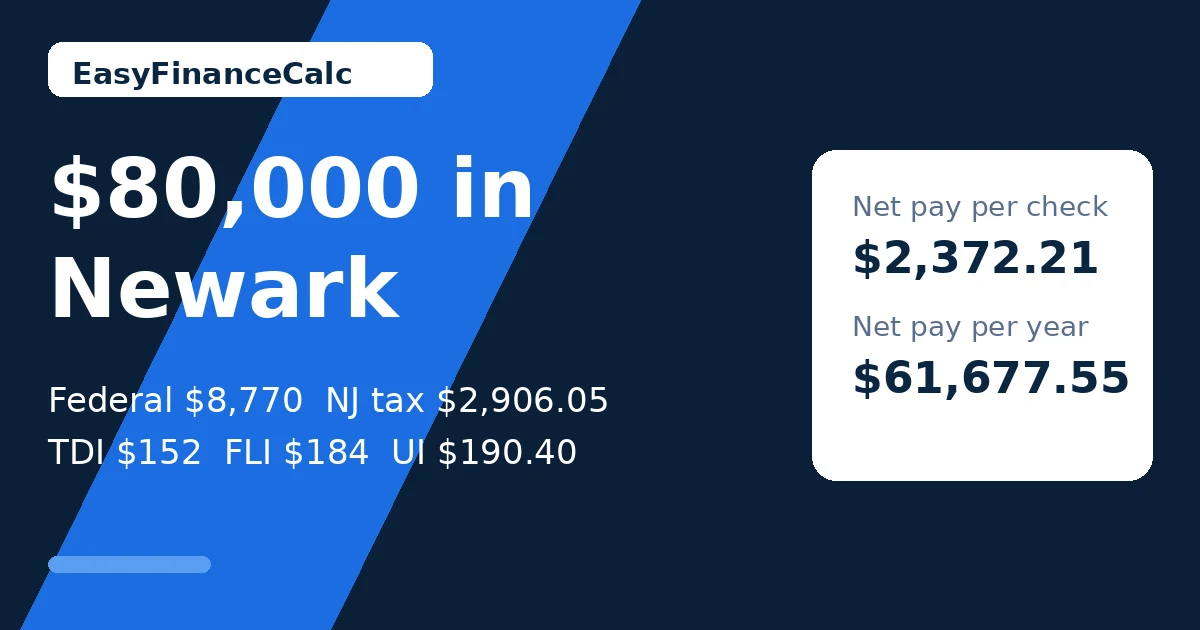
Meet Dan, a warehouse supervisor in Newark who earns $80,000 a year, files single, and gets paid every 2 weeks. His paycheck shows every line a New Jersey worker actually sees.
| Line | Per paycheck | Per year |
|---|---|---|
| Gross pay | $3,076.92 | $80,000.00 |
| Federal income tax | $337.31 | $8,770.00 |
| New Jersey state income tax | $111.77 | $2,906.05 |
| NJ Temporary Disability (0.19%) | $5.85 | $152.00 |
| NJ Family Leave (0.23%) | $7.08 | $184.00 |
| NJ Unemployment / Workforce (0.425%) | $7.32 | $190.40 |
| Social Security (6.2%) | $190.77 | $4,960.00 |
| Medicare (1.45%) | $44.62 | $1,160.00 |
| Take home pay | $2,372.21 | $61,677.55 |
Here is the math behind his check. His federal taxable income is $80,000 less the $16,100 federal standard deduction, which leaves $63,900. The 2026 federal brackets tax that at 10% on the first $12,400, 12% on the next $38,000, and 22% on the last $13,500, for a total of $8,770. His New Jersey taxable income is $80,000 less only the $1,000 personal exemption, which leaves $79,000. The Table A brackets tax that at 1.4% on the first $20,000, 1.75% on the next $15,000, 3.5% on the next $5,000, 5.525% on the next $35,000, and 6.37% on the last $4,000, for a total of $2,906.05. The three payroll deductions add $526.40: TDI $152, FLI $184, and UI $190.40. Social Security takes $4,960 and Medicare takes $1,160. Add it all up and Dan keeps $61,677.55 of his $80,000, or $2,372.21 every two weeks.
Dan works in Newark, so the 1% city payroll tax would take another $800 a year from him, or $30.77 per check, leaving $2,341.44. Workers anywhere else in the state skip that line entirely. The New Jersey paycheck calculator gives you the same breakdown for any salary you type in, so try your own number next.
What about an hourly worker? Take a home health aide in Trenton who earns $20 an hour and works 40 hours a week. That is $41,600 a year. Federal tax comes to $2,812, New Jersey tax comes to $750.65, TDI is $79.04, FLI is $95.68, UI is $176.80, Social Security is $2,579.20, and Medicare is $603.20. Take home pay is $34,503.43 a year, or $1,327.06 every two weeks. At this income the payroll deductions are small in dollars, but they still take $351.52 a year, which is real money on a $41,600 salary.
A married couple shows how Table B helps. Dan’s neighbors, a couple filing jointly on $120,000, pay $3,744.50 in New Jersey tax, $10,040 federal, $228 TDI, $276 FLI, $190.40 UI, $7,440 Social Security, and $1,740 Medicare, for take home pay of $96,341.10 a year. The wider Table B brackets save them about $900 versus two single filers on the same total income.
How does New Jersey compare with Pennsylvania and New York?
Run the same $90,000 single salary through the New Jersey paycheck calculator and then look at the neighbors. The table below uses each state’s own 2026 rules and the same $90,000 salary, single, no 401k, no extra deductions, state income tax only.
| State | 2026 income tax on $90,000 single |
|---|---|
| New Jersey | $3,543.05 |
| New York | $4,269.75 |
| Pennsylvania | $2,763.00 |
New Jersey sits in the middle. Pennsylvania is cheapest because its flat 3.07% applies to the whole salary with no brackets, and New York is most expensive because its graduated rates climb to 6.37% in the middle brackets plus its own payroll deductions. But the state income tax is only part of the story. New Jersey adds $526.40 of TDI, FLI, and UI at $80,000, while New York adds its own paid family leave and disability lines, and Pennsylvania adds a local earned income tax of about 1% almost everywhere. The full paycheck comparison is always closer than the income tax comparison alone.
Pennsylvania commuters get a special break. New Jersey and Pennsylvania have a reciprocity agreement, the only one New Jersey holds. If you live in Pennsylvania and work in New Jersey, you can file Form NJ-165 with your employer and have Pennsylvania tax withheld instead of New Jersey tax. The reverse works too. Without the form, your employer withholds for the work state, and you claim a credit on your home state return, which is slower and messier. File the form on day one.
What makes New Jersey different from other states?
New Jersey has the highest property taxes in the country, and the state knows it. Residents can claim a property tax deduction of up to $15,000 against their New Jersey income, or a property tax credit instead, but not both. Renters are not left out. The state treats 18% of your rent as property tax for the deduction, which helps the many New Jersey workers who rent near the city.
Social Security benefits are fully exempt from New Jersey income tax. If you are 62 or older, you may also be able to exclude pension and other retirement income, but only if your total income is $150,000 or less. The exclusion phases in with income, so check the NJ-1040 instructions before you assume the full amount. That $150,000 line is a cliff worth planning around, because a dollar over it can cost you the whole exclusion.
The minimum wage in New Jersey is $15.92 an hour for most employees as of January 1, 2026, up from $15.49. Small and seasonal employers pay $15.23, farm workers get $14.20, and direct care staff at long term care facilities get $18.92. Tipped workers get a cash wage of $6.05 an hour with a $9.87 tip credit, and the employer must make up any shortfall if tips do not reach $15.92. At $15.92 an hour, full time work pays $33,113.60 a year before taxes, more than double North Carolina’s $15,080 at the federal floor.
The sales tax is 6.625% statewide, with no local add on. Groceries, most clothing, and prescription drugs are exempt, which softens the bill for everyday shopping. The state also runs its own earned income tax credit and a child tax credit, both claimed on the NJ-1040, and both worth checking if your income is modest.
If you expect to owe more than $400 in New Jersey tax after withholding, you must make estimated payments on Form NJ-1040-ES, due April 15, June 15, September 15, and January 15. You can skip the January payment if you file your return and pay in full by February 15. The safe harbor is the smaller of 80% of this year’s tax or 100% of last year’s tax, and the interest rate on a shortfall is 10% a year for 2026, so the estimated payments are worth taking seriously.
5 mistakes that shrink a New Jersey paycheck
- Assuming your 401k lowers your New Jersey tax. It does not. New Jersey taxes 401k deferrals as wages. If you raise your contribution, your federal tax falls but your state tax stays exactly the same.
- Forgetting the TDI, FLI, and UI lines. Together they cost up to $909.02 a year at full pay, and most online calculators leave them out entirely. A paycheck estimate without them is high by that much.
- Using the federal standard deduction for New Jersey. New Jersey has no standard deduction, only a $1,000 personal exemption. Your New Jersey taxable income is thousands of dollars higher than your federal taxable income, and the state tax follows it.
- Missing the Pennsylvania reciprocity form. If you live in Pennsylvania and work in New Jersey, file Form NJ-165 on day one. Without it, you pay New Jersey withholding all year and wait for a credit on your Pennsylvania return.
- Ignoring the Newark payroll tax. Newark is the only New Jersey city with its own payroll tax, and it takes 1% of gross pay. A Newark worker who budgets on the calculator alone comes up $800 short on an $80,000 salary.
Related Calculators
- Paycheck Calculator
- Texas Paycheck Calculator
- Florida Paycheck Calculator
- California Paycheck Calculator
- Illinois Paycheck Calculator
- Nevada Paycheck Calculator
- Washington Paycheck Calculator
- Tennessee Paycheck Calculator
- South Dakota Paycheck Calculator
- Wyoming Paycheck Calculator
- Alaska Paycheck Calculator
- New York Paycheck Calculator
- Pennsylvania Paycheck Calculator
- Salary to Hourly Calculator
- Tip Calculator
Bookmark the New Jersey paycheck calculator and come back whenever your pay changes. A raise, a new job, a move to Newark, or a bigger 401k contribution all change the answer, and the three payroll lines make the new math worth checking in seconds.
Frequently asked questions
What is the New Jersey income tax rate for 2026?
New Jersey taxes income on a graduated scale from 1.4% to 10.75%. Single filers use Table A and joint filers use Table B, with different bracket lines. The top rate of 10.75% applies only to taxable income above $1 million.
How much New Jersey income tax will I pay on $80,000?
A single filer with $80,000 of income and the $1,000 personal exemption pays $2,906.05 in New Jersey income tax for 2026, plus $152 TDI, $184 FLI, and $190.40 UI and workforce funds. A married couple filing jointly on the same income pays less, because Table B has wider brackets.
Does New Jersey tax my 401k contributions?
Yes. New Jersey taxes 401k deferrals as wages in the year you earn them. Your 401k lowers your federal tax and your Social Security tax, but it does not lower your New Jersey tax. The same rule applies in Pennsylvania.
What are TDI and FLI on my New Jersey pay stub?
TDI is Temporary Disability Insurance at 0.19% of wages up to $171,100, and FLI is Family Leave Insurance at 0.23% of wages up to the same $171,100. Together they cap at $718.62 a year. TDI replaces wages when illness or injury keeps you from work, and FLI replaces wages when you care for a new child or a seriously ill family member.
What is UI, WF, and SWF on my New Jersey pay stub?
UI is Unemployment Insurance at 0.3825% and WF and SWF are workforce funds at 0.0425%, for a combined 0.425% of wages up to $44,800, or $190.40 a year at most. Once your pay passes $44,800, the deduction stops for the rest of the year.
Does New Jersey have a standard deduction?
No. New Jersey has no standard deduction. Instead, the state gives a personal exemption of $1,000 for yourself, $2,000 if you file jointly, $1,500 per dependent, and extra amounts for age, blindness, disability, and veterans. Your New Jersey taxable income is almost always higher than your federal taxable income.
Do I pay extra tax if I work in Newark?
Yes, 1% of your gross pay. Newark is the only New Jersey city with its own payroll tax, and it applies to people who live or work there. On an $80,000 salary that is $800 a year. No other New Jersey city charges a local income tax.
I live in Pennsylvania and work in New Jersey. Where do I pay tax?
You can pay Pennsylvania tax instead, because the two states have a reciprocity agreement. File Form NJ-165 with your employer so Pennsylvania tax is withheld from the first check. Without the form, your employer withholds New Jersey tax and you claim a credit on your Pennsylvania return.
Does New Jersey tax Social Security benefits?
No. Social Security benefits are fully exempt from New Jersey income tax. If you are 62 or older with total income of $150,000 or less, you may also be able to exclude pension and other retirement income. Check the NJ-1040 instructions for the exact exclusion amount.
What is the minimum wage in New Jersey in 2026?
The minimum wage is $15.92 an hour for most employees, up from $15.49 in 2025. Small and seasonal employers pay $15.23, farm workers get $14.20, and direct care staff at long term care facilities get $18.92. Tipped workers get $6.05 an hour in cash wages plus tips.
When is the New Jersey tax return due?
April 15. A federal extension automatically extends the New Jersey filing deadline, but tax owed is still due by April 15. If you expect to owe more than $400 after withholding, make estimated payments on Form NJ-1040-ES on April 15, June 15, September 15, and January 15.
Can I use this calculator if I am paid hourly instead of salary?
Yes. Enter your hourly wage and your hours per week, and the calculator converts it to an annual salary first, then runs the same federal tax, New Jersey tax, TDI, FLI, UI, Social Security, and Medicare math. The graduated brackets and the payroll caps apply to hourly workers exactly as they do to salaried workers.
Disclaimer
This calculator is for education only. It is not tax advice, financial advice, or legal advice. Tax law changes, and your real paycheck depends on your W-4, your NJ-W4, your benefits, and your employer’s payroll schedule. Check your numbers with a licensed tax professional before you make a decision based on them.
Sources
New Jersey Division of Taxation, 2026 NJ-1040-ES Instructions, including Tables A and B; New Jersey Department of Labor and Workforce Development, New Benefit Rates for 2026; New Jersey Department of Labor and Workforce Development, Minimum Wage to Increase to $15.92 on Jan. 1; Internal Revenue Service, Publication 15-T; Social Security Administration, 2026 wage base.