
North Carolina Paycheck Calculator: Your Real 2026 Take Home Pay
A North Carolina paycheck calculator shows you exactly what lands in your bank account after North Carolina takes its flat 3.99% and the federal government takes its share. Enter your salary, pick your pay frequency, and you get your take home pay per paycheck and per year in seconds. No signup, no email, no cost.
North Carolina Paycheck Calculator
Enter your pay and see exactly what lands in your bank account for 2026.
| Per paycheck | Per year | |
|---|---|---|
| Gross pay | ||
| Federal income tax | ||
| North Carolina state income tax | ||
| Social Security (6.2%) | ||
| Medicare (1.45%) | ||
| Take home pay |
North Carolina charges a flat 3.99% on your taxable income after the state standard deduction of $12,750 single, $19,125 head of household, or $25,500 married filing jointly. The rate fell from 4.25% in 2025 and is scheduled to fall again to 3.49% in 2027. There is no local income tax anywhere in North Carolina. Estimates use 2026 IRS brackets and the 2026 Social Security wage base of $184,500. Your real withholding follows the NCDOR NC-30 tables, which withhold at 4.09%, so your actual check can differ by a few dollars.
How do I use the North Carolina paycheck calculator?
Using the North Carolina paycheck calculator takes less than a minute. So how much will you actually take home? Let us run the numbers together.
- Enter your gross pay. Type your salary per year, your pay per paycheck, or your hourly wage. The calculator converts hourly pay using 40 hours a week and 52 weeks a year.
- Pick your pay frequency. Weekly, every 2 weeks, twice a month, or monthly. Most North Carolina employers pay every 2 weeks.
- Choose your filing status. Single, married filing jointly, or head of household. Your status changes both your federal tax and your North Carolina standard deduction.
- Add your 401k and other pre tax deductions. Your 401k and your health insurance premiums lower the income North Carolina taxes, so add them to get an exact result.
- Press Calculate My Take Home Pay. You get your net pay per paycheck and per year, with every deduction shown on its own line.
How much is North Carolina income tax in 2026?
North Carolina charges one flat rate of 3.99% on your taxable income in 2026. There are no brackets to climb and no separate rate for high earners. Every dollar of taxable income pays the same 3.99%. The rate fell from 4.25% in 2025, and it is scheduled to fall again to 3.49% in 2027 if the revenue triggers in Session Law 2023-134 are met.
Your North Carolina taxable income is your federal adjusted gross income, less the North Carolina standard deduction, plus or minus a small set of state adjustments. The standard deduction for 2026 is $12,750 if you file single, $19,125 if you file as head of household, and $25,500 if you file married filing jointly. North Carolina sets these amounts by statute, so they do not rise with inflation the way the federal standard deduction does.
| Filing status | North Carolina standard deduction | 2026 flat rate |
|---|---|---|
| Single | $12,750 | 3.99% |
| Head of household | $19,125 | 3.99% |
| Married filing jointly | $25,500 | 3.99% |
One detail catches people out. Your employer withholds North Carolina tax at 4.09% under the NCDOR NC-30 withholding tables, which is a little higher than the 3.99% you actually owe. That gap is deliberate. It keeps most workers from owing a balance in April, and the extra comes back to you as a refund when you file Form D-400. So if your pay stub shows a slightly higher state line than this calculator, that is why. The calculator shows your true tax, not the withholding estimate. That is the whole calculation, and it is why the North Carolina paycheck calculator asks for your filing status first. The status sets your deduction, the deduction sets your taxable income, and the flat rate does the rest.
North Carolina has no local income tax. No county, city, or town in the state can add its own income tax to your paycheck. Your rate is the same in Charlotte, Raleigh, Asheville, and every small town in between. Local governments raise money through property tax and sales tax instead.
What does a $75,000 salary look like in North Carolina?
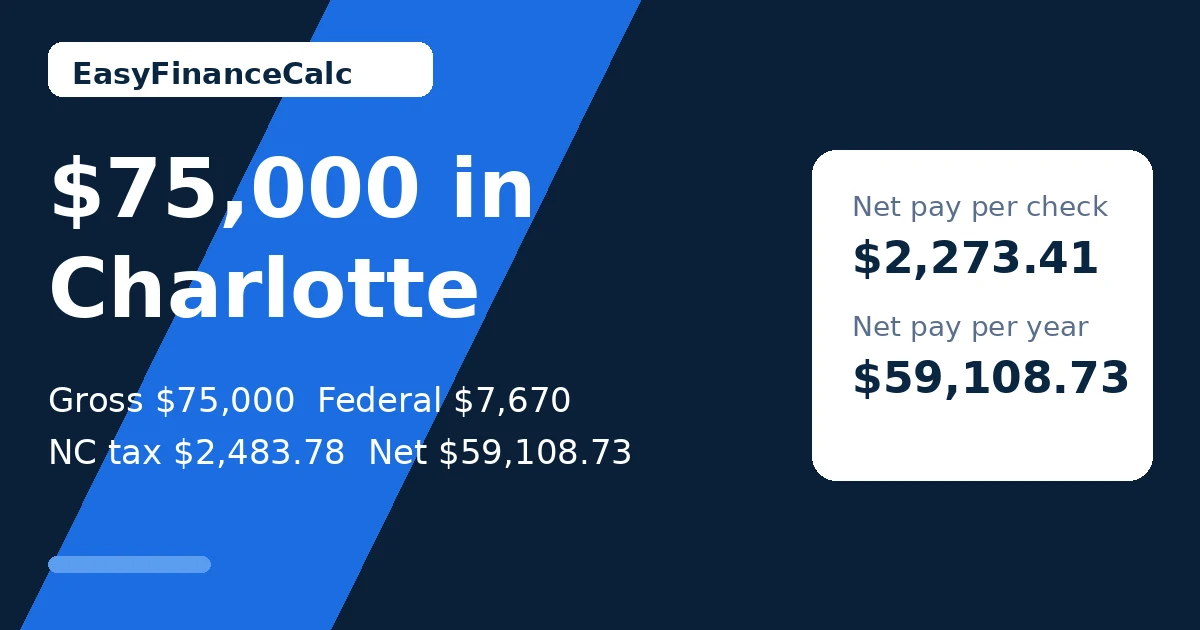
Meet Priya, a project manager in Charlotte who earns $75,000 a year, files single, and gets paid every 2 weeks. Her paycheck shows exactly how the flat rate works in real life.
| Line | Per paycheck | Per year |
|---|---|---|
| Gross pay | $2,884.62 | $75,000.00 |
| Federal income tax | $295.00 | $7,670.00 |
| North Carolina state income tax | $95.53 | $2,483.78 |
| Social Security (6.2%) | $178.85 | $4,650.00 |
| Medicare (1.45%) | $41.83 | $1,087.50 |
| Take home pay | $2,273.41 | $59,108.73 |
Here is the math behind her check. Her federal taxable income is $75,000 less the $16,100 federal standard deduction, which leaves $58,900. The 2026 federal brackets tax that at 10% on the first $12,400, 12% on the next $38,000, and 22% on the last $8,500, for a total of $7,670. Her North Carolina taxable income is $75,000 less the $12,750 state standard deduction, which leaves $62,250. The flat 3.99% on that amount is $2,483.78. Social Security takes 6.2% of $75,000, which is $4,650, and Medicare takes 1.45%, which is $1,087.50. Add it all up and Priya keeps $59,108.73 of her $75,000, or $2,273.41 every two weeks.
Now compare that with 2025. At the old 4.25% rate, Priya would have paid $2,645.63 in state tax. The 2026 cut saves her $161.85 a year. It is not a fortune, but it is real money, and the scheduled drop to 3.49% in 2027 would save her another $311.25 on the same salary. The North Carolina paycheck calculator gives you the same breakdown for any salary you type in, so try your own number next.
What about an hourly worker? Take a warehouse associate in Greensboro who earns $25 an hour and works 40 hours a week. That is $52,000 a year. Federal tax comes to $4,060, North Carolina tax comes to $1,566.07, Social Security is $3,224, and Medicare is $754. Take home pay is $42,395.93 a year, or $1,630.61 every two weeks. The same flat rate applies at every income level, so the math stays simple no matter what you earn.
How does North Carolina compare with nearby states?
Run the same $75,000 single salary through the North Carolina paycheck calculator and then look at what the neighbors charge. The table below uses each state’s own 2026 rules and the same $75,000 salary, single, no 401k, no extra deductions.
| State | 2026 income tax | Tax on $75,000 single |
|---|---|---|
| North Carolina | 3.99% flat | $2,483.78 |
| Georgia | 4.99% flat | $2,994.00 |
| Tennessee | No income tax | $0 |
| Florida | No income tax | $0 |
| Texas | No income tax | $0 |
North Carolina sits in the middle. Georgia charges $510.22 more than North Carolina on the same salary, because Georgia’s flat rate is a full point higher and its standard deduction is only a little bigger. The no tax states still win outright, and nobody can beat zero, but North Carolina is the cheapest taxed state in its neighborhood, and the gap grows as the rate falls toward 3.49%.
The comparison also shows why the standard deduction matters as much as the rate. Georgia’s rate is higher, but its $15,000 single standard deduction is bigger than North Carolina’s $12,750. Even so, the rate difference wins out at $75,000. At lower incomes the picture flips a little, because the deduction shelters a bigger share of a small salary. That is exactly why a calculator beats a rule of thumb. Type in your own salary and see your own number instead of trusting a comparison built on someone else’s pay.
Charlotte and the Research Triangle drive the other side of the decision. Charlotte is the second biggest banking center in the country, and the Triangle holds the universities, the hospitals, and the tech employers. Salaries there run higher than the state average, which makes the flat rate more valuable, because a flat rate never punishes a raise the way a graduated scale does. A promotion from $75,000 to $95,000 costs the same 3.99% on every new dollar, and there is no bracket jump waiting to take a bigger bite.
What makes North Carolina different from other states?
North Carolina is the only state in the Southeast with a flat income tax that keeps falling on a fixed schedule. The rate was 4.99% in 2022, 4.75% in 2023, 4.50% in 2024, 4.25% in 2025, and 3.99% in 2026. The law that set this path also raises the standard deduction and phases the corporate tax toward zero by 2030. If you are choosing between job offers in Charlotte and Atlanta, that falling rate is worth real money over a career.
Social Security benefits are fully exempt from North Carolina income tax. If you are retired and living on Social Security plus a pension, the pension is taxed at 3.99% but the Social Security checks are not. Government retirees covered by the Bailey settlement can also exclude their state, local, and federal government retirement benefits entirely, provided they had five or more years of creditable service by August 12, 1989. Private pensions, 401k withdrawals, and IRA distributions do not qualify for the Bailey exclusion.
The minimum wage in North Carolina is $7.25 an hour, the same as the federal floor, and it has not changed since 2009. Tipped workers can be paid a cash wage of $2.13 an hour as long as tips bring them to at least $7.25. Cities and counties cannot set a higher local minimum wage because state law preempts them. At $7.25 an hour, full time work pays $15,080 a year before taxes, which is why the calculator matters most for the workers earning the least.
North Carolina does not require paid sick leave by state law, and it has no state run disability or family leave payroll deduction. Your paycheck carries no extra state line beyond the 3.99% income tax. That is a real difference from states like California and New Jersey, where payroll deductions add extra lines to every check.
The sales tax tells the other half of the story. North Carolina charges 4.75% statewide, and counties add their own share, so most shoppers pay 6.75% to 7.5% at the register. Mecklenburg County, home to Charlotte, charges 8.25% since a 1% transit tax was added in July 2026. The state keeps income tax low and collects more at the register, which is a trade worth knowing before you move.
5 mistakes that shrink a North Carolina paycheck
These are the five errors the North Carolina paycheck calculator cannot fix for you, so check them yourself before you blame the math.
- Forgetting the standard deduction. A single filer who applies 3.99% to the whole salary overstates the tax by more than $500. Always subtract the $12,750 first.
- Confusing the withholding rate with the tax rate. Your employer withholds at 4.09%, but you owe 3.99%. Budget on the 3.99% and treat the refund as a bonus, not income.
- Ignoring the Bailey exclusion. Retired teachers, state workers, and federal retirees who qualify can exclude their entire government pension from North Carolina tax. Missing it costs thousands a year.
- Assuming every state taxes Social Security. North Carolina does not. If you are planning retirement income, do not subtract state tax from your Social Security checks.
- Skipping the NC-4 form. Every new employee in North Carolina must complete Form NC-4, the state withholding certificate. If you never file one, your employer withholds as if you are single with no allowances, and your checks come in smaller than they should.
Related Calculators
- Paycheck Calculator
- Texas Paycheck Calculator
- Florida Paycheck Calculator
- California Paycheck Calculator
- Illinois Paycheck Calculator
- Nevada Paycheck Calculator
- Washington Paycheck Calculator
- Tennessee Paycheck Calculator
- South Dakota Paycheck Calculator
- Wyoming Paycheck Calculator
- Alaska Paycheck Calculator
- New York Paycheck Calculator
- Pennsylvania Paycheck Calculator
- Salary to Hourly Calculator
- Tip Calculator
Bookmark the North Carolina paycheck calculator and come back whenever your pay changes. A raise, a new job, or a bigger 401k contribution all change the answer, and the flat rate makes the new math easy to check in seconds.
Frequently asked questions
What is the North Carolina income tax rate for 2026?
The rate is a flat 3.99% for tax year 2026, down from 4.25% in 2025. It applies to all taxable income after the standard deduction, regardless of how much you earn. The rate is scheduled to fall to 3.49% for tax years 2027 through 2029 if the revenue triggers are met.
How much North Carolina income tax will I pay on $75,000?
A single filer with $75,000 of income and the standard deduction pays $2,483.78 in North Carolina income tax for 2026. A married couple filing jointly with the same income pays $1,975. In 2027, when the rate drops to 3.49%, the single filer’s tax falls to about $2,173.
Does North Carolina have a local income tax?
No. North Carolina does not allow local income taxes. You pay the same state rate whether you live in Charlotte, Raleigh, or a rural county. Local governments raise money through property tax and sales tax instead.
Why does my pay stub show more state tax than the calculator?
Your employer withholds at 4.09% under the NCDOR NC-30 tables, while your actual tax rate is 3.99%. The extra withholding protects you from owing a balance in April, and it comes back as a refund when you file Form D-400.
Does North Carolina tax Social Security benefits?
No. Social Security benefits are fully exempt from North Carolina income tax. Pensions, 401k withdrawals, and IRA distributions are taxed at the flat 3.99% rate, except for government retirement benefits covered by the Bailey settlement.
What is the Bailey settlement and who qualifies?
The Bailey settlement lets certain government retirees exclude their state, local, and federal government retirement benefits from North Carolina tax. You qualify if you had five or more years of creditable service in a qualifying government plan by August 12, 1989. Private pensions and IRAs do not qualify.
What is the North Carolina standard deduction for 2026?
The standard deduction is $12,750 for single filers, $19,125 for heads of household, and $25,500 for married couples filing jointly. The amounts are set by statute and do not adjust for inflation each year.
When is the North Carolina tax return due?
April 15. A federal extension automatically extends the North Carolina filing deadline to October 15, but tax owed is still due by April 15. The return is filed on Form D-400 with the North Carolina Department of Revenue.
What is the minimum wage in North Carolina?
The minimum wage is $7.25 an hour, the same as the federal minimum, and it has not changed since 2009. Tipped workers can be paid $2.13 an hour in cash wages as long as tips bring them to at least $7.25. Cities cannot set a higher local rate.
Do I have to file a North Carolina return if I work here but live in another state?
Yes, if you are a nonresident with income from North Carolina sources, you must file. Part year residents file for the months they lived in the state. Your filing threshold matches your standard deduction amount for your status.
Does North Carolina tax my 401k contributions?
Your 401k contributions lower your federal adjusted gross income, and North Carolina starts its calculation from federal adjusted gross income, so your 401k contributions lower your North Carolina taxable income too. The same is true for pre tax health insurance premiums paid through your employer.
How do I change my North Carolina withholding?
Complete Form NC-4, the Employee’s Withholding Allowance Certificate, and give it to your employer. Use Form NC-4 EZ if you plan to claim the standard deduction and no other allowances. If you never file one, your employer withholds as if you are single with no allowances.
Disclaimer
This calculator is for education only. It is not tax advice, financial advice, or legal advice. Tax law changes, and your real paycheck depends on your W-4, your NC-4, your benefits, and your employer’s payroll schedule. Check your numbers with a licensed tax professional before you make a decision based on them.
Sources
North Carolina Department of Revenue, Tax Rate Schedules; North Carolina Department of Revenue, 2026 Income Tax Withholding Tables and Instructions for Employers (NC-30); North Carolina General Statutes 105-153.7, Individual Income Tax Imposed, and 105-153.5, Standard Deduction; North Carolina Department of Labor, Minimum Wage in North Carolina; Internal Revenue Service, Publication 15-T; Social Security Administration, 2026 wage base.