
Ohio Paycheck Calculator: Your Real Take Home Pay
This ohio paycheck calculator shows what actually lands in your bank account when you work in the Buckeye State. Ohio taxes pay at one flat rate, 2.75 percent, on income above $26,050, with a $332 base amount added once you pass that line. That sounds simple, and the state part is, but most Ohio workers also pay a city income tax and sometimes a school district tax on top of it. So what does an Ohio check really look like after the state, the city, and the federal lines? Run your salary through the numbers below and see it line by line.
Quick Answer
Here is the short version. Ohio charges a flat 2.75 percent on Ohio taxable income above $26,050, plus a $332 base amount, under House Bill 96. On a $75,000 salary, a single filer in Columbus takes home about $59,973.50 a year, roughly 80 percent of gross pay. That figure includes $1,619 of Ohio state tax. A good ohio paycheck calculator must use the $332 base and the personal exemption, because a flat 2.75 percent applied to the whole salary overstates the state tax. If a tool skips the base or the exemption, its Ohio number is wrong.
Ohio Paycheck Calculator
Enter your pay and see exactly what lands in your bank account for 2026.
| Per paycheck | Per year | |
|---|---|---|
| Gross pay | ||
| Federal income tax | ||
| Ohio state income tax | ||
| Social Security (6.2%) | ||
| Medicare (1.45%) | ||
| Take home pay |
Ohio state tax uses the 2026 schedule: $332 plus 2.75% of Ohio taxable income over $26,050, after the personal exemption. City and school district taxes are separate and not included. Estimates use 2026 IRS brackets and the 2026 Social Security wage base of $184,500. Your real withholding follows IRS Publication 15-T tables and your W-4, so your actual check can differ by a few dollars.
The ohio paycheck calculator above takes your gross pay, pay frequency, and filing status, then subtracts federal income tax, Ohio state income tax, Social Security, and Medicare to give your net pay per paycheck and per year. Add a 401k contribution or health premium to see how voluntary deductions change the result. It works as a paycheck calculator ohio workers can rely on because the state line uses the 2026 schedule from the Ohio Revised Code, with the $332 base and the personal exemption by income band. For the sitewide federal only version, see our main paycheck calculator.
How to Use This Calculator
- Enter your gross salary or hourly wage.
- Pick how often you get paid, such as every 2 weeks.
- Choose your filing status: single, married filing jointly, or head of household.
- Add any 401k contribution or health premium you pay each year.
- Read your net pay per paycheck and per year, with each deduction listed.
Ohio Tax Rules That Shape Your Paycheck
One flat rate: 2.75 percent above $26,050, plus a $332 base
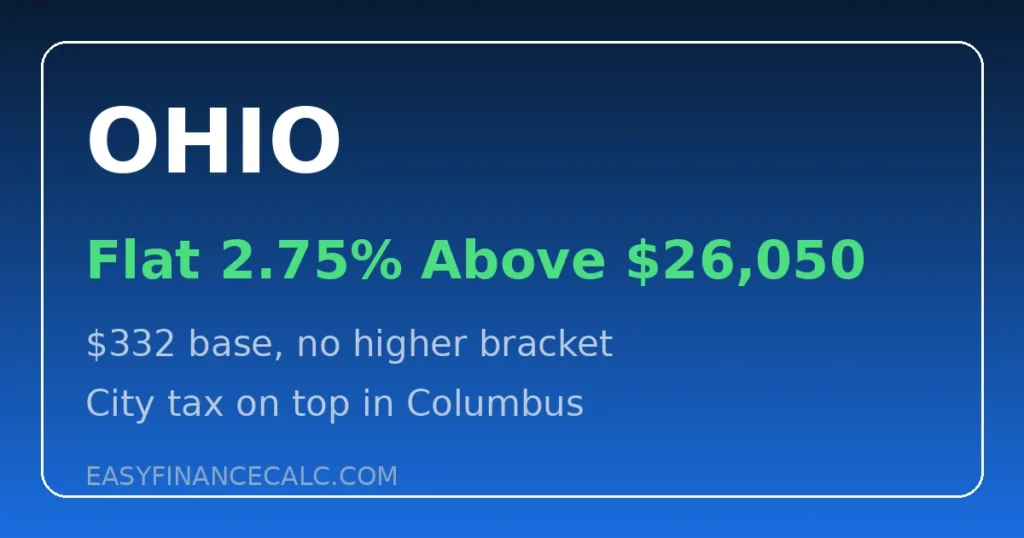
Ohio taxes nonbusiness income at a single flat rate of 2.75 percent. The rate applies only to Ohio taxable income above $26,050, and a $332 base amount is added once you pass that line. Below $26,050 of Ohio taxable income, the state tax is zero. The schedule comes from Ohio Revised Code section 5747.02 as amended by House Bill 96, which took effect for tax years beginning in 2026. The old top bracket of 3.125 percent on income above $100,000 is gone. Your state tax is $332 plus 2.75 percent of the amount over $26,050, and that is the whole calculation for wage income.
The personal exemption, not a standard deduction
Ohio gives no standard deduction. Instead, Ohio starts from your federal adjusted gross income and subtracts a personal exemption for you, your spouse, and each dependent. For 2026 the exemption is $2,400 per person when modified adjusted gross income is $40,000 or less, $2,150 when it is $40,001 to $80,000, and $1,900 when it is $80,001 to $500,000. House Bill 96 froze the inflation adjustments to these amounts for 2025 and 2026, so the 2025 figures still apply. If your income less exemptions is under $30,000, a $20 credit per exemption applies on top of that. The exemption is why a worker earning $75,000 pays state tax on $72,850, not on the full $75,000.
Business income is taxed separately at 3 percent
Wages are nonbusiness income, but Ohio taxes business income under its own rule. Business income is taxed at a flat 3 percent, and the first $250,000 of business income is exempt through the Business Income Deduction, $125,000 if you file married filing separately. If you run a side business alongside a salaried job, the two kinds of income follow different schedules. The calculator on this page covers wage income, so a side business needs its own estimate.
City income tax is the real second line
Ohio lets cities and villages levy their own income tax, and most of them do. Columbus charges 2.5 percent, Cleveland charges 2.5 percent, Cincinnati charges 1.8 percent, and Akron, Toledo, and Dayton each charge 2.5 percent. The city tax applies to wages earned in the city, so commuters pay it too, and many cities give a credit for tax paid to another city. The tax is collected through the Regional Income Tax Agency, known as RITA, or the Central Collection Agency, or directly by the city. The calculator on this page shows the state line only, because the city rate depends on where you live and work. A Columbus worker on a $75,000 salary pays about $1,875 a year in city tax on top of the $1,619 state tax.
School district income tax adds a third line for many workers
On top of the city tax, many Ohio school districts levy their own income tax, usually 0.25 percent to 2 percent, filed on Form SD 100. The district tax is separate from the city tax and from the state tax, and it applies where you live, not where you work. A worker can owe state tax, city tax, and school district tax on the same paycheck. Check whether your school district levies the tax before you judge a job offer, because it can add hundreds of dollars a year.
Social Security is not taxed by Ohio
Ohio fully exempts Social Security benefits from state income tax. That makes Ohio friendlier to retirees than its wage tax suggests, and it pairs with a retirement income credit of up to $200 for taxpayers age 65 and older with retirement income. The exemption applies to benefits only, not to wages, so working retirees still pay Ohio tax on their paychecks. If you are planning a move for retirement, the Social Security exemption is worth more than the flat rate costs you while working.
Reciprocity with five neighboring states
Ohio has reciprocity agreements with Indiana, Kentucky, Michigan, Pennsylvania, and West Virginia. If you live in one of those states and work in Ohio, your employer withholds tax for your home state, not Ohio, and you do not owe Ohio tax on those wages. The same works in reverse for Ohio residents working across the border. File the right exemption certificate with your employer so the withholding goes to the right state from the first check.
Minimum wage is $11.00 an hour in 2026
Ohio raised its minimum wage to $11.00 an hour on January 1, 2026, up from $10.70 in 2025, under the constitutional amendment that adjusts the rate for inflation every year. The tipped cash wage is $5.50 an hour, exactly half the standard rate, as long as tips bring total pay to at least $11.00. The rate applies to employers with annual gross receipts over $405,000. Smaller employers and workers under 16 follow the federal $7.25 floor. Ohio law blocks cities from setting a higher local minimum, so the rate is the same in Columbus, Cleveland, and Cincinnati.
Worked Example: Test the Ohio Paycheck Calculator on a $75,000 Salary
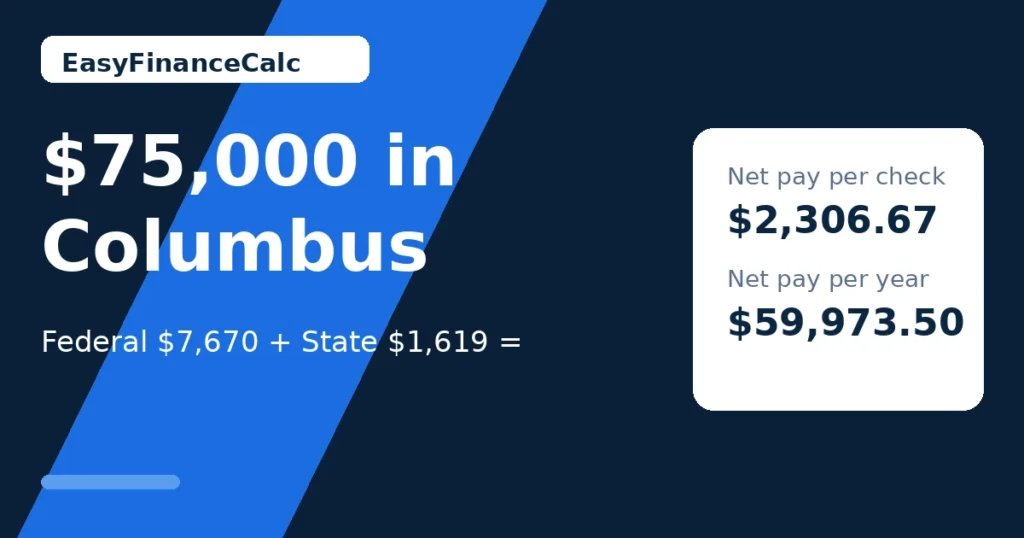
Numbers make this real. Michael earns $75,000 a year in Columbus, files as single, and gets paid every 2 weeks, which means 26 paychecks a year. Treat this ohio paycheck calculator example like the widget in action: salary in, take home pay out. His federal taxable income is $58,900, which is $75,000 minus the $16,100 federal standard deduction. His federal tax is $7,670 for the year: 10 percent of $12,400 equals $1,240, plus 12 percent of $38,000 equals $4,560, plus 22 percent of $8,500 equals $1,870. His Ohio taxable income is $72,850, which is $75,000 minus the $2,150 personal exemption for his income band. His Ohio tax is $1,619, which is $332 plus 2.75 percent of $46,800, the amount over $26,050.
| Deduction | Per Paycheck | Per Year |
|---|---|---|
| Gross pay | $2,884.62 | $75,000.00 |
| Federal income tax | $295.00 | $7,670.00 |
| Ohio state income tax | $62.27 | $1,619.00 |
| Social Security (6.2 percent) | $178.85 | $4,650.00 |
| Medicare (1.45 percent) | $41.83 | $1,087.50 |
| Net pay | $2,306.67 | $59,973.50 |
Michael keeps $2,306.67 from every $2,884.62 paycheck. His take home pay is about 80 percent of his gross pay. The state line takes $1,619 a year, and the 2.5 percent Columbus city tax would take another $1,875 a year on top of that.
Ohio Paycheck Tips
Check your city rate before you accept an offer. The state tax is the same everywhere in Ohio, but the city income tax is not. A job in Columbus carries a 2.5 percent city tax that a job in a township without a city tax does not. Run the ohio paycheck calculator above first, then add your city rate.
Do not forget the school district tax. Many Ohio school districts levy their own income tax on top of the state and city lines. It is filed on Form SD 100 and it applies where you live. A state only estimate misses it entirely.
Use the exemption band to your advantage. The personal exemption falls as income rises, from $2,400 to $2,150 to $1,900. A raise that pushes you over $40,000 or $80,000 of modified adjusted gross income trims the exemption, so the state tax rises a little faster than the raise alone suggests.
Fix reciprocity paperwork on day one. If you live in Indiana, Kentucky, Michigan, Pennsylvania, or West Virginia and work in Ohio, file the exemption certificate with your employer so tax is withheld for your home state. Fixing it later means filing two returns and waiting for a refund.
Plan retirement with the Social Security exemption in mind. Ohio taxes your pay now, but it does not tax your Social Security benefits when you retire, and it offers a retirement income credit for seniors. That trade off favors workers who stay in Ohio through retirement.
5 Common Mistakes Ohio Workers Make
- Applying 2.75 percent to the whole salary. The rate applies only above $26,050 of Ohio taxable income, and a $332 base is added. Taxing the full salary overstates the state tax.
- Forgetting the personal exemption. Ohio subtracts a personal exemption of $2,400, $2,150, or $1,900 per person before the rate applies. A federal style standard deduction is the wrong tool here.
- Forgetting the city tax. The 2.5 percent Columbus or Cleveland city tax, or the 1.8 percent Cincinnati tax, is a separate line on your stub. A state only estimate misses it entirely.
- Missing the school district tax. Many districts levy 0.25 percent to 2 percent on top of everything else. Check your district before you judge a job offer.
- Using the old 3.125 percent top bracket. House Bill 96 removed the top bracket for 2026. The rate is a single 2.75 percent above $26,050, and old calculators still showing 3.125 percent overstate the tax.
Frequently Asked Questions
What is the Ohio income tax rate for 2026?
Ohio charges a flat 2.75 percent on nonbusiness income above $26,050 of Ohio taxable income, plus a $332 base amount. Below $26,050 the state tax is zero. The schedule comes from Ohio Revised Code section 5747.02 as amended by House Bill 96, and the old 3.125 percent top bracket is gone for 2026.
What is the $332 base amount in the Ohio tax calculation?
The $332 base is part of the 2026 tax schedule in Ohio Revised Code section 5747.02. Once your Ohio taxable income passes $26,050, your tax is $332 plus 2.75 percent of the amount over $26,050. It replaces the $342 base from the 2025 schedule. House Bill 96 cut the base by $10 and removed the top bracket as part of the move to a flat rate.
Does Ohio have a standard deduction?
No. Ohio gives no standard deduction. Instead, Ohio subtracts a personal exemption for you, your spouse, and each dependent from your federal adjusted gross income. For 2026 the exemption is $2,400 per person when modified adjusted gross income is $40,000 or less, $2,150 when it is $40,001 to $80,000, and $1,900 when it is $80,001 to $500,000.
How much Ohio tax will I pay on a 75,000 dollar salary?
A single filer in Columbus pays $1,619 of Ohio state tax on a $75,000 salary in 2026. That is $332 plus 2.75 percent of $46,800, after the $2,150 personal exemption brings Ohio taxable income to $72,850. The 2.5 percent Columbus city tax would add about $1,875 a year on top of that.
What is the Columbus city income tax?
Columbus charges a 2.5 percent municipal income tax on wages earned in the city. Cleveland, Akron, Toledo, and Dayton also charge 2.5 percent, and Cincinnati charges 1.8 percent. The city tax is separate from the state tax and it applies to commuters as well as residents. Many cities give a credit for income tax paid to another city.
What is the Ohio school district income tax?
Many Ohio school districts levy their own income tax, usually 0.25 percent to 2 percent, filed on Form SD 100. It applies where you live, not where you work, and it is separate from both the state tax and the city tax. Check whether your district levies the tax, because a state only estimate misses it entirely.
Does Ohio tax Social Security benefits?
No. Ohio fully exempts Social Security benefits from state income tax. Ohio also offers a retirement income credit of up to $200 for taxpayers age 65 and older with retirement income. The exemption applies to benefits only, so working retirees still pay Ohio tax on their wages.
Does Ohio tax business income differently?
Yes. Business income is taxed at a flat 3 percent, separate from the 2.75 percent rate on wages. The first $250,000 of business income is exempt through the Business Income Deduction, or $125,000 if you file married filing separately. The calculator on this page covers wage income only.
I live in Pennsylvania and work in Ohio. Do I pay Ohio tax?
No, if you file the right paperwork. Ohio has reciprocity with Pennsylvania, Indiana, Kentucky, Michigan, and West Virginia. Your employer withholds tax for your home state instead of Ohio. File the exemption certificate with your employer so the withholding goes to the right state from the first check.
What is the minimum wage in Ohio in 2026?
Ohio raised its minimum wage to $11.00 an hour on January 1, 2026, with a $5.50 tipped cash wage. The rate applies to employers with annual gross receipts over $405,000. Smaller employers and workers under 16 follow the federal $7.25 floor. Ohio law blocks cities from setting a higher local minimum.
Does Ohio tax overtime pay or bonuses?
Yes. Ohio taxes overtime, bonuses, commissions, and tips at the same flat 2.75 percent as regular pay, once income passes the $26,050 line. There is no special rate for supplemental wages. Social Security and Medicare apply to overtime and bonuses too.
Can I use this calculator if I am paid hourly instead of salary?
Yes. Enter your hourly wage and hours, and the ohio salary calculator logic works the same way: gross pay first, then federal tax, Ohio tax at 2.75 percent above $26,050 plus the $332 base, Social Security, and Medicare. The flat rate applies to hourly workers exactly as it does to salaried workers.
Related Calculators
- Paycheck Calculator
- Texas Paycheck Calculator
- Florida Paycheck Calculator
- California Paycheck Calculator
- Illinois Paycheck Calculator
- Nevada Paycheck Calculator
- Washington Paycheck Calculator
- Tennessee Paycheck Calculator
- South Dakota Paycheck Calculator
- Wyoming Paycheck Calculator
- Alaska Paycheck Calculator
- New York Paycheck Calculator
- Pennsylvania Paycheck Calculator
- Salary to Hourly Calculator
- Tip Calculator
Disclaimer
This page provides estimates for education only. Your actual withholding depends on your W-4, benefits, city and school district tax rates, and employer payroll setup. This is not tax advice. For your own tax decisions, talk to a qualified tax professional.
Sources
Ohio Revised Code section 5747.02, Tax rates, as amended by House Bill 96; Ohio Department of Taxation, Annual Tax Rates; Ohio Department of Commerce, 2026 Minimum Wage; IRS Publication 15-T (2026); Social Security Administration.