Roth Conversion Taxes: What You Pay and How to Plan for 2026
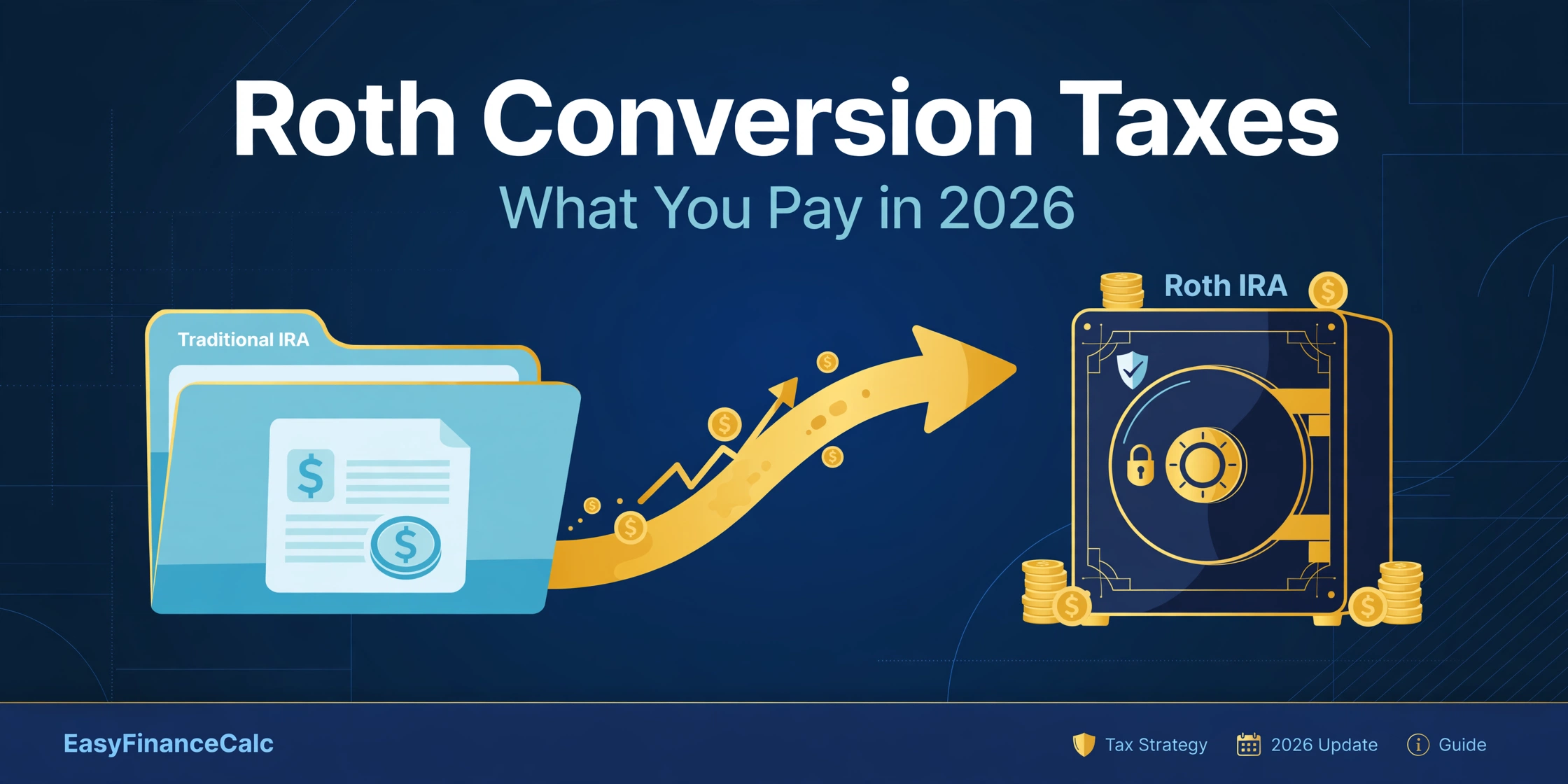
Roth conversion taxes are the income tax you pay when you move money from a traditional IRA or a 401(k) into a Roth IRA. The pre tax part of the amount you convert is added to your income for the year, and it is taxed at your ordinary income tax rates, just like salary. This guide explains how much you will pay, the pro rata rule that can surprise you, the five year rule, and a real $20,000 conversion worked out to the dollar.
A Roth conversion is one of the few retirement moves with no income limit and no dollar cap. Anyone can convert any amount, at any income, in any year. The catch is the tax bill, and it arrives in the same year as the conversion, whether you are ready for it or not. So how do you work out what a conversion will actually cost? Let us run through it step by step.
What Are Roth Conversion Taxes?
A Roth conversion moves money from a pre tax retirement account, like a traditional IRA, a SEP IRA, a SIMPLE IRA, or a pre tax 401(k), into a Roth IRA. The money in the pre tax account has never been taxed. When you convert it, the IRS treats the pre tax amount as income in that year, and you pay tax on it at your ordinary income tax rates. The after tax part of the amount, money you already paid tax on, is not taxed again.
There is no income limit on Roth conversions. Direct Roth IRA contributions are phased out, for 2026 the phase out runs from $153,000 to $168,000 for single filers and $242,000 to $252,000 for married couples filing jointly, but conversions have no such limit. There is also no cap on how much you can convert in a year. You could convert $5,000 or $500,000. The only limit is the tax bill, and it grows with the amount you convert. Conversion amounts also do not count against the annual IRA contribution limit, which is $7,500 for 2026, or $8,600 if you are 50 or older.
One important rule: conversions are permanent. Since 2018, you cannot undo a Roth conversion. Before that year, you could recharacterize a conversion and put the money back. Congress removed that option, so once the money moves into the Roth IRA, the conversion and its tax bill are final. That makes planning before you convert more important than ever.
How Are Roth Conversion Taxes Calculated?
The calculation has three steps. First, work out your taxable income without the conversion: your total income minus deductions, including the 2026 standard deduction of $16,100 for single filers or $32,200 for married couples filing jointly. Second, add the taxable part of the conversion to that income. Third, apply the 2026 tax brackets to the new total. Only the dollars inside each bracket are taxed at that bracket rate, so a conversion that stays inside one bracket is taxed entirely at that rate.
Here are the 2026 federal brackets for single filers, from IRS Revenue Procedure 2025-32.
| Tax rate | Single filer taxable income |
|---|---|
| 10 percent | Up to $12,400 |
| 12 percent | $12,401 to $50,400 |
| 22 percent | $50,401 to $105,700 |
| 24 percent | $105,701 to $201,775 |
| 32 percent | $201,776 to $256,225 |
| 35 percent | $256,226 to $640,600 |
| 37 percent | Over $640,600 |
Notice the brackets apply to taxable income, not to your salary. Your taxable income is your income after deductions, so the standard deduction of $16,100 sits between your salary and the bracket table. That matters, because it means a conversion can push you into a higher bracket even if your salary alone would not. Before you convert, work out where your taxable income sits now, and how much room you have left in your current bracket. Converting an amount that fits inside your current bracket keeps the tax rate predictable.
A Real Conversion, Worked Out to the Dollar
Meet Marcus, 52, from Texas. He earns a salary of $95,000 and wants to convert $20,000 from his traditional IRA to a Roth IRA in 2026. Texas has no state income tax, so this example covers federal tax only. His standard deduction is $16,100.
| Step | Amount |
|---|---|
| Salary | $95,000 |
| Standard deduction | minus $16,100 |
| Taxable income before conversion | $78,900 |
| Conversion amount | plus $20,000 |
| Taxable income after conversion | $98,900 |
Now the tax. Before the conversion, his tax is $1,240 on the first $12,400 at 10 percent, plus $4,560 on the next $38,000 at 12 percent, which comes to $5,800, plus 22 percent of the $28,500 between $50,400 and $78,900, which is $6,270. Total tax before the conversion: $12,070.
After the conversion, his taxable income is $98,900. The first $50,400 still costs $5,800, and 22 percent of the $48,500 between $50,400 and $98,900 is $10,670. Total tax after the conversion: $16,470. The difference is $4,400, which is exactly 22 percent of the $20,000 conversion. The whole conversion sat inside the 22 percent bracket, so the tax on it was simple to predict. If Marcus had converted $40,000 instead, the extra $20,000 would have crossed into the 24 percent bracket at $105,700, and part of it would have been taxed at 24 percent. That is why the size of the conversion matters as much as the decision to convert.
If you want to test your own numbers, try our free Roth IRA calculator to see how a conversion fits your situation. And if your income is too high to contribute to a Roth IRA directly, our backdoor Roth IRA guide explains how a conversion is the second step of that strategy.
The Pro Rata Rule: When Part of Your Conversion Is Taxed
The pro rata rule is the surprise that catches most people. If you hold any pre tax money in traditional, SEP, or SIMPLE IRAs, the IRS will not let you convert only the after tax dollars. Instead, it treats every dollar you convert as a proportional mix of pre tax and after tax money across all of those accounts combined. The IRS pools them into one total, and your conversion comes out of that pool in proportion.
Here is a simple example. Suppose you have $60,000 of pre tax money in a traditional IRA and $10,000 of after tax basis from nondeductible contributions, for a total of $70,000. You convert $14,000. Your after tax share is $10,000 divided by $70,000, or 14.29 percent. So of the $14,000 you convert, only $2,000 is tax free, and the other $12,000 is taxable. You cannot choose to convert only the $10,000 of after tax money and pay no tax on it. The rule applies even if the after tax money sits in a separate IRA at a different custodian, because the IRS looks at all of your traditional, SEP, and SIMPLE IRAs together.
The way around the pro rata rule is to move your pre tax IRA money into an employer plan, like a 401(k), before you convert. Employer plans sit outside the pool the IRS uses for the calculation, so once only after tax dollars remain in your IRAs, a conversion of those dollars is tax free. You report all of this on Form 8606 with your tax return, which tracks your after tax basis and calculates the taxable part of the conversion. File it carefully, because an error on Form 8606 is how most pro rata surprises turn into IRS notices.
The Five Year Rule and Other Timing Traps
Roth IRAs have a five year rule that applies to conversions in a specific way. Each conversion starts its own five year clock, and if you withdraw the taxable part of a conversion before that clock runs out and before you reach age 59 and a half, you pay a 10 percent early withdrawal penalty on the taxable portion. The converted money itself was already taxed, so there is no second income tax, only the penalty. After the five years pass, or after you reach 59 and a half, the penalty goes away. There is also a separate five year rule for qualified distributions of earnings, which starts when you first open any Roth IRA.
Three timing traps deserve attention. First, never pay the conversion tax out of the converted money itself. If you withhold tax from the conversion, the withheld amount counts as a distribution, and if you are under 59 and a half, that part also faces the 10 percent penalty. Pay the tax from outside funds, like a savings account, so the full converted amount lands in the Roth IRA.
Second, remember that a conversion raises your income for the year, which can affect other things: the taxation of your Social Security benefits, Medicare premium surcharges, and eligibility for credits like the Earned Income Tax Credit. Third, conversions are permanent since 2018, so a conversion you regret cannot be undone. If the market falls after you convert, the tax bill stays the same. Plan the conversion, the tax payment, and the timing before you move the money.
Common Mistakes to Avoid
These six mistakes cause most of the regret around Roth conversions.
- Converting too much in one year. A large conversion can push you into a higher bracket and cost more than the same amount spread over two or three years. Compare the brackets before you pick the amount.
- Forgetting the pro rata rule. If you have pre tax IRA balances, part of every conversion is taxable, even if you only meant to convert after tax dollars. Check all of your IRA balances first.
- Paying the tax from inside the conversion. Withholding tax from the converted amount shrinks the Roth IRA and can trigger the 10 percent penalty under age 59 and a half. Pay from outside funds.
- Ignoring the effect on other benefits. A conversion that raises your income can increase Medicare premiums and the tax on Social Security benefits. Check the side effects, not just the tax rate.
- Converting without cash to pay the tax. If you have no outside funds for the tax bill, you will either withhold from the conversion or owe the IRS in April, plus possible penalties. Have the tax money set aside before you convert.
- Forgetting Form 8606. If you have after tax basis in your IRAs, Form 8606 is how you prove it. Without it, the IRS may treat the whole conversion as taxable.
Frequently Asked Questions
How are Roth conversion taxes calculated?
The pre tax part of the amount you convert is added to your income for the year, and it is taxed at your ordinary income tax rates. Work out your taxable income first, add the conversion, then apply the 2026 brackets. A conversion that stays inside one bracket is taxed entirely at that bracket rate.
Is there an income limit for Roth conversions?
No. There is no income limit on converting a traditional IRA or 401(k) to a Roth IRA. The income limits apply only to direct Roth IRA contributions, which for 2026 phase out between $153,000 and $168,000 for single filers and $242,000 and $252,000 for married couples filing jointly.
How much can I convert to a Roth IRA in 2026?
There is no dollar cap on conversion amounts. You can convert any amount, in any year. The annual IRA contribution limit of $7,500 for 2026, or $8,600 if you are 50 or older, does not apply to conversions.
What is the pro rata rule for Roth conversions?
If you hold pre tax money in traditional, SEP, or SIMPLE IRAs, the IRS treats every conversion as a proportional mix of pre tax and after tax money across all of those accounts. You cannot convert only the after tax dollars. The taxable portion is calculated on Form 8606.
Do I pay state tax on a Roth conversion?
It depends on your state. Most states with an income tax treat a conversion as taxable income, just like the federal government. Nine states have no state income tax, so residents there pay no state tax on a conversion. Check your state rules before you convert.
Can I undo a Roth conversion?
No. Since 2018, recharacterization of Roth conversions is banned. Once the money moves into the Roth IRA, the conversion and its tax bill are final, so plan the amount and the timing before you convert.
What is the five year rule for Roth conversions?
Each conversion starts its own five year clock. If you withdraw the taxable part of a conversion before the clock runs out and before age 59 and a half, you pay a 10 percent penalty on the taxable portion. After five years, or after age 59 and a half, the penalty goes away.
Should I pay Roth conversion taxes from the IRA or from outside funds?
From outside funds. If you withhold tax from the conversion, the withheld amount counts as a distribution and can trigger the 10 percent penalty if you are under 59 and a half. Paying from outside funds also leaves the full converted amount in the Roth IRA.
Does a Roth conversion affect my Medicare premiums?
It can. A conversion raises your modified adjusted gross income for the year, and higher income can trigger Medicare premium surcharges two years later. If you are near a surcharge threshold, a smaller conversion may be the smarter move.
What form do I use to report a Roth conversion?
Form 8606, filed with your tax return. It tracks your after tax IRA basis and calculates the taxable portion of the conversion. Your IRA custodian also sends you Form 1099-R showing the distribution from the traditional IRA.
Test Your Conversion Numbers First
Run your own Roth conversion through our free Roth IRA calculator before you move the money.
Calculate Your Roth IRAIf your income is too high for a direct Roth contribution, read our backdoor Roth IRA guide to see how a conversion fits that strategy, and our Roth IRA vs Traditional IRA guide to compare the two accounts side by side. Our 401(k) contribution limits 2026 guide has the current limits for workplace plans, and you can browse the Retirement Calculators hub for every retirement tool in one place. Those are the roth conversion taxes in plain terms, and the habit that pays off is running the bracket math before you convert, not after.
Disclaimer: This guide is for education only and is not financial, tax, or legal advice. Roth conversion rules are complex, and a conversion can affect your taxes, Medicare premiums, and benefits, so talk to a qualified tax professional before converting.
Sources: Internal Revenue Service, Publication 590-A, Contributions to Individual Retirement Arrangements. Internal Revenue Service, Notice 2025-67, 2026 cost of living adjustments for retirement plans. Internal Revenue Service, Revenue Procedure 2025-32, 2026 tax brackets and standard deduction.
By EasyFinanceCalc Team | Published October 27, 2026 | Last updated October 27, 2026
Written by Daniel
Writes about retirement planning and 401(k) accounts for Easy Finance Calc.