

Earned Income Tax Credit 2026: How Much You Can Claim
The earned income tax credit is money back for working people with low to moderate income, and for tax year 2026 it is worth up to $8,231 for a family with three or more qualifying children. You claim it on your federal return, and because the credit is refundable, you can receive money even if you owe no income tax.
Here is the short version. The credit rewards work: you must have earned income, and the amount you get depends on how many qualifying children you have and how much you earn. Earn too little and the credit is small, earn in the middle range and it hits its maximum, earn past the limit and it shrinks to zero. So how do you know where you land? This guide gives you the exact 2026 numbers, the qualification rules, and two worked examples.
What Is the Earned Income Tax Credit?
The earned income tax credit, usually called the EITC, is a federal tax credit for people who work but earn low to moderate income. It is different from a deduction. A deduction lowers the income you are taxed on, while a credit lowers your tax bill dollar for dollar. And because the EITC is refundable, it can do more than wipe out your tax bill: if the credit is bigger than the tax you owe, the IRS sends you the difference as a refund.
That refundable part is why the EITC matters so much to working families. A worker who owes $800 in federal income tax and qualifies for a $4,427 credit does not just pay zero tax. That worker gets a $3,627 refund from the credit alone. It is also why you should file a return even in a year when your employer withheld nothing and you think you owe nothing: no return means no credit, and the credit is often the biggest refund a low income worker will ever see.
The credit is claimed on your federal income tax return for the year you earned the income. The 2026 figures in this guide apply to income earned during 2026, which you report on the return you file in early 2027.
How Much Is the EITC in 2026?
The maximum credit depends on how many qualifying children you claim. Here are the 2026 maximums, set by the IRS inflation adjustments in Revenue Procedure 2025-32.
| Qualifying children | 2026 maximum credit |
|---|---|
| None | $664 |
| 1 | $4,427 |
| 2 | $7,316 |
| 3 or more | $8,231 |
Those are maximums, not promises. Most people receive less than the maximum, because the credit depends on your exact earned income and adjusted gross income. The credit grows as your earnings rise from zero, holds at the maximum across a middle range, then shrinks as your income passes a threshold, until it reaches zero at the income limit.
Those income limits matter as much as the maximums. Both your earned income and your adjusted gross income must sit below the limit for your family size and filing status, or the credit is zero.
| Qualifying children | Income limit, single or head of household | Income limit, married filing jointly |
|---|---|---|
| None | $19,540 | $26,820 |
| 1 | $51,593 | $58,863 |
| 2 | $58,629 | $65,899 |
| 3 or more | $62,974 | $70,244 |
A married couple with three children and income of $60,000 is still inside the $70,244 joint limit, so they still qualify, but for less than the $8,231 maximum. A single worker with no children earning $20,000 is past the $19,540 limit and gets nothing. The limits are cliffs in one sense and slopes in another: the credit fades gradually, then stops exactly at the limit.
Who Qualifies for the Earned Income Tax Credit?
Five rules decide whether you qualify. Miss one and the credit is off the table, no matter how low your income is.
First, you must have earned income. Wages, salaries, tips, and net earnings from self employment all count. Nontaxable combat pay can also count if you choose to include it. What does not count is unemployment benefits, Social Security, pensions, interest, dividends, and capital gains. If all of your income comes from those sources, you do not qualify.
Second, your investment income must be $12,200 or less for 2026. Investment income here means interest, dividends, capital gains, and similar earnings added together. Cross that line by even one dollar and the whole credit disappears, regardless of how low your wages are. This rule catches self employed workers who also hold modest investments, so check it before you assume you qualify.
Third, you, your spouse if you file jointly, and each qualifying child must have a valid Social Security number issued before the due date of your return, including extensions. An Individual Taxpayer Identification Number does not work for the EITC.
Fourth, your filing status must be single, head of household, married filing jointly, or qualifying surviving spouse. You generally cannot claim the credit if you file separately, with one exception: if you lived apart from your spouse for the last six months of the year, or you are legally separated under a written agreement, you may still qualify.
Fifth, you must meet the rules for your family size. A qualifying child must be related to you (a son, daughter, stepchild, foster child, sibling, or a descendant of any of those), must be under age 19 at the end of the year, or under age 24 if a full time student, or any age if permanently and totally disabled, and must have lived with you for more than half the year. Workers with no qualifying children must be at least age 25 and under age 65, must have lived in the United States for more than half the year, and cannot be claimed as a dependent on someone else’s return.
How Does the Credit Grow and Shrink?
The EITC follows a simple shape: it rises, it plateaus, then it falls. In the rising part, the credit equals a percentage of your earned income. The percentages are 7.65 percent with no qualifying children, 34 percent with one child, 40 percent with two children, and 45 percent with three or more children.
That means the maximum credit is reached at a specific earnings level for each family size. For 2026, those levels are $8,680 with no children, $13,020 with one child, and $18,290 with two or with three or more children. Earn exactly that much and you hit the maximum. Earn more and the credit stays at the maximum for a while, then starts to shrink as your income rises, until it reaches zero at the income limit in the table above.
So the same credit can be small, maximum, or zero depending entirely on where your income lands. That is why two neighbors with the same number of children can receive very different credits, and why estimating your own number from the tables alone is not enough. The worked examples below show the math at two points on that curve.
Worked Example: Maria and the $7,316 Credit
Maria is a single mother of two children, ages 6 and 9, who live with her all year. She works full time as a home health aide in Texas and earned $18,290 in 2026. Her adjusted gross income is the same $18,290, and she has no investment income.
Her credit calculation is short. With two qualifying children, the credit equals 40 percent of earned income up to the maximum. Forty percent of $18,290 is $7,316, which is exactly the 2026 maximum for two children. Because her income sits below the $58,629 single limit for two children, nothing is phased out. Maria’s earned income tax credit is $7,316.
What does that mean in practice? Suppose Maria’s federal income tax before credits is $1,100. The credit wipes out that $1,100 and leaves $6,216, which the IRS sends her as a refund. That refund is the reason filing matters: without a return, Maria would never see a dollar of it.
One timing rule applies to Maria. Because her refund includes the EITC, the IRS cannot release it before mid February under the PATH Act, no matter how early she files. Early filers with the EITC usually see their refunds in late February or early March, even with direct deposit.
Worked Example: James and the $664 Credit
James is 29, single, with no children. He works part time in a warehouse in Ohio and earned $8,680 in 2026. He is not a dependent on anyone else’s return, he lived in the United States all year, and he has no investment income.
With no qualifying children, the credit equals 7.65 percent of earned income up to the maximum. That math gives $8,680 times 7.65 percent, which is $664.02, rounded to the $664 maximum for workers with no children. His income is also below the $19,540 single limit for no children, so nothing is phased out. James’s earned income tax credit is $664.
James’s case shows why the childless credit is small but still worth claiming. If his federal tax before credits is $300, the credit covers it and leaves a $364 refund. Many childless workers skip filing because they assume a small income means no refund, and that assumption costs them exactly this kind of money.
Notice what would disqualify James. If he earned $20,000 instead of $8,680, he would be past the $19,540 limit and get zero. If he were 22 instead of 29, he would fail the age 25 rule and get zero. If he were claimed as a dependent by a parent, he would get zero. The rules are strict, but they are also clear, and checking them takes five minutes.
When Will Your EITC Refund Arrive?
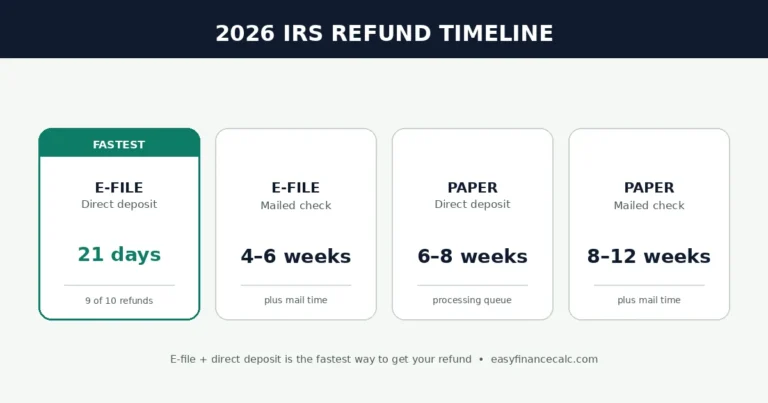
If your refund includes the earned income tax credit, the IRS is legally barred from releasing it before mid February. This is the PATH Act hold, and it applies even if you file in January and even if you choose direct deposit. The hold exists so the IRS has time to match wage reports against EITC claims and catch fraud before money goes out.
In practice, that means early filers with the EITC usually receive their refunds in late February or early March. Filing early still helps, because your return is processed first once the hold lifts, but it cannot beat the mid February floor. If you file in April, your refund follows the normal processing time after that, and the hold no longer matters.
You can track the refund with the IRS Where’s My Refund tool once your return is accepted. A refund that includes the EITC will typically show as approved a few days after the hold lifts, and direct deposit lands a few days after that.
6 Mistakes That Cost People the Credit
The first mistake is not filing at all. Workers who owe no tax often skip filing, and that is the single biggest reason EITC money goes unclaimed. If you earned income in 2026 and your income is under the limits in this guide, file a return. The credit may be waiting for you.
The second mistake is ignoring the investment income limit. A worker with $8,000 in wages and $13,000 in dividends gets no EITC at all for 2026, because the $12,200 investment income limit is a hard cutoff. Check that number before you count on the credit.
The third mistake is claiming a child who does not meet the residency test. The child must have lived with you for more than half the year. A child who lives with the other parent most of the year generally cannot be your qualifying child, even if you provide most of the financial support. When parents split custody, only one of them can claim the child for the EITC in a given year.
The fourth mistake is filing separately without knowing the exception. Married couples who file separately generally cannot claim the EITC, and many couples discover this only after filing. The exception for spouses who lived apart for the last six months of the year, or are legally separated, is narrow, so check it before you choose separate returns.
The fifth mistake is confusing the EITC with the child tax credit. They are separate credits with separate rules, separate limits, and separate phase outs. Qualifying for one does not automatically mean you qualify for the other, and the child tax credit has its own refundable portion with its own rules.
The sixth mistake is using the wrong income figure. The EITC looks at both earned income and adjusted gross income, and the credit is based on whichever gives the smaller result once the phase out starts. Self employed workers should also remember that net earnings, after business expenses, are what counts, not gross receipts. Overstating your earned income can inflate your expected credit and lead to a smaller refund than you planned for.
How Do You Claim the EITC?
Claiming the credit takes four steps, and none of them needs a paid preparer.
Step one, gather your income documents: Form W-2 from each employer, records of self employment income and expenses if you are self employed, and any statements showing investment income, so you can check the $12,200 limit.
Step two, confirm each qualifying child passes the relationship, age, and residency tests, and that every Social Security number is valid and was issued before the return due date.
Step three, file a federal income tax return and attach Schedule EIC if you claim a qualifying child. Tax software walks through the EITC questions automatically, and the IRS EITC Assistant on irs.gov gives a free eligibility check before you file.
Step four, choose direct deposit for the fastest refund, and remember the PATH Act hold: a refund that includes the EITC cannot arrive before mid February, so plan around late February or early March if you file early.
If you already filed and forgot the credit, you can usually fix it by filing an amended return. You generally have three years from the original filing deadline to amend and claim a credit you missed, so a missed EITC from a recent year is often still recoverable.
Frequently Asked Questions
How much is the earned income tax credit for 2026?
For tax year 2026 the maximum credit is $664 with no qualifying children, $4,427 with one child, $7,316 with two children, and $8,231 with three or more children. Your actual credit depends on your earned income and adjusted gross income, and most people receive less than the maximum.
What is the income limit for the earned income tax credit in 2026?
Both your earned income and your adjusted gross income must be below the limit. For single or head of household filers the limits are $19,540 with no children, $51,593 with one child, $58,629 with two children, and $62,974 with three or more. For married couples filing jointly the limits are $26,820, $58,863, $65,899, and $70,244.
Do I qualify for the earned income tax credit if I have no children?
Yes, if you meet the childless worker rules. You must be at least age 25 and under age 65, you must have lived in the United States for more than half the year, you cannot be claimed as a dependent on someone else’s return, and your income must be under the $19,540 single or $26,820 joint limit. The maximum credit with no children is $664.
What counts as earned income for the EITC?
Wages, salaries, tips, and net earnings from self employment count as earned income. Nontaxable combat pay can also count if you choose to include it. Unemployment benefits, Social Security, pensions, interest, dividends, and capital gains do not count, so a household living only on those sources does not qualify.
What is the investment income limit for the EITC?
For 2026 your investment income must be $12,200 or less. Investment income includes interest, dividends, capital gains, and similar earnings added together. If you cross the limit by even one dollar, you lose the entire credit, no matter how low your wages are.
Can I claim the earned income tax credit if I file separately?
Generally no. Married couples filing separately cannot claim the credit, with one exception: if you lived apart from your spouse for the last six months of the year, or you are legally separated under a written agreement, you may still qualify. Check that exception before choosing separate returns.
When will I get my EITC refund?
The IRS cannot release a refund that includes the EITC before mid February because of the PATH Act hold. Early filers usually receive their refunds in late February or early March with direct deposit. Filing early still helps, because your return is processed first once the hold lifts.
Do I need to owe taxes to get the EITC?
No. The credit is refundable, which means it can be larger than the tax you owe, and the IRS sends you the difference as a refund. The credit itself is not taxable income. If you earned income and your income is under the limits, file a return even if you think you owe nothing.
Can I claim the EITC if I am self employed?
Yes. Net earnings from self employment count as earned income for the EITC. That means your income after business expenses, not your gross receipts. Keep clean records of income and expenses, because the IRS matches self employment claims carefully, and check the $12,200 investment income limit as well.
What if I forgot to claim the EITC?
You can usually fix it by filing an amended return. You generally have three years from the original filing deadline to amend and claim a credit you missed. If you skipped filing entirely in a year when you qualified, filing a late original return for that year can still recover the credit within the same window.
See What Your Refund Could Look Like
Run your numbers through our free tax refund calculator and see how credits like the EITC change your refund.
Estimate Your RefundOnce you know your credit, see how the rest of your return fits together. Our tax refund calculator estimates your refund with your credits built in, our standard vs itemized deductions guide shows which deduction wins for 2026, and our self employed tax deductions guide lists every write off that lowers income before credits enter the picture. If withholding is your worry instead, our guide on how to fill out W-4 walks through every step, and if you are married, our guide on married filing jointly vs separately explains why filing status changes the credits you can claim. The earned income tax credit is one of the largest refunds working families receive, and the habit that pays off is checking it every year, not just once. You can also browse the Tax Calculators hub for more calculators.
Disclaimer: This guide is for education only and is not financial, tax, or legal advice. Tax rules change, and your situation may differ from the examples here. Check the IRS publications listed below, and talk to a qualified tax professional before you act.
Sources: Internal Revenue Service, Revenue Procedure 2025-32, 2026 inflation adjustments. Internal Revenue Service, IR-2025-103, tax inflation adjustments for 2026. Internal Revenue Service, Earned Income Tax Credit Central. Internal Revenue Service, Publication 596, earned income credit. Internal Revenue Service, EITC Assistant.
By EasyFinanceCalc Team | Published October 30, 2026 | Last updated October 30, 2026
Written by Marcus
Tax editor at Easy Finance Calc, covering federal taxes, refunds, and credits.


3 Comments